





 Portuguese
  English
  Spanish
  4 min of reading
  0 comments


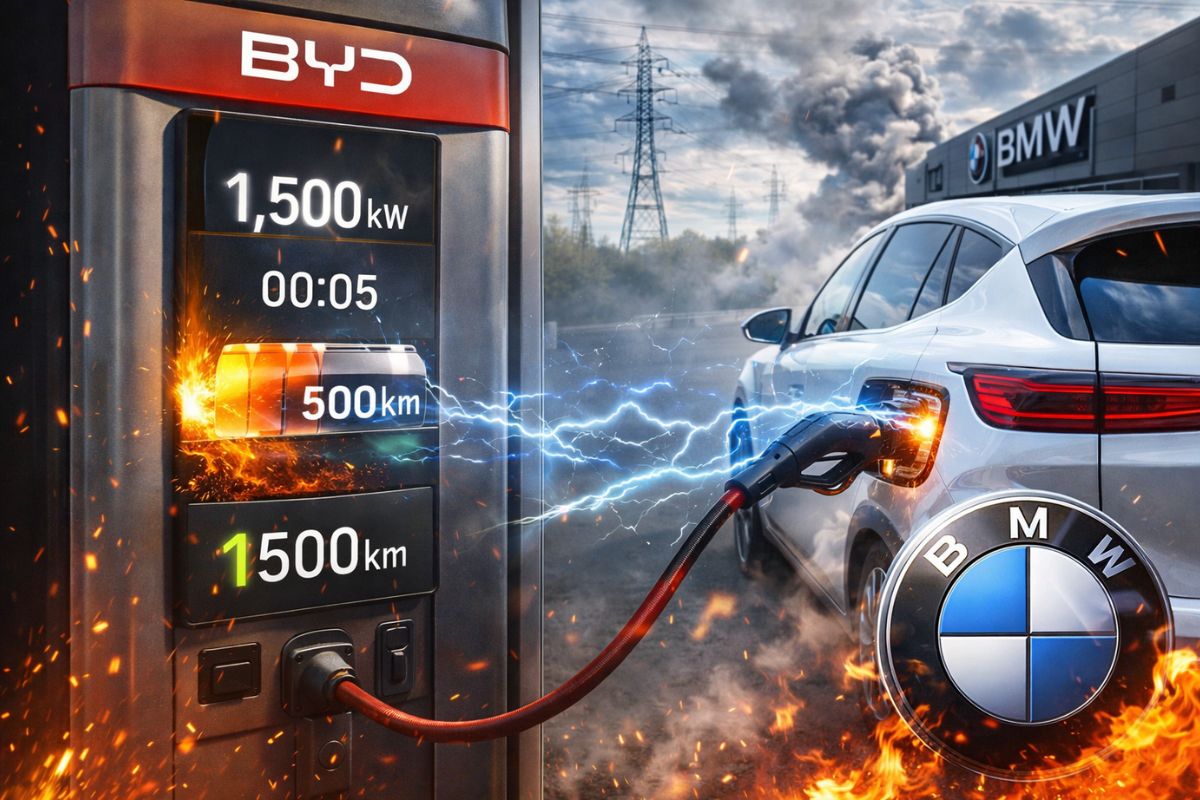
BYD promises that the Denza Z9GT recharges 500 km in five minutes with the second generation Blade battery and 1,500 kW technology while BMW limits its models to 400 kW and claims that exceeding this speed sacrifices battery durability, range, and safety in exchange for a single impressive number.
BYD presented in China a 1,500 kW charging system that promises to transform the experience of refueling an electric car. According to the automaker, the Denza Z9GT can add approximately 500 km of range in just five minutes of charging, thanks to the second generation Blade battery and megavolt-level hardware with extremely high current supply. If the numbers are confirmed in practice, BYD would be eliminating the main argument against electric cars: the charging time.
But BMW did not remain silent in the face of the announcement. Markus Fallböhmer, head of battery production at the German automaker, publicly questioned whether pursuing such extreme charging speeds is a good idea. “One must be cautious with this type of announcement. It is possible to optimize a single performance indicator, but this implies concessions in other areas,” said the executive. BYD promises 1,500 kW; BMW limits itself to 400 kW in its fastest models and guarantees that at this speed it can ensure quality and safety. The question remains: who is right?
What the 1,500 kW charging from BYD promises to deliver
According to the portal Xataka, the numbers are impressive from any angle. BYD’s 1,500 kW system is nearly four times more powerful than the fastest charging offered by BMW and far exceeds Tesla’s superchargers.
-
Hotel Nacional connects the colors of Brazil on the Rio waterfront, transforms Oscar Niemeyer’s facade into a giant postcard, and makes even those passing by São Conrado look twice.

-
Ancient footprints in the Bàsura Cave reveal how a human group and a dog illuminated deep tunnels with pine branches.
-
In Florianópolis, a community with just over 40 families lives without buses or mail service, preserves mills, distilleries, and centuries-old farms, and reveals a rural side of the Island of Magic that many people don’t even imagine exists.

-
The GPS signal disappeared in large areas of the planet, and this alarmed experts, but a study analyzed events and placed Russian early warning satellites at the center of the investigation.




Adding 500 km of range in five minutes is a speed that approaches the refueling time of a gasoline car and would eliminate the main psychological barrier to the adoption of electric vehicles.
The system relies on two components working in sync: BYD’s second generation Blade battery, designed to withstand extremely high currents, and megavolt-level charging stations capable of delivering that power.
In practice, this means that BYD needs not only compatible cars but also a network of infrastructure that is still being built. The Denza Z9GT is the first model to demonstrate the technology, but the expansion to other vehicles and markets will depend on how long BYD takes to scale both the cars and the stations.
Why BMW says 1,500 kW is a bad idea for the battery
BMW’s position is straightforward: extreme charging speed comes at a cost in other areas of the battery. Executive Markus Fallböhmer used a simple analogy: “It’s like a blanket; if you pull one side, you’ll see the problem on the other.”
According to him, BYD may have optimized the charging speed, but this likely implies concessions in battery durability, total range, and system cost.
BMW offers a maximum charging of 400 kW in the second generation iX3 models and the new i3, enough to fully charge the i3, with 400 km of range, in about 10 minutes.
Mike Reichelt, head of BMW’s Neue Klasse models, emphasized that the company is keeping an eye on Chinese speed but will not compromise on ensuring quality, safety, and durability.
The concern is not abstract: if charging speeds are increased too much, batteries can overheat, creating thermal management risks that range from accelerated degradation to more severe scenarios.
What science says about charging batteries at extreme speeds like BYD’s
The physics of lithium batteries imposes limits that no marketing can circumvent. When a battery is charged too quickly, lithium ions move between the electrodes at high speed, generating heat and internal stress.
If thermal management is not perfect, this process can cause lithium metal deposition, a condition that reduces battery capacity over time and, in extreme cases, can create safety risks.
BYD claims that the second generation Blade battery was designed to withstand these currents without significant degradation, but BMW suggests that long-term durability data still needs to be demonstrated.
The competition to reduce charging times in electric cars follows the same dynamics we have seen in Chinese smartphones, where manufacturers like Xiaomi and Oppo lead in charging speed, while Apple and Samsung prioritize battery longevity. BYD is doing in the automotive sector what Chinese brands did in mobile phones: pushing the technical limit to see what happens.
What this dispute between BYD and BMW means for electric car buyers
For the consumer, the question is practical. Five minutes for 500 km of range is fantastic if the battery maintains that capacity over years of use. Ten minutes for 400 km is slightly slower but potentially safer for the vehicle’s lifespan.
BYD bets that speed is what sells; BMW bets that reliability is what builds loyalty. Both arguments have merit.
The market will decide who is right. If BYD can demonstrate that 1,500 kW does not significantly degrade the battery over hundreds of charging cycles, BMW will have been too conservative.
If, on the other hand, BYD vehicle owners begin to report accelerated loss of range after a few years, BMW’s warning will have proven justified. For now, both sides present their arguments, and the electric car consumer benefits from the competition, as it is what drives the entire industry forward.
Do you prefer ultrafast charging like BYD’s or prioritize battery durability as BMW advocates? What weighs more in your decision?





Be the first to react!