





 Portuguese
  English
  Spanish
  4 min of reading
  0 comments


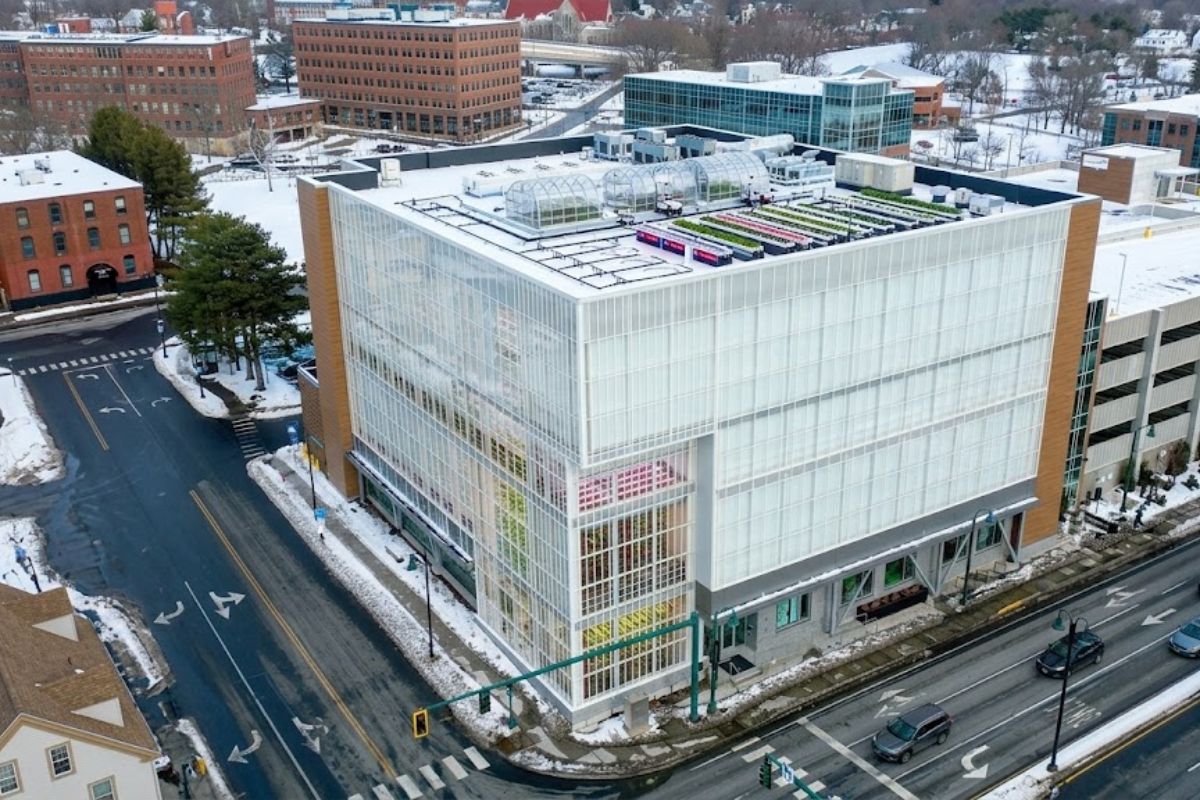
Vertical Harvest is a vertical farm in Westbrook, Maine, that occupies half an acre and produces 1.6 million pounds of food per year, the same amount as a conventional 250-acre farm. Without natural sunlight, without soil, with 42,000 LEDs, hydroponics, and 95% of recycled water, this farm produces 365 days a year and delivers fresh vegetables directly to local supermarkets.
A farm that does not use sunlight or soil and produces 500 times more food per square meter than traditional agriculture. It sounds like fiction, but it exists in the outskirts of Portland, Maine. Vertical Harvest is a vertical farm that occupies half an acre and produces about 1.6 million pounds of vegetables per year, equivalent to a conventional 250-acre farm. Every photon of light that reaches the plants comes from 42,000 LED lights. No sunlight enters this farm.
The farm operates 365 days a year using hydroponics, recycling 95% of the water, and repurposing the heat from the LEDs to climate-control the building. Vegetables go straight from the farm to local supermarkets, with such a short cold chain that they last weeks longer than products coming from distant farms. If the vertical farm is so efficient, why hasn’t it replaced conventional agriculture? The answer lies in energy and smart choices about what to grow.
42,000 LEDs and zero sun: how the farm cultivates without natural light

In the original pilot farm in Jackson, Wyoming, south-facing windows helped with cultivation. But sunlight created problems: it heated one side of the building more than the other, formed microclimates, and caused plants to grow unevenly.
-
The water that almost everyone throws away after cooking potatoes carries nutrients released during the preparation and can be reused to help in the development of plants when used correctly at the base of gardens and pots, at no additional cost and without changing the routine.

-
The sea water temperature rose from 28 to 34 degrees in Santa Catarina and killed up to 90% of the oysters: producers who planted over 1 million seeds lost practically everything and say that if it happens again, production is doomed to end.

-
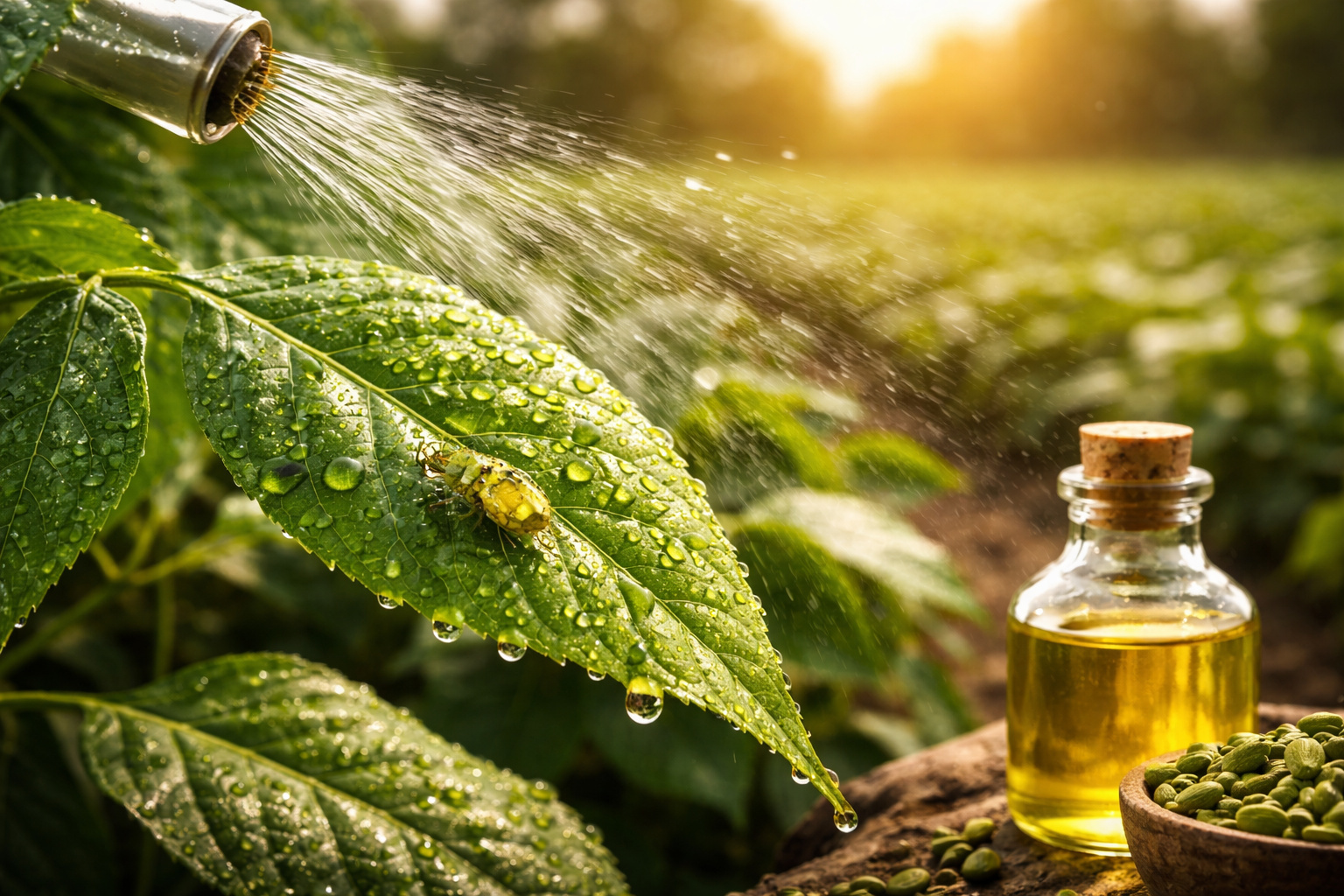
An Indian tree that grows in the Brazilian Northeast produces an oil capable of acting against more than 200 species of pests and interrupting the insect cycle, gaining ground as a natural alternative in soybean, cotton, and vegetable crops.
-
The rise in oil prices in the Middle East is already affecting Brazilian sugar: mills in the Central-South are seeing their margins shrink just as ethanol gains strength.

In the new farm in Westbrook, all the light comes exclusively from LEDs—42,000 individual lamps, one for each growing tray.

Plants do not use green light, which is why they appear green to us. The farm does not waste energy on useless wavelengths. Red LEDs are inexpensive and provide the essentials for photosynthesis, with a bit of blue to optimize growth and nutritional value.
It is this combination that gives the farm its characteristic pink glow and keeps the energy bill manageable.
No soil and with 95% of recycled water: the hydroponics that feed the farm

The farm does not use soil. All cultivation is done through hydroponics—plants grow in trays fed by nutrient-rich water. The water drips at the base of each tray, the trays are tilted for the water to drain, and the system recycles 95% of all the water used. Before returning to the plants, the water passes through 50-micron filters and UV reactors.
If the UV transmission level drops, the system shuts down automatically, performs an acid wash to remove biofilm, discards the water, and restarts everything automatically.
In a farm where a pathogen can contaminate thousands of trays at once, cleaning the water is a matter of survival. The system also automatically adjusts pH and nutrients before each irrigation cycle.
From seed to packaging: how the farm automates the entire cycle across multiple floors

Everything starts on the ground floor with seeding using vacuum drums—each type of plant has its specific drum.
The trays go to the germination room with a capacity for 6,000 trays, then ascend via elevators to the cultivation rooms on the upper floors, where each tray has its own LED light, irrigation, and controlled airflow.
The 42,000 trays have RFID tags that track their position throughout the system from seeding to harvesting. When ready, they descend via elevator to the harvesting floor, are cut by blades, packaged, and sealed.

The entire building operates as a continuous circuit. The farm also injects 30 tons of CO2 per month because in a closed environment, the plants quickly consume all the CO2 in the air.
1.5 megawatts of energy: the biggest challenge preventing the vertical farm from scaling
The farm consumes 1.5 megawatts, mostly for the LEDs. Outdoors, sun and soil are free. In a vertical farm, everything needs to be generated artificially, making energy the biggest cost and the main obstacle to the industry’s expansion.
That is why vertical farming has not yet established itself as a mass alternative.
The farm reduces the power of the LEDs during peak electrical grid hours and increases production at night when energy is cheaper.
The heat from the 42,000 LEDs is repurposed by the climate control system. And the choice to grow only leafy greens, herbs, and microgreens—fast-growing and high-value crops—is what makes the numbers work. Wheat, corn, and rice are simply not viable in this system.
Half an acre producing year-round: where the vertical farm makes sense
The vertical farm does not aim to replace traditional agriculture; it aims to complement it where it fails. In dense urban areas, in climates with short seasons, in places where the supply chain is long and fragile, a half-acre farm producing millions of pounds of vegetables year-round is a hard proposition to contest.
42,000 LEDs, 42,000 trays with RFID, hydroponics with 95% recycled water, 30 tons of CO2 per month, and a system that reuses its own heat. The vertical farm is more complex than just plants on shelves, and its future looks stunningly pink and green.
With information from the Channel Undecided with Matt Ferrell
Would you eat vegetables grown without sun and soil? Do you think vertical farming makes sense for Brazil? And would you like to see one of these in your city? Let us know in the comments.








Seja o primeiro a reagir!