





 Portuguese
  English
  Spanish
  6 min of reading
  0 comments


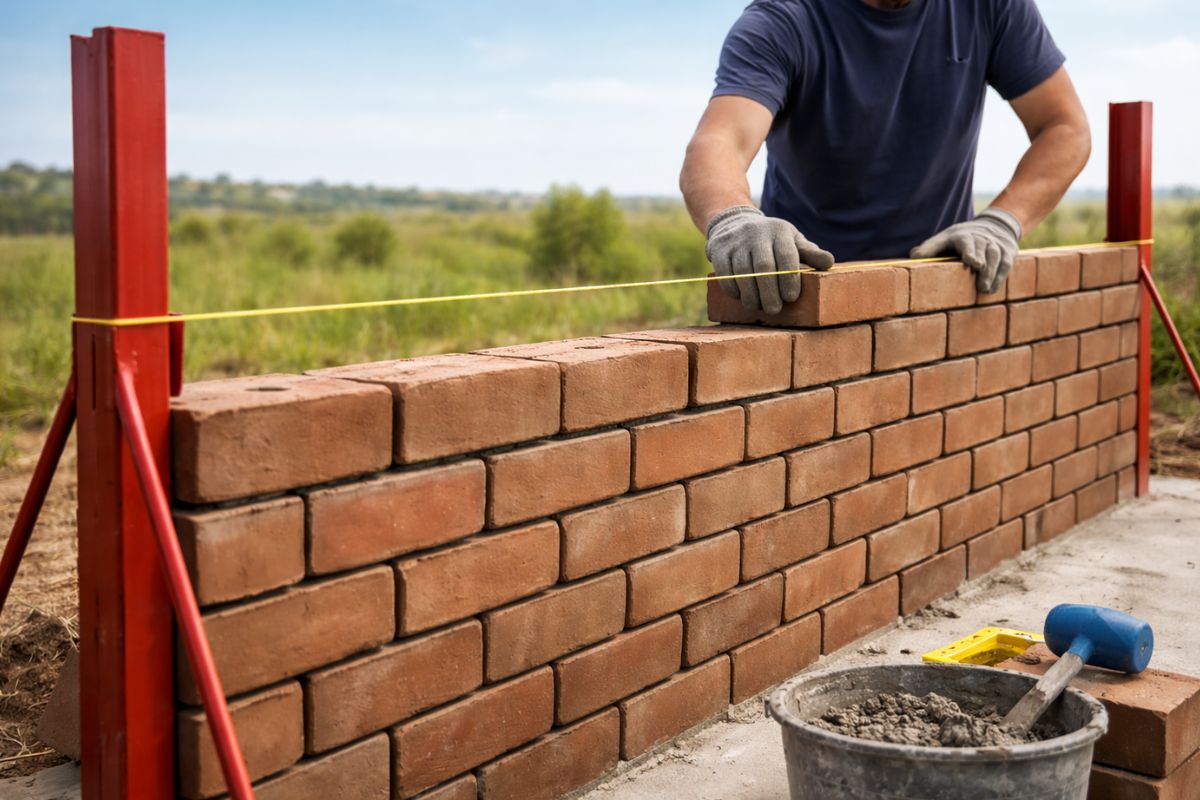
A simple tool called the squaring tool dispenses the repetitive plumb line, accelerates the laying of bricks by up to 40%, and allows even laborers to align walls themselves, but Brazilian construction still ignores this resource in most works.
In practically every construction site in Brazil, the ritual of laying bricks repeats itself row after row: the mason lays the brick, takes the plumb line, checks, adjusts, checks again, stretches the line, makes the head, and only then moves on to the next section. There is a simple tool that eliminates almost all this repetitive work, and it is called the squaring tool. It consists of a vertical metal rod, fixed at the ends of the walls, which serves as a permanent guide for alignment and plumb throughout the entire masonry elevation.
The most surprising thing is that this simple tool costs little, can be made by any metalworker, and increases laying productivity by 20 to 40%, according to international technical manuals for bricklayers. Even so, it is practically unknown in most small and medium-sized construction sites in the country. Those who discover and start using it never go back to the traditional method. The question remains: why does the Brazilian construction still resist adopting something so practical?
What is the squaring tool and how does this simple tool work on site
According to Marcelo from the CASA.PIPA channel, the squaring tool is a vertical structure, usually made of metal with welded flat bars, that functions as a fixed guide for laying bricks.
-
Won R$ 72 million in the British lottery, but lost it all for not claiming: October ticket in Bexley was forgotten, the 180-day deadline passed, and the fortune will fund local community projects in London.

-
Mixing vinegar with detergent in a blender has become the most talked-about cleaning trick on the internet because it solves a problem that everyone has in the kitchen in seconds and uses only two ingredients that you already have at home.

-
The largest fortress on the planet is located in a city with 10 km star-shaped walls, 300 hectares protected, an aqueduct with 843 arches and 7 km long, strategic forts, and a UNESCO title that intrigues specialists.

-
USS Gerald R. Ford: the floating city of $13 billion where 5,000 sailors serve 17,000 meals a day, sleep in stacked bunks, take 10-liter showers, and keep 75 fighter jets ready.

It is installed at the ends and corners of the wall, always plumb, and receives a line that serves as a reference for all subsequent rows. Instead of checking the plumb with each brick or each head, the mason simply follows the stretched line between the squaring tools and lays the bricks continuously.
In practice, the operation is straightforward. The line wraps around all the squaring tools on the site, and after each completed row, it is simply raised for the next height. There is no need to disassemble supports, redo heads, or keep checking the plumb at various points.
The simple tool maintains constant vertical and horizontal alignment throughout the entire wall, resulting in straight and precise surfaces with much less manual effort.
Why the squaring tool accelerates the laying of bricks by up to 40%


The productivity gain occurs because the simple tool eliminates the most time-consuming steps of the traditional method. In the conventional system, the mason needs to raise three or four heads at each end, check the plumb with each brick, stretch the line with supports, and repeat the entire process for each new row.
With the squaring tool, the plumb is checked only once, at the time of installation, and after that, the line is already positioned as a permanent reference.
According to technical manuals for bricklayers used abroad, the average gain estimated with the use of the squaring tool varies between 20 and 40% in productivity. In the practical experience of those who have already adopted this simple tool in real works, the result is even more noticeable.
In addition to speed, quality control improves significantly because the entire wall rises with the same alignment standard, without depending on the individual skill of the mason at each section.
Any laborer can align the wall themselves with this simple tool
One of the most relevant advantages of the squaring tool is the democratization of work on the site. In the traditional method, there is usually a master or experienced mason responsible for making the heads and positioning the line.
The laborer or assistant is limited to preparing the mortar and performing secondary tasks. Those who do not master the plumb technique hardly lay bricks with quality.
With the squaring tool installed, this scenario changes completely. The simple tool works as a visual guide so clear that even trainees can lay aligned bricks by themselves. The laborer just needs to work with the bubble level in hand and follow the line that is already stretched in the correct position.
The concern with plumb and lateral alignment disappears because the squaring tool has already solved that at installation. In practice, everyone on the site can get their hands dirty and produce with a quality standard.
How to install the squaring tool on site step by step
The installation requires attention at the beginning, but pays off in all subsequent rows. The first step is to fix the squaring tool at the ends and corners of the wall, using anchors and screws. The base of the simple tool has flat bars with holes that allow for fine adjustment of the position.
The initial alignment can be done with a bubble level just to mark the holes, as there is a margin for lateral adjustment.
The most important moment is the final tightening with the plumb. Each squaring tool needs to be checked from both sides because when tightening one screw, the base may shift slightly. The process is to tighten, check with the plumb, go back to the other side, check again, and repeat until the rod is perfectly vertical.
Once all the squaring tools are fixed and plumbed, the line is passed around all of them, tensioned, and tied with a firm knot. From there, the laying continues row by row, simply raising the line for the next height.
Why almost no one in Brazil uses the squaring tool if it is so efficient
The answer lies in the culture of construction and lack of information. In Brazil, the squaring tool appears more frequently in structural masonry works, those that use concrete or ceramic blocks with embedded columns.
In the vast majority of small and medium-sized constructions, the concrete structures are made before the masonry, and the columns themselves serve as a reference for the walls. This has prevented the simple tool from becoming popular in the daily routine of conventional construction sites.
Another factor is the difficulty of finding the squaring tool ready to buy. It is not a common item in construction material stores, which deters those who are not used to having tools custom-made.
However, any metalworker can produce a squaring tool with metal, flat bars, screws, and welding. The cost of manufacturing eight units, a quantity sufficient for a complete residential construction, is low compared to the time and quality gain that the simple tool provides throughout the entire construction.
The advantages that make this simple tool a game changer on site
Those who adopt the squaring tool for the first time usually have the same reaction: they do not understand how they built for so long without it. The greater precision in the walls eliminates rework, reduces the consumption of corrective plaster, and delivers a visibly superior final result.
Straighter walls mean less finishing material, less waste of material, and fewer hours of work to correct imperfections.
In addition to direct savings, the simple tool brings operational peace of mind that changes the dynamics of the site. The mason no longer needs to stop every row to check the plumb at various points.
The laborer can contribute productively to the laying of bricks. And the entire construction rises in a synchronized manner, row by row, without the problem of one wall rising faster than the others and then needing to catch up in height. The result is a more organized construction, faster and with a consistent quality standard from start to finish.
Did you already know about the squaring tool or do you still use the traditional method with plumb and line for each row? If you have already tried this simple tool in your work, share how the difference was. And if you have never heard of it, it is worth looking for a metalworker and testing it. Leave your comment. This type of practical information needs to circulate more among those who build in Brazil.








Seja o primeiro a reagir!