





 Portuguese
  English
  Spanish
 3 min of reading
  0 comments


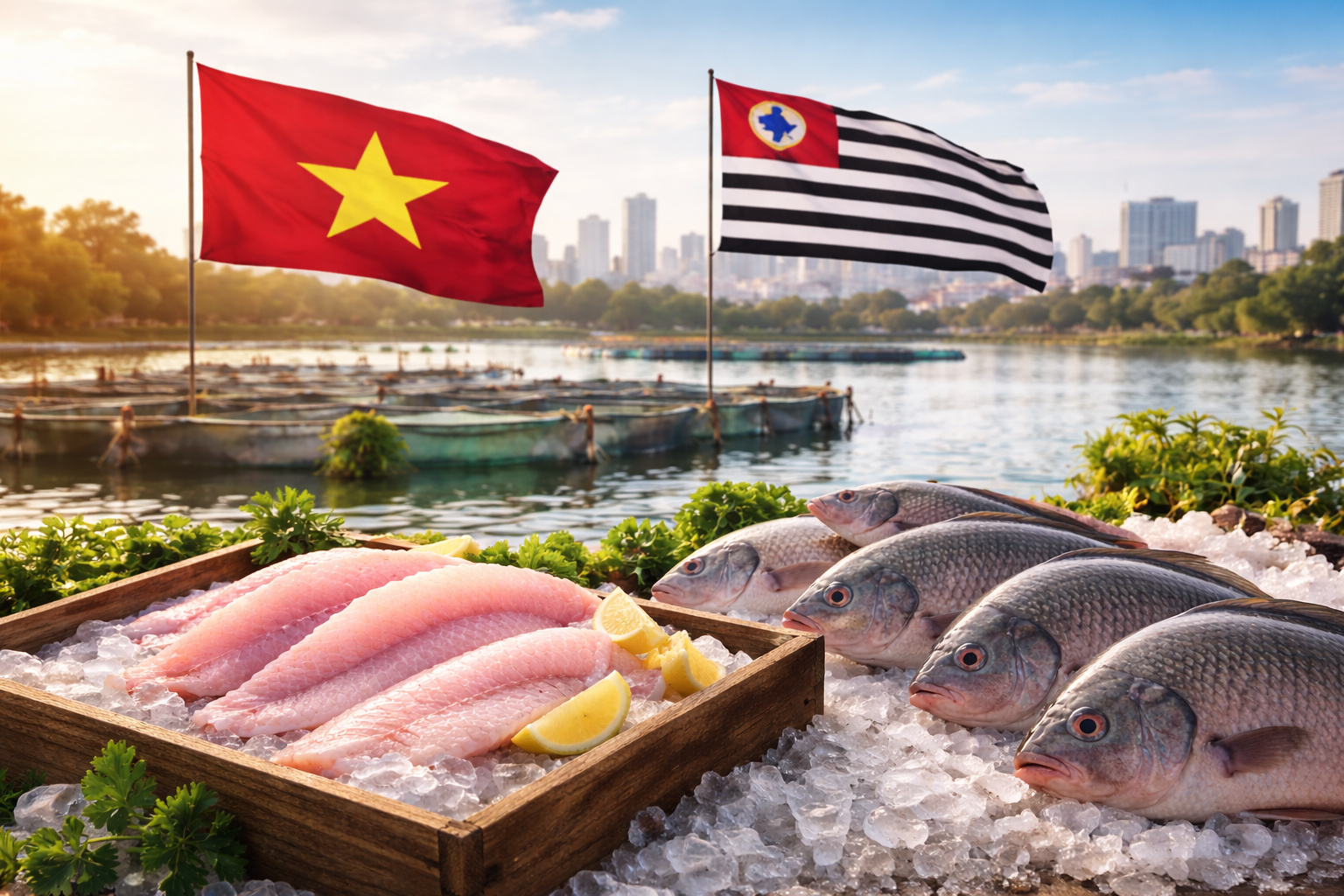
Request Submitted In February 2026 Involves Risk Of Tilapia Lake Virus, Economic Impact, And Possible Structural Changes In Paulista Aquaculture
An institutional movement of great impact for Brazilian aquaculture took place at the beginning of 2026, attracting national attention. On February 3, 2026, the Brazilian Fish Farming Association (PEIXE BR) formalized, together with the Secretariat of Agriculture and Supply of São Paulo, then headed by Geraldo Mello Filho, a request to suspend the import of tilapia fillets from Vietnam.
The request arises, therefore, as a direct response to sanitary and economic concerns, which may consequently redefine the tilapia market in São Paulo starting in 2026.
Sanitary Alert Puts Paulista Production At Risk
The main argument presented by PEIXE BR is related to the prevention of Tilapia Lake Virus (TiLV). Currently, the virus is not registered in Paulista territory, while, on the other hand, there is confirmed occurrence in Vietnam, according to data from the aquaculture sector.
-
The sugar-energy sector advances with agricultural technology, but agricultural productivity still raises concerns.

-
The eggshell that almost everyone throws away is made up of about 95% calcium carbonate and can help enrich the soil when crushed, slowly releasing nutrients and being reused in home gardens and vegetable patches.

-
This farm in the United States does not use sunlight, does not use soil, and produces 500 times more food per square meter than traditional agriculture: the secret lies in 42,000 LEDs, hydroponics, and a system that recycles even the heat from the lamps.

-
The water that almost everyone throws away after cooking potatoes carries nutrients released during the preparation and can be reused to help in the development of plants when used correctly at the base of gardens and pots, at no additional cost and without changing the routine.


Thus, the import of Vietnamese fillet has come to be seen as a risk vector, capable of compromising the health of local stocks. Therefore, the entity advocates for the adoption of immediate preventive measures, avoiding irreversible impacts on the Paulista productive ecosystem.
During the institutional meeting, technical concerns about the possible introduction of TiLV were formalized, which could therefore affect not only producers but the entire chain of state aquaculture.

Precedent Set In Santa Catarina Reinforces Request
The request submitted in São Paulo, in fact, follows a model already adopted by Santa Catarina, which previously banned the trade of Vietnamese tilapia based on similar sanitary criteria.
Thus, the experience from Santa Catarina has been used as a reference, reinforcing the thesis that sanitary prevention should prevail over commercial risks. Consequently, PEIXE BR assesses that São Paulo can adopt an equivalent measure in 2026, protecting its local production.
Tax Imbalance Increases Tension In The Sector
In addition to the sanitary risk, the debate has moved to the tax sphere, thus increasing pressure on the state government. Currently, São Paulo applies ICMS on locally produced tilapia and on fish from other states.
In contrast, the tilapia fillet imported from Vietnam remains completely exempt from the tax, thus creating a relevant competitive asymmetry. This way, Paulista producers face higher costs, while the foreign product enters the market under more favorable fiscal conditions.
This scenario, therefore, is viewed as a disincentive to local investment, in addition to representing a risk to job maintenance and the operation of industries established in the state.
Economic Impact Concerns Paulista Productive Chain
According to industry representatives, maintaining this tax imbalance may cause investment losses, factory closures, and job reductions. Thus, the absence of regulatory adjustments increases the economic vulnerability of Paulista aquaculture.
It is worth noting that São Paulo ranks second among the largest tilapia producers in Brazil, trailing only Paraná. Therefore, any regulatory instability tends to create wide-ranging effects on the state economy.
Expectation Of Strategic Decision In 2026
In this context, the sector’s expectation is that São Paulo will follow the example of Santa Catarina and suspend the import of Vietnamese tilapia in 2026. Thus, the state could preserve the health of local stocks, while also correcting tax distortions pointed out by the industry.
Thus, the debate remains at the center of discussions in the aquaculture sector throughout 2026, involving authorities, producers, and representative entities.
In your opinion, should São Paulo prioritize health protection and tax balance in the sector or maintain the current import model to ensure lower prices for consumers?










-

-

4 pessoas reagiram a isso.