





 Portuguese
  English
  Spanish
  5 min of reading
  0 comments


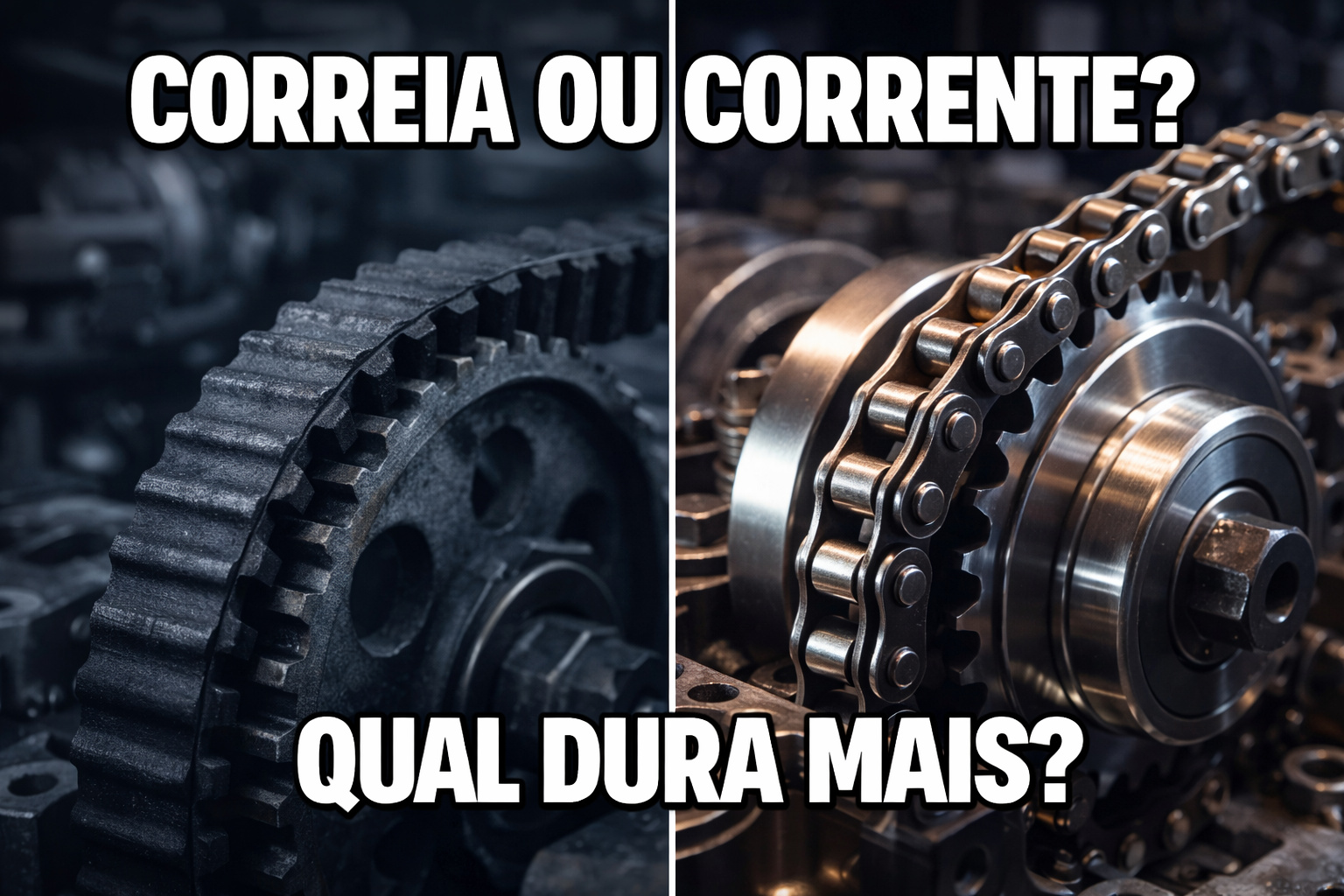
Timing Chain or Timing Belt? Understand Why Engines with Chains, Made of Metal and Oil-Bathed, Tend to Last Longer and Require Less Maintenance Over the Years.
For many years, the choice between timing chains and timing belts went unnoticed by most consumers. For the average driver, what mattered was simply whether the car “ran well” and didn’t cause headaches. However, from an automotive engineering perspective, this decision directly influences engine durability, maintenance costs, and the risk of catastrophic failures over time.
In recent years, with the pursuit of greater reliability and reduced scheduled maintenance, several automakers have begun to rethink this choice. The result is an increasingly relevant debate: why do engines with timing chains tend to last longer than those equipped with timing belts?
The Role of Synchronization in Engine Functioning
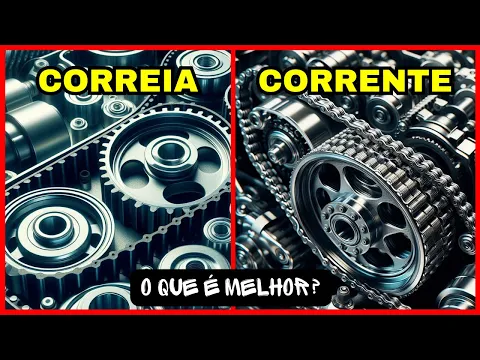
Both the chain and the belt have the same essential function: to synchronize the crankshaft with the camshaft, ensuring that pistons and valves move in perfect harmony.
-
A French brand placed a car on four huge red balloons to prove that its suspension made the vehicle “float,” and the surreal scene became one of the most iconic and unusual images in automotive history.
-
Jeep Avenger begins production in Brazil, debuting as the brand’s new entry-level SUV and inaugurating an unprecedented phase by becoming the first national Jeep manufactured outside of Goiana, as part of a R$ 3 billion plan.
-
Costing R$ 12,490, the new Shineray Urban Lite 150 “cheap one” arrives in Brazil with a CVT transmission, digital dashboard, and LED lights, making it more affordable than the Biz and targeting those who want to abandon the bus.
-
Ducati brings to Brazil the Superleggera V4 Centenario: 228 hp that become 247 with a track kit, carbon fiber and carbon-ceramic brakes, estimated price between R$ 1.5 and 2 million, deliveries only in 2027.

Any failure in this synchronization can cause:
- collisions between pistons and valves,
- warping of the cylinder head,
- breaking of valves,
- and, in many cases, total engine failure.
Therefore, the timing system is one of the most critical points of any internal combustion engine.
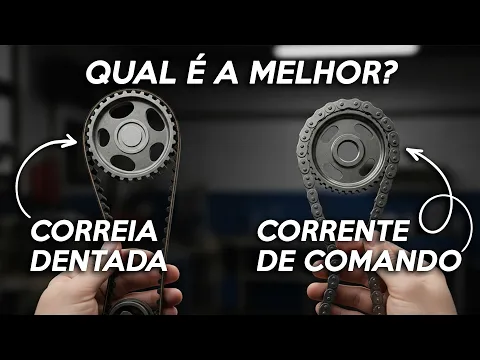

Timing Belt: Simplicity, Low Initial Cost, and Limitations
The timing belt is made of rubber reinforced with synthetic fibers. It gained traction mainly for being:
- quieter,
- lighter,
- and cheaper to produce.
For decades, it was the preferred solution in compact and mid-sized engines. However, the belt has a structural problem: it degrades over time, regardless of mileage.
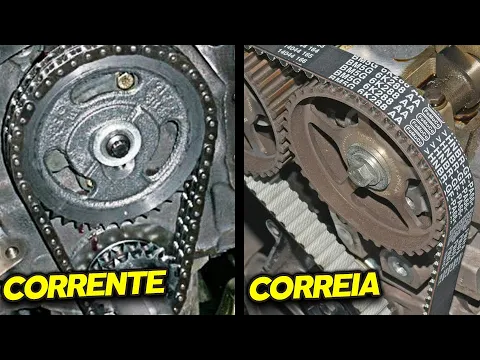
Heat, humidity, thermal variations, and the natural aging of the material cause the belt to lose strength, even in lightly used engines. Therefore, manufacturers determine fixed replacement intervals, usually between 60,000 and 120,000 kilometers, or by time.
Ignoring this maintenance can result in a sudden failure, almost always with severe consequences for the engine.
Timing Chain: Metal Construction and Greater Longevity
The timing chain, on the other hand, is made of metal and works oil-bathed inside the engine. This difference in material and working environment completely changes the scenario.
Being metallic and constantly lubricated, the chain:
- experiences less degradation over time,
- does not rely on scheduled periodic replacements,
- and tends to last throughout the engine’s lifespan in well-designed projects.
In many cases, the chain only requires intervention after hundreds of thousands of kilometers, and even then gradually, with noises or progressive slack, not sudden failures.
Less Scheduled Maintenance and Lower Risk of Catastrophic Failure
One of the biggest attractions of the timing chain is the reduction in maintenance costs over the years. While the belt requires preventive replacement—often accompanied by the replacement of tensioners, pulleys, and water pumps—the chain eliminates this step.
Additionally, when a chain begins to show wear, the signs are usually gradual:
- metallic noise on startup,
- irregular operation,
- detectable failures in diagnostics.
On the other hand, when a belt breaks, it usually does not give a warning. The failure is instantaneous and, in most modern engines, destructive.
Why Not Every Engine with a Chain is More Durable
It is important to make a clear distinction: chain is not an automatic synonym for durability. Longevity depends on design, sizing, and proper lubrication.
Undersized chains, fragile hydraulic tensioners, or overly compact designs can create problems. There are examples of modern engines where the chain experienced premature wear precisely due to engineering decisions aimed at reducing weight and cost.
In other words, the advantage of the chain appears when it is part of a conservative design, not when used merely as a marketing argument.
Why Some Automakers Have Returned to Chains
In recent years, several automakers have shifted back to timing chains in popular and mid-sized engines. The reason was not only technical but also strategic.
Engines with chains:
- reduce the perceived maintenance cost for the customer,
- improve the brand’s reliability image,
- and decrease the risk of failures outside of warranty.
In markets where consumers keep cars for many years or buy used vehicles, this characteristic becomes a relevant competitive differentiator.
Direct Impact on the Used Car Market
In the used car market, the presence of timing chains is increasingly valued. Many buyers already associate timing belts with:
- immediate costs after purchase,
- the risk of maintenance neglected by the previous owner,
- and unexpected expenses.
Engines with chains, when well maintained, transmit a greater sense of security to the second or third owner, which helps maintain resale value.
Belt Still Makes Sense in Some Projects
Despite the advantages of the chain, the timing belt is not an obsolete solution. In well-executed projects, with strict maintenance and easy access for replacement, it can still be efficient and reliable.
The problem arises when:
- access is complex,
- the replacement cost is high,
- or the replacement interval is not respected.
In these cases, the belt ceases to be a simple solution and becomes a critical risk point.
An Engineering Choice That Defines the Engine’s Lifespan
The difference between chains and belts goes far beyond a technical detail. It is a structural engineering decision that directly influences how long an engine can last and how much it will cost over its lifespan.
Engines with timing chains, when well-designed, tend to offer greater longevity, less scheduled maintenance, and lower risk of catastrophic failures, particularly under prolonged use.
In a scenario where cars are becoming increasingly complex and expensive to maintain, this quiet choice remains one of the most important factors for those seeking real durability, not just momentary performance.









Seja o primeiro a reagir!