





 Portuguese
  English
  Spanish
  4 min of reading
  43 comments





Designed To Be 100% Reusable, The Titan Cosmos Spaceship Promises Trips To Mars Two Times Faster Than SpaceX, With Advanced Technology, Heat-Resistant Materials And Capacity For Up To Five Astronauts On Interplanetary Missions.
Traveling to Mars in half the time promised by SpaceX? That’s exactly what the Titan Cosmos project aims to achieve. This futuristic spaceship promises to take astronauts to the red planet in just 39 days. It’s more than speed: it’s a revolution in how we approach space exploration.
Developed by Oscar Viñals, the Titan Cosmos is not only fast, but also sustainable, versatile and innovative.
What Is The Titan Cosmos Spaceship?
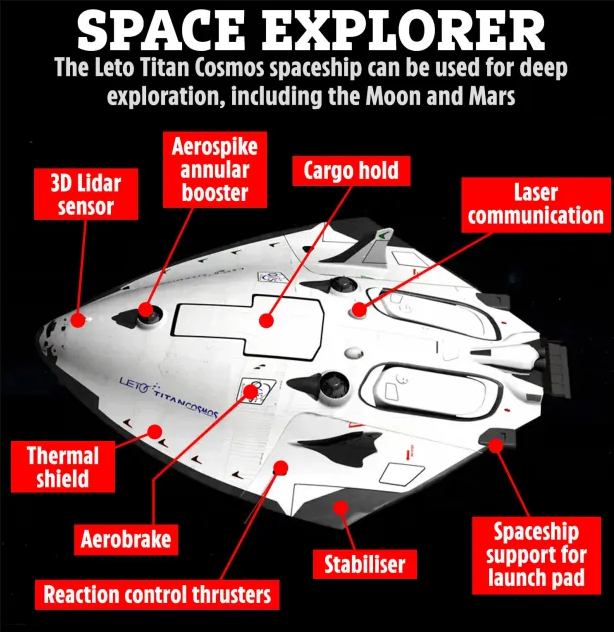
The Titan Cosmos is a spaceship that carries a concept of innovation in all aspects. Inspired by NASA’s space shuttle, it was named after the goddess Leto, a titan from Greek mythology. Just as Leto gave birth to Apollo and Artemis, the spaceship pays homage to NASA’s space programs that carry the same names.
-
In a flooded well, archaeologists found a 1,700-year-old Roman egg that still contains clear and yolk intact inside the very thin shell.

-
Something is happening around the Earth: Inside the huge explosion of fireballs in 2026

-
A hot air bubble coming from Argentina expands over Brazil, causing thermometers to exceed 38 degrees with a thermal sensation of 40 degrees in late March, affecting 6 states at once.

-
The radish leaf that almost everyone throws away has more polyphenols, flavonoids, and fiber than the consumed root, and a 2025 study showed that the leaf contains compounds that protect the intestine, combat inflammation, and may inhibit the growth of cancer cells.


Viñals’ goal with the Titan Cosmos is to create a 100% reusable vehicle that can reduce costs and environmental impacts while paving the way for more ambitious missions, such as asteroid mining and the colonization of other planets.
Impressive Technical Features
The Titan Cosmos is built with cutting-edge materials, such as graphene and thermal tiles. This ensures resistance to extreme heat and durability on different planetary surfaces. These materials allow the spaceship to withstand repeated atmospheric reentries, something essential for long-term missions.
Its design includes wavy shapes and diffusers that manage the plasma generated by reentry into the atmosphere. This way, heat is distributed evenly, protecting the structure of the spaceship. This innovation makes the Titan Cosmos safer and capable of facing extreme conditions.
One of the most fascinating characteristics of the Titan Cosmos is its versatility. It can be used for a variety of missions, from the exploration of distant planets to resource mining on asteroids. The spaceship is an essential tool for both space agencies and the private sector, capable of supporting government initiatives or operating independently.
The Engine
The Titan Cosmos engine, the centerpiece of its revolutionary proposal, utilizes advanced propulsion technologies based on a hybrid ionic and nuclear fusion propulsion system. This engine is designed to achieve extremely high speeds, drastically reducing the time needed for interplanetary travels, such as the journey to Mars, which the Titan Cosmos promises to complete in just 39 days. The combination of these methods allows for greater efficiency in energy use, while also reducing conventional fuel consumption, aligning with sustainable advances in space exploration.
A fundamental characteristic of the engine is its ability to generate continuous propulsion for long periods, unlike conventional systems that rely on intermittent chemical combustion. Nuclear fusion, in particular, provides an almost inexhaustible and incredibly powerful energy source, while ionic propulsion offers precision and control in deep space. This technological advancement is essential to mitigate the challenges of interplanetary travel, such as the impact of space radiation and physical wear on astronauts, making Mars exploration more practical and safe.
Life Aboard The Titan Cosmos
Traveling through space can be a challenging experience, but the design of the Titan Cosmos prioritizes the well-being of the crew. Previous research, such as those conducted on the ISS, was taken into account to create communal spaces that promote comfort and interaction. Reducing travel time decreases the effects of low gravity and enhances the experience for astronauts.
Challenges And The Future Of Space Exploration
Despite being an incredibly promising project, the Titan Cosmos faces significant challenges, such as the need for funding and strategic partnerships with companies and aerospace agencies. Nonetheless, Viñals believes that, even if it is not built immediately, the spaceship already serves as an inspiration for other technological advancements.
The Titan Cosmos is a glimpse into the future of humanity in space. With its promise of faster travel, greater sustainability and unprecedented versatility, it represents a bold step toward interplanetary exploration. Whether the spaceship will actually be built or not, only time will tell, but one thing is certain: the Titan Cosmos is already transforming the way we dream about space.







Creio até 2050 está nave estará
Viajando no sistema solar
Espero que saia do papel. E que nesta década esteja em funcionamento
Difícil acreditar nessa. A menor distância dependendo da posição das órbitas de terra e de Marte são 57 milhões de km.
Pra fazer em 39 dias teria que ter uma velocidade um pouco acima de 60 mil km/h.
Só pra efeito de comparação os testes da nave Orion que vai levar os caras pra lua atingiu 3.300 km/h. É 20x maior para a tecnologia que estão agora.
Se fosse somente 39 dias, já tinham partido umas 15 caravanas kkk
Mas “se tá na internet, é verdade” kkkk