





 Portuguese
  English
  Spanish
  4 min of reading
  0 comments


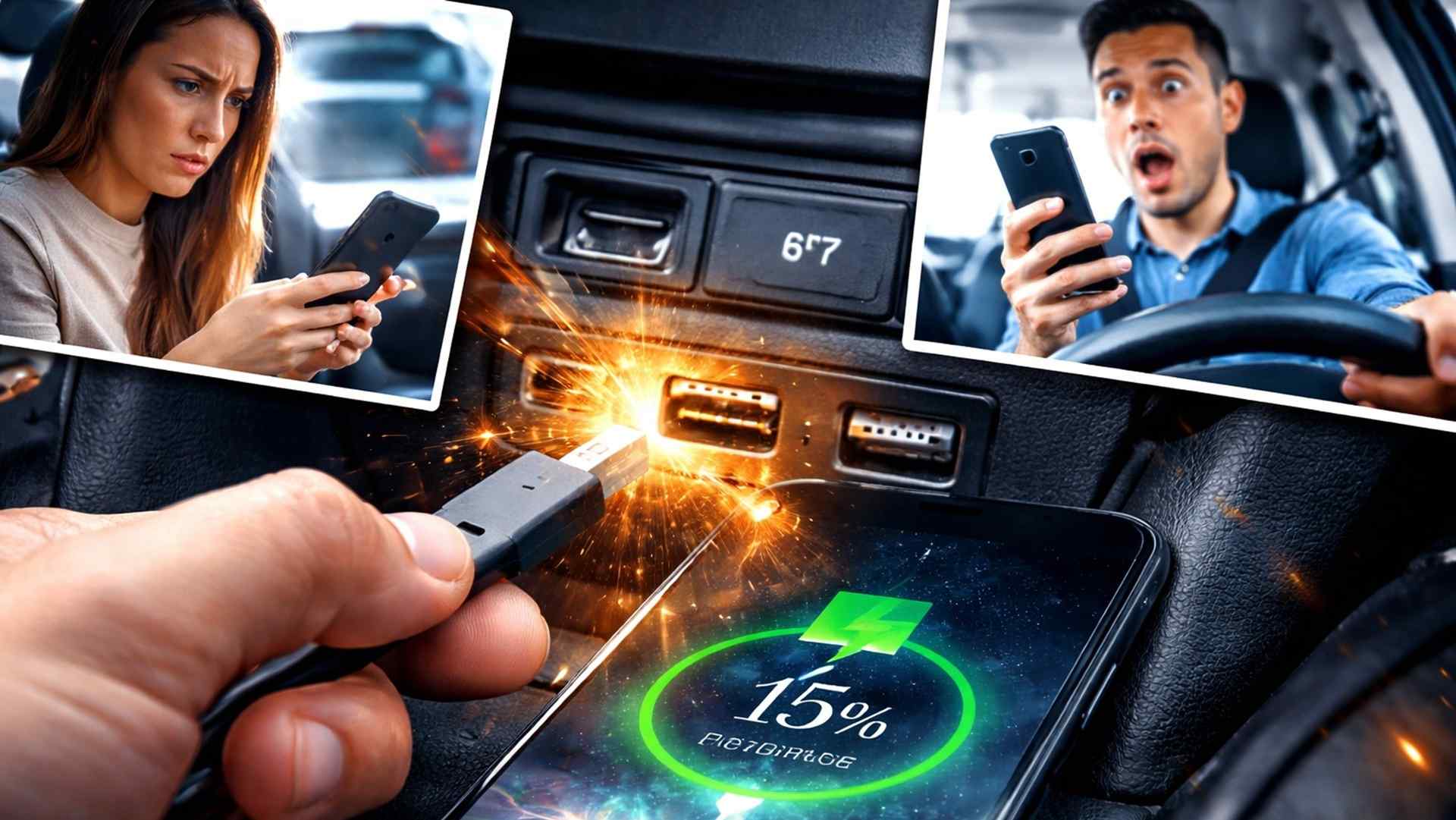
Drivers Who Tend to Charge Their Phone Via USB Port in the Car May Face Slow Recharging, With an Average Gain of Only 3% to 5% Per Hour, Since Many Automotive Connections Provide Between 0.5 A and 1 A, Prioritizing Data Over Energy
If you usually charge your phone via the USB port in your car, be aware that most provide only 0.5 A to 1 A, resulting in a 3% to 5% charge per hour, while the 12V socket can deliver up to 240W and allow for fast charging with dedicated chargers.
Relatively new vehicles already come with USB-A and USB-C ports on the dashboard, in the center console, and even in the rear. The presence of these connectors suggests convenience for charging the phone, but in practice, performance tends to be limited.
Cases where the driver connects the device for an hour and notices minimal progress in battery life are common. This situation occurs even in recent models equipped with apparently more modern USB-C ports.
-
A 68-year-old pizza delivery driver went off route to buy a soda that was missing from a visually impaired customer’s order, refused an extra tip, and now Dan Simpson has over R$ 546,000 in donations from people around the world who want to ensure he can retire peacefully on April 30.

-
Amateur archaeologists were searching a forest in Poland with metal detectors when they found a ceramic pot buried for over 1,500 years. Inside was a pure gold necklace weighing 222 grams, folded to fit in the vessel, and when experts examined the piece, they discovered it was the first Gothic torque ever found in Polish territory.

-
Millions of people have been eating pomegranates for centuries without knowing that this ancient fruit contains punicalagins, which scientists are studying for their possible effects on memory and vascular health.

-
Argentina patrols the South Atlantic with ships built in France and monitors over 1.1 million km² with 87 m OPVs, a range of 7,500 miles, 360° radar, and a 30 mm cannon against illegal fishing in the 200-mile zone.

In a 2024 Chevrolet Blazer, for example, there are two USB-C ports on the dashboard. Despite the update from the old USB-A, the expectation of fast charging does not hold true when the device is connected.
During a trip, a Samsung Galaxy S25+ was connected with 56% battery remaining. The screen indicated 2 h 51 min for a full charge, although the same model can go from 0 to 50% in about 30 minutes with a suitable home charger.
The difference highlights that the power provided by the automotive USB port is not comparable to that of a wall charger. When used with active navigation on Google Maps, the available energy barely maintains battery level.
Why Charging the Phone Via USB Port in the Car Is Slow
The USB ports integrated into most vehicles are not primarily designed for charging phones. Their main function is data transfer and integration with the entertainment system.
They allow access to CarPlay, Android Auto, hands-free calls, and music playback. However, they do not provide the same power as a conventional home charger.
Tests with a USB voltage meter show that many automotive ports deliver about 0.5 A. This level is sufficient for data transfer but limited for effective charging.
As a result, after an hour connected, the gain tends to be between 3% and 5% battery. For modern smartphones with large-capacity batteries, this current is insufficient even to maintain stable levels.
Secondary Ports of 1A or 2.1A Remain Limited
Some vehicles include a second USB port labeled as “always on,” theoretically intended to charge devices even with the car turned off. In certain models, one port is dedicated to data, and the other for charging.
Even so, many of these secondary outputs provide only 1A. In some cases, there is indication of 2.1A, but the actual performance remains limited.
This occurs because the voltage may be low or because the priority of the system is data communication. Thus, even with a higher label, charging remains slow.
In the case of the Samsung Galaxy S25, the device supports fast charging of 25 W, requiring a 3 A charger with Power Delivery technology. The Galaxy S25+ and S25 Ultra support 45 W, needing a 5 A cable and charger.
An iPhone 17, in turn, can reach up to 40 W wired, provided that the charger supplies 20 V at 2 A or 15 V at 2.67 A. Given these requirements, an automotive USB port that barely reaches 1 A is clearly insufficient.
12V Socket Can Provide From 120W to 240W
In light of these limitations, the recommended alternative is to use the vehicle’s 12V auxiliary socket, known as the 12V power socket for cigarette lighters.
These sockets generally support from 10 to 20 amperes. This means providing 120W to 240W of power, well above the capacity of integrated USB ports.
With this energy reserve, it becomes possible to use dedicated high-power vehicle chargers. One cited example is the UGREEN 130W car charger with three ports.
In this model, the central USB-A port provides 22.5W, sufficient for most devices. The USB-C ports, especially the lower one at 100W, can provide energy equivalent to that of a home charger.
Thus, it is possible to charge phones, tablets, laptops, and other devices at speeds comparable to what is achieved at home. The practical difference is significant when compared to the integrated USB ports on the dashboard.
Integrated USB Port Prioritizes Data, Not Energy
In summary, the car’s USB port was primarily designed for integration with systems like Android Auto and CarPlay. The provision of energy is secondary.
Even in recent vehicles, the limitation of 0.5 A to 1 A drastically reduces efficiency in charging the phone. In scenarios of simultaneous use with navigation and active screen, the battery may hardly progress.
On the other hand, the 12V socket, with a capacity of up to 240W, allows the use of chargers compatible with current standards of 25 W, 40 W, or 45 W, as long as the adapter and cable are adequate.
In summary, for those who need fast charging during daily commutes or on long trips, relying solely on the integrated USB port may result in poor performance and frustrating expectations. The practical solution lies in the 12V socket with a dedicated charger.
By understanding this technical difference between data transfer and effective energy provision, the driver avoids surprises and optimizes charging time in the vehicle, even if the solution may seem less obvious at first glance.









Seja o primeiro a reagir!