






 Portuguese


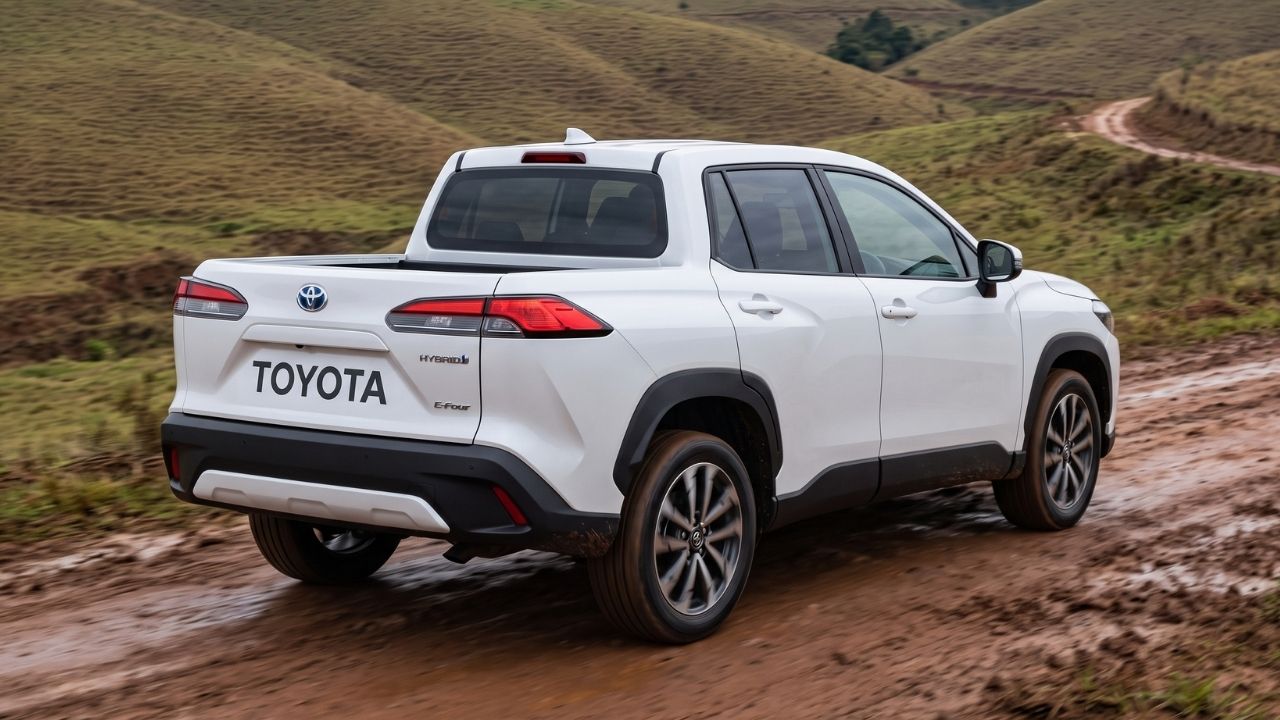

Toyota Project 150D to Arrive in 2027 with TNGA Platform from Corolla Cross, Hybrid System, E-Four All-Wheel Drive, and Domestic Production in Sorocaba.
Toyota is gearing up for 2027 with its first domestically-produced monocoque mid-size pickup, known during development by the code Project 150D. The truck will be manufactured in Sorocaba, feature architecture derived from the Corolla Cross family, and is set to fill the substantial gap between the brand’s SUVs and the Hilux, taking on competitors like the Fiat Toro, Ford Maverick, and Ram Rampage.
According to Quatro Rodas reports, the higher versions of Project 150D are being developed with a flex hybrid system, electric all-wheel drive E-Four, and a configuration capable of combining a 2.5 combustion engine with electric motors, representing an evolution of the technology used by Toyota in models like the RAV4. Recent reports also indicate that a plug-in flex hybrid variant is under development, while the final technical specifications are yet to be finalized before commercial launch.
Project 150D will be the Missing Pickup Between Corolla Cross and Hilux
Currently, Toyota has a significant gap between its monocoque vehicles and the Hilux, a traditional mid-size pickup built on a separate chassis and also aimed at heavy-duty use.
-
Used 2022 Hyundai HB20X Priced Around R$ 70,000, Over R$ 10,000 Below Fipe Guide, Features 1.6 Engine with 130 HP, Six-Speed Automatic Transmission, Warranty Until 2027

-
Geely Reveals New EX5 with 329 hp, 61.5 or 70 kWh Batteries, 160-liter Front Trunk, Up to 635 km Range, and Roof-mounted LiDAR Technology
-
Yaris Cross Reaches 28,240 Registrations, Approaches Hilux, and May Become Toyota’s Best-Selling Vehicle in Brazil by 2026
-
6 Luxury Used Cars Cheaper Than Many New Models in Brazil: BMW, Audi, Volvo Options from R$ 60,000


Project 150D is designed specifically to fill this space. Instead of competing directly with the Ranger, S10, Hilux, and Dakota, its architecture and dimensions will be tailored to target the segment created in Brazil by models such as Fiat Toro, which has since been followed by both the Ram Rampage and the Ford Maverick.


This means a double cab for five occupants, an integrated bed with the body, and behavior closer to that of an SUV than a traditional pickup.
Toyota aims to combine drivability, comfort, and electrification in a product that continues to offer the practicality of a pickup without relying on the heavy ladder chassis used by the Hilux.
TNGA Platform Connects the New Pickup to the Corolla Cross
The base will be a variant of the Toyota New Global Architecture, or TNGA, used in the Corolla family. Reports indicate a particularly close relationship with the Corolla Cross produced in Brazil.
This choice completely alters the philosophy compared to the Hilux.
In a traditional pickup, the cab and bed rest on an independent structure formed by the chassis. In the future 150D, the body and structure will essentially form a single monocoque unit.

The result is expected to provide less mass, a more favorable center of gravity, and cornering behavior closer to that of a car.
It also allows for the use of components already manufactured or developed for the Corolla Cross, reducing industrial complexity and facilitating production in Sorocaba.
Toyota will extend the platform to make room for the cargo bed
Despite its relation to the Corolla Cross, it won’t simply be a matter of cutting the SUV’s rear and adding a cargo bed.
The engineering team must increase the wheelbase, creating enough space to maintain a five-seat cabin and add the cargo area.
Prototypes already spotted in São Paulo show clearly longer proportions than those of the Corolla Cross, along with a completely redesigned rear.
The front end will also have its own identity. While some stamping and architectural elements are shared, the grille and bumpers will feature a more robust design to differentiate the pickup from a mere SUV adaptation.
At the rear, the tailgate will be conventional, opening downward, while the taillights are expected to extend into the cargo bed area in more sophisticated configurations.
EPU concept showed a Toyota measuring 5.07 meters
The final dimensions of Project 150D have not yet been published by the manufacturer, but a good indication of the intended size appeared in the Toyota EPU Concept, presented at the 2023 Japan Mobility Show.
The prototype measures 5.07 meters in length and has an impressive 3.35 meters between the axles.
By comparison, the Ford Maverick currently sold in Brazil measures 5.096 meters and has 3.077 meters between the axles. The Fiat Toro is approximately 4.95 meters long.

This places the upcoming Toyota squarely in the mid-size segment, without reaching the over 5.3 meters typical of traditional midsize pickups.
The EPU concept was electric and does not necessarily represent the final design of the 150D, but clearly demonstrated that Toyota has been studying a smaller unibody truck than the Hilux for years.
Hybrid system will be one of the weapons against Toro and Rampage
Electrification is expected to be one of the main differentiators of Project 150D.
According to Quatro Rodas, higher configurations are being developed with a 2.5 flex engine coupled to the brand’s hybrid system and up to three electric motors, an architecture capable of enabling four-wheel drive without a conventional driveshaft.
The principle is similar to that used by Toyota in AWD electrified models: the combustion engine and front electric components drive the front axle, while an independent electric motor can directly power the rear.
This design allows torque distribution to be managed electronically.
Toyota already uses a 2.5 hybrid with electric AWD in the current RAV4. In the SUV sold in Brazil, the setup combines a 2.5 Atkinson cycle engine with electric motors to deliver up to 239 hp of combined power in the 2026 generation.
E-Four Eliminates Driveshaft for Rear Axle Operation
In the E-Four system, the rear axle receives its own electric motor. It is not necessary to transmit power mechanically from the front via a long driveshaft.
This solution helps reduce mechanical components and provides freedom to distribute torque based on traction, acceleration, and terrain conditions.
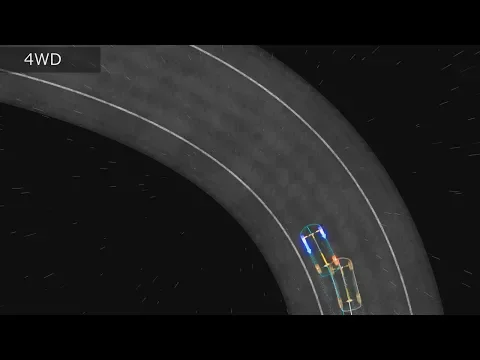
During normal use, the vehicle can prioritize efficiency. When the system detects a need for greater traction, the rear electric motor can immediately engage.
This concept also works particularly well with a unibody pickup, where space under the chassis must be divided among the battery, exhaust, suspension, and bed structure.
In addition to efficiency, all-wheel drive could be crucial for positioning Project 150D directly against AWD versions of the Ford Maverick and 4×4 configurations of the Ram Rampage.
Plug-in Hybrid Flex System Also Under Development
The final mechanical configuration is still evolving. Subsequent findings regarding Project 150D indicate that Toyota is also working on a plug-in hybrid flex solution, capable of receiving external charging.
One of the configurations under evaluation combines a 2.0 engine with front electric propulsion and a rear electric motor. In the international system used as a reference, the combined power can reach 223 hp.
The existence of different configurations during development aligns with Toyota’s strategy to work with multiple electrification technologies.
The brand officially states that its strategy includes conventional hybrids, flex hybrids, and plug-in systems, tailored to the characteristics of each market.
For Brazil, the presence of ethanol adds a particularly important feature: even when the combustion engine is activated, it can use biofuel.
Cheaper Versions May Use the 2.0 Flex Engine of Up to 176 hp
The pickup will not rely solely on electrified versions.
Insider information suggests that entry-level configurations may utilize the 2.0 Dynamic Force flex already known from the Corolla Cross family, paired with the Direct Shift CVT transmission.
This engine achieves 176 hp with ethanol and 169 hp with gasoline, along with approximately 21.4 kgfm of torque.
The CVT transmission features a physical first-gear component, primarily used for acceleration. After that, the system utilizes a continuously variable ratio.
In a pickup, this initial gear can be particularly useful as it reduces some of the belt’s effort when starting with a load.
A lineup consisting of 2.0 flex versions and hybrid configurations would also allow Toyota to cover a much broader price range.
Sorocaba will be the industrial center of the new strategy
Domestic production is directly tied to the transformation of Toyota’s operations in Brazil.
The automaker officially announced a cycle of R$ 11 billion in investments until 2030, aimed at expanding production and introducing new hybrid flex models.

The new structure in Sorocaba is part of this plan. Toyota confirmed that expanding the facility will allow for the production of two new hybrid flex models, as well as increasing industrial capacity and technological concentration within the São Paulo complex.
The 150D pickup is expected to be produced at this plant.
BNDES has also approved R$ 500 million in credit for machinery, equipment, and technological services aimed at new projects related to hybrid flex vehicles in Sorocaba.
This places the future truck within one of the largest investment cycles in the history of Toyota in Brazil.
Local production will also involve batteries and increased local content
Toyota announced that Sorocaba will have local battery assembly for its hybrids, enhancing the Brazilian supply chain’s contribution to electrification components.
The goal is to reduce external dependence, increase local content, and create scale for different electrified vehicles.
This structure could directly benefit the pickup, especially if hybrid configurations capture a significant share of sales.
Toyota has been producing hybrid flex vehicles in Brazil since 2019, when it introduced the electrified Corolla capable of running on ethanol. More recently, it has expanded the strategy to include the Corolla Cross and Yaris Cross.
The 150D will carry this experience into a segment that still has few electrified alternatives.
Fiat Toro is the benchmark Toyota needs to confront
The most evident target is the Fiat Toro. Stellantis’ pickup has solidified the monocoque architecture formula in Brazil, featuring a double cab, SUV-like comfort, and a cargo bed sufficient for everyday and professional uses.
Currently, the Toro offers 937 liters of cargo bed volume and a load capacity that can range from 750 to 1,000 kg, depending on the configuration.
It also has electrified versions with a mild hybrid system, as well as turbodiesel options and different drivetrain configurations.
For Toyota, surpassing the Toro will depend not only on fuel efficiency but also on internal space, load capacity, cargo bed size, suspension robustness, and pricing being crucial factors.
Ford Maverick Illustrates How a Hybrid Can Perform in This Segment
Another strategic competitor is the Ford Maverick Hybrid. The truck uses a 2.5-liter Atkinson cycle engine combined with an electric system, generating 194 hp of combined power, and in its current Brazilian configuration, features intelligent AWD.
It offers 943 liters of cargo volume, a payload capacity of 584 kg, and measures 5.096 meters in length.
This means that Toyota will not enter the intermediate hybrid truck territory alone.
The difference will primarily lie in the Japanese brand’s ability to combine electrification with flex fuel and, depending on the final configuration, a plug-in system.
Ram Rampage Puts Up to 272 hp in the Competition
At the performance end is the Ram Rampage, another contender built with a unibody structure and developed with significant input from Brazilian engineering.
Its 2.0 Turbo Flex version delivers 272 hp and 400 Nm, while the new 2.2 turbodiesel reaches 200 hp and 450 Nm.
The cargo bed holds 980 liters, and the body measures 5.028 meters in length.
Therefore, Project 150D will need to balance performance and efficiency.
Even if the future Toyota does not aim to exceed the 272 hp of the gasoline Rampage, the instant torque from electric motors and E-Four traction could provide a significantly different response, especially in launches and slippery surfaces.
Price Expected to Fall Between Toro and Hilux
Reports from Quatro Rodas indicate an estimated price range of R$ 180,000 to R$ 240,000, depending on the engine and equipment level.
This positioning would be strategic.
Entry-level versions could directly compete for buyers of the Toro, while the more sophisticated hybrids would target the Ford Maverick and Ram Rampage.
At the same time, Toyota would maintain space above the new pickup for the Hilux, which will continue to be a larger truck designed for more severe uses.
The differentiation would be similar to what exists in other brands that simultaneously offer unibody pickups and traditional mid-sized trucks.
Project 150D Now Circulating with Final Body in Brazil
The new pickup has ceased to exist only in projections.
In June 2026, a camouflaged prototype with a final body was spotted on the Castelo Branco Highway in São Paulo, near the Sorocaba area.
The images revealed a double cab, a proportionally short bed, and various elements related to the Corolla Cross.
They also indicated that development is already in an advanced stage.
The expectation reported by different specialized outlets is for a commercial launch in 2027, with the first quarter or first half being the most likely timeframe.
Project 150D Could Transform Toyota’s Position Among Trucks
Toyota already has a strong association with trucks due to the Hilux, but Project 150D represents a completely different approach.
Instead of a separate chassis, diesel engine, and a primary focus on durability for heavy-duty work, the new pickup will use unibody construction, TNGA architecture, and a range aimed also at electrification.
Information gathered during development points to 2.0 flex versions and higher hybrid configurations, with the E-Four electric all-wheel drive being one of the most important technologies in the future lineup. Quatro Rodas also notes a system based on the 2.5 flex electrified in the top versions, while other reports indicate a plug-in solution based on the 2.0 still in development.
When it arrives at dealerships in 2027, Toyota will have for the first time in the country a pickup designed specifically for the market occupied by Fiat Toro, Ford Maverick, and Ram Rampage, combining a truck bed, double cab, and mid-sized design with a traction and electrification technology that could become its main differentiator in the segment.


