





 Portuguese
  English
  Spanish
 4 min of reading
  0 comments


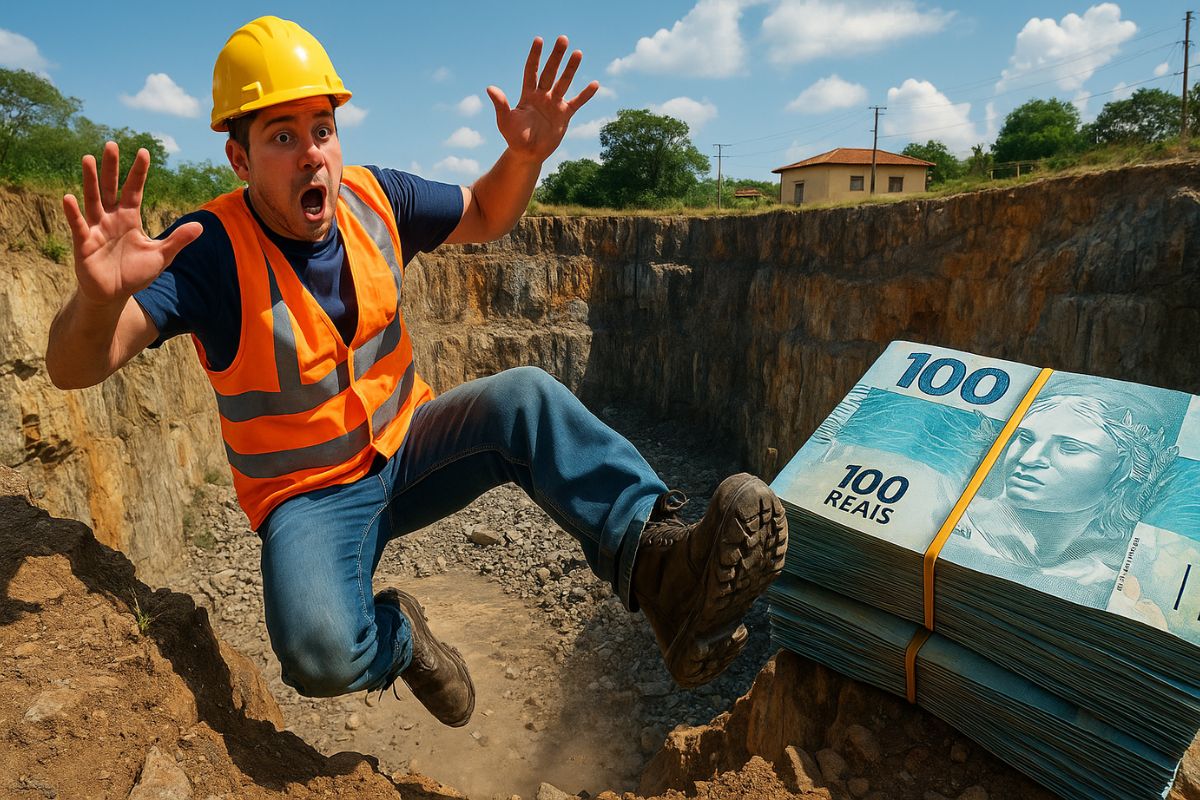
TRT-SC Decision Confirms Responsibilities of Company and Municipality After 26-Year-Old Worker Falls About 30 Meters in Quarry Without Guardrails in Imbuia; Amounts Include Moral Damages, Loss of Work Capacity, and Medical Assistance, According to ConJur.
The worker was operating a crusher in a municipal quarry in Imbuia (SC) when, in August 2023, he fell from a cliff approximately 30 meters while trying to unlock the conveyor belt in an area without guardrails and without a safety belt. He spent 20 days in a coma and developed paraplegia, with total and permanent inability to work, according to reports by ConJur.
The 1st Panel of the TRT of the 12th Region unanimously confirmed that there was a serious security failure and set damages exceeding R$ 1 million. The case, detailed by ConJur, highlights omissions in risk management and reinforces how Labor Justice has addressed accidents in high-risk environments.
What Happened and Why the Location Was Unsafe
Witnesses reported that the route along the cliff’s edge was routinely used by employees to free the crusher’s conveyor belt.
-
With the arrival of Law 11.788, internships are now recognized as professional experience.

-
The Brazilian Civil Code states that a property owner has the right to cut the roots of a neighbor’s tree that invade their land, as long as it does not harm the tree itself. The owner must notify the neighbor before taking such action.
-
Engineer is sentenced to repay R$ 148 thousand after holding public positions in three municipalities in Rondônia with incompatible schedules, and the decision is upheld by the Court of Justice.

-
Chamber approves project that creates mandatory Life Insurance for police officers, firefighters, guards, and traffic agents.

The absence of physical barriers and adequate PPE turned an ordinary activity into a high-risk operation.
According to the records cited by ConJur, the municipality was aware of the dangerous conditions.
Nevertheless, the procedure continued to be adopted, which, in the court’s assessment, represented tolerance for an unsafe practice.
Who Was Held Responsible by Justice — and Why
At first instance, judge Ângela Maria Konrath (2nd Labor Court of Rio do Sul) recognized the objective liability of the contracted company and the joint liability of the municipality.
High-risk environment (level 4, according to NR-4), combined with the lack of training and equipment, formed the basis for this understanding.
The Panel maintained the responsibilities.
According to the rapporteur, judge Maria de Lourdes Leiria, it was proven that the path along the cliff’s edge was known and tolerated by the municipality’s representatives — a decisive fact for the conviction, as recorded by ConJur.
How Much the Worker Will Receive and How the Amount Was Calculated
At first instance, there were settlements of R$ 500 thousand for moral damages, R$ 790.9 thousand for loss of work capacity (calculated at 70% of the total of wages until age 73, male life expectancy), and R$ 40 thousand for medical assistance and related expenses.
The total exceeded R$ 1.33 million.
When reviewing the appeals, the 1st Panel of the TRT-SC reduced the moral damage to R$ 300 thousand, considering the last salary (just under R$ 2 thousand) and the limited economic capacity of the defendants (small company and municipality with few resources).
The final amount was set at R$ 1.24 million, subject to adjustments and potential appeals, as reported by ConJur.
For the worker, the amount seeks to compensate for the permanent loss of work capacity and the moral distress.
What the Company and Municipality Said — and Why the Arguments Did Not Convince
The company claimed that the worker’s transfer to the quarry was the municipality’s decision and that it fulfilled its obligation to provide labor.
Meanwhile, the municipality attempted to assign exclusive blame to the worker, alleging that he chose to pass through the dangerous area.
The allegations did not prosper.
The practice was known and tolerated, and it was the responsibility of those in charge to eliminate the risk at the source, install collective protections, provide adequate PPE, and train the team.
Without effective risk management, the duty of protection was violated, concluded the panel, as quoted by ConJur.
What This Case Signals for Other Work Environments
Beyond the amount, the decision reaffirms the standard of diligence required in risky operations.
It is not enough to point out individual recklessness when the organization normalizes dangerous routes and fails to provide barriers and safe procedures.
Companies and public entities must map hazards, block insecure access, train teams, and oversee routines, especially in mining, construction, and public services.
When the risk is known and repeated, liability tends to be joint — a message reinforced in various rulings reported by ConJur.
Concise Timeline of the Process
August/2023: accident at the municipal quarry; worker spends 20 days in a coma and is diagnosed with paraplegia.
1st Instance: ruling with R$ 500 thousand (moral damages), R$ 790.9 thousand (work capacity), and R$ 40 thousand (assistance).
1st Panel of the TRT-SC: maintenance of responsibilities; moral damage reduced to R$ 300 thousand; total of R$ 1.24 million, subject to adjustments and appeals — according to ConJur.
The case in Imbuia shows that structural failures and the normalization of risk carry an enormous human and financial cost — for the worker, for the company, and for the public authority.
When prevention fails, compensation is inevitable and likely to be substantial.
Do you work — or have you ever worked — in high-risk areas? In your opinion, does the amount set provide justice for the harm suffered by the worker? How can we ensure that municipalities and companies adopt real barriers against accidents in quarries and construction sites? Share in the comments: concrete stories help improve safety and pressure managers for changes that save lives.










-

-

-

-

-

-

40 pessoas reagiram a isso.