





 Portuguese
  English
  Spanish
  5 min of reading
  0 comments



Understand How the Energy Transition and ESG Directly Influence the Market Value of Companies, as They Impact Competitiveness, Access to Capital, and Strategic Decisions in an Increasingly Sustainable Economic Scenario.
Currently, the energy transition has ceased to be just an environmental debate. Instead, it has become the center of companies’ strategic decisions worldwide. As companies replace fossil fuels with clean energy, they also incorporate ESG criteria, which consequently redefines how the market evaluates performance, growth, and long-term resilience.
Throughout history, the global energy model has been structured around coal, oil, and natural gas. Since the Industrial Revolution, these sources have supported economic expansion and industrialization. However, at the same time, this model has caused significant environmental impacts, such as increased greenhouse gas emissions, intensified air pollution, and aggravated climate change.
Since the end of the 20th century, however, these impacts have gained greater visibility. For this reason, governments, international organizations, and companies began discussing structural solutions. Thus, international agreements, environmental public policies, and new regulatory requirements started to directly influence the corporate environment.
-
A Canadian retiree creates a hydroelectric system on a real river, generating energy continuously throughout the day and demonstrating how the power of water can supply a house with stability even in a simple structure.

-
Petrobras reaffirms its commitment to the market and ensures that it will carry out the energy transition safely to maintain national sovereignty.

-
Researchers discover a possible hydrogen deposit of up to 46 million tons beneath an ancient coal basin, and the volume could exceed half of the entire global production.

-
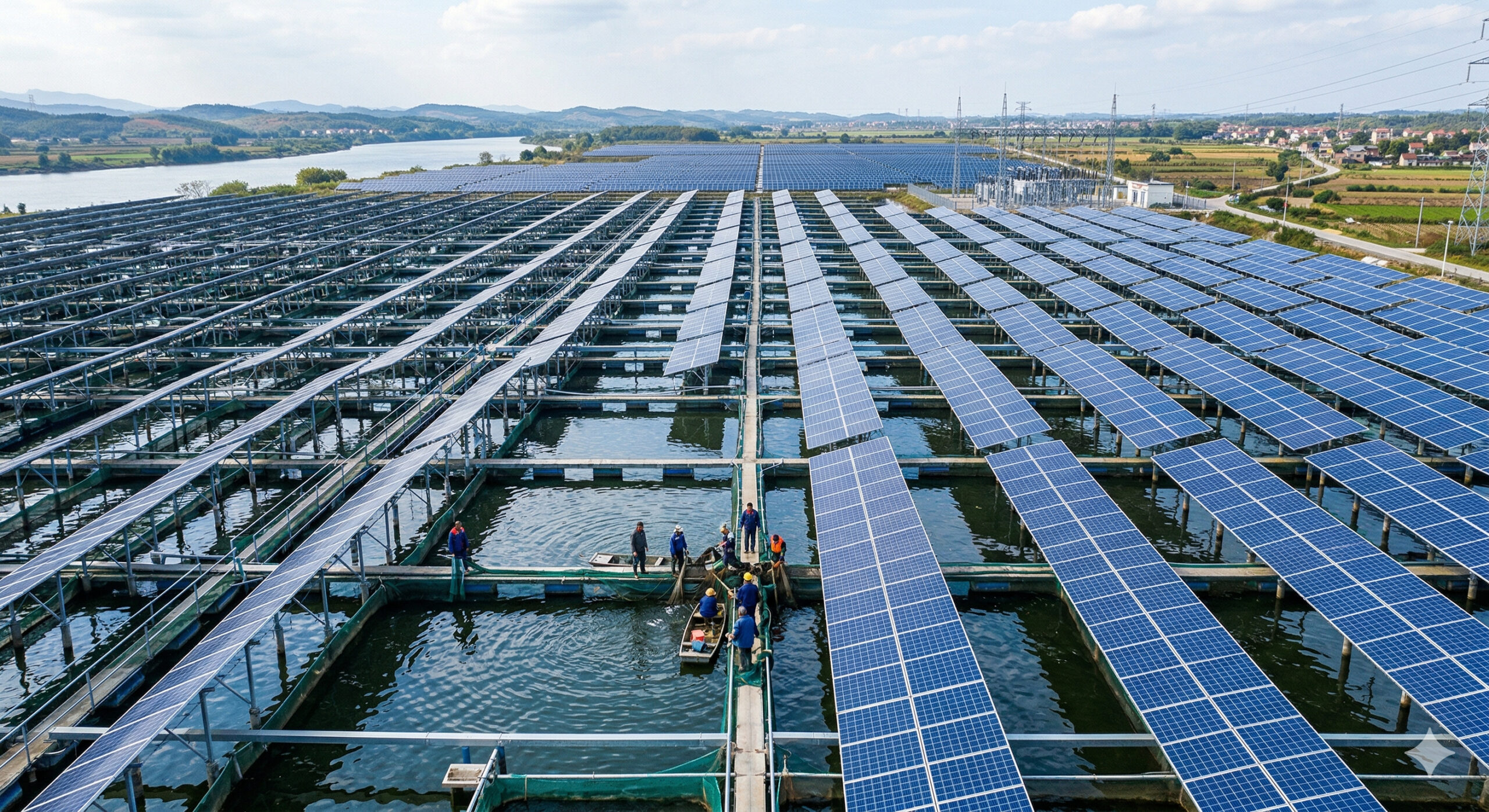
China bets on the Fishery-PV model and transforms fish farms into giant solar plants, covering ponds with panels that generate energy while utilizing the same space for large-scale aquaculture production.

In this context, therefore, the energy transition emerges as a response to a model that has lost economic and environmental sustainability. Moreover, the advancement of renewable energies, such as solar, wind, biomass, and hydroelectric, has begun to strengthen competitiveness, stimulate innovation, and enhance energy security. Consequently, these changes have started to directly impact the market value of companies.
ESG and the New Logic of Company Evaluation
In parallel, ESG criteria have established a new evaluation logic in the corporate market. First, the environmental pillar is directly connected to the energy transition, as it addresses emission reductions, the efficient use of natural resources, and investment in clean energy. Then, the social and governance aspects complement this agenda, reinforcing transparency, corporate responsibility, and risk management.
In recent years, for instance, institutional investors and investment funds have begun to prioritize companies with good performance in ESG. Thus, the market has started to associate these companies with lower exposure to regulatory, social, and reputational risks.
As a consequence, this perception reduces the perceived risk and strengthens stock valuations. Furthermore, companies that demonstrate a consistent commitment to clean energy and ESG practices begin to integrate into sustainable indices, attracting more stable and long-term capital.
At the same time, the alignment between energy transition and ESG strengthens corporate reputation. In an environment of greater transparency, therefore, companies that present concrete results build stronger relationships with investors, customers, suppliers, and local communities.
Clean Energy, Efficiency, and Generating Economic Value
In addition to reputational effects, the energy transition directly impacts the cost structure of companies. In particular, investment in energy efficiency and renewable sources reduces operational expenses in the medium and long term, especially in sectors with high energy consumption.
Similarly, long-term clean energy supply contracts increase cost predictability. As a result, companies reduce their exposure to the volatility of fossil fuel prices and external shocks. Consequently, financial planning becomes more efficient, and results gain greater stability.
Moreover, the adoption of clean energy also drives gains in productivity. As companies modernize their energy infrastructure and adopt more efficient technologies, they can optimize processes, reduce waste, and improve operational performance.
Another relevant point, therefore, concerns access to capital. Currently, banks, financial institutions, and investors are increasingly directing resources to projects aligned with a low-carbon economy. Thus, companies committed to the energy transition and ESG criteria can raise funds on more favorable terms and accelerate their growth plans.
Value Recovery and Sustainable Financing Strategies
In this sense, the energy transition also creates opportunities for companies that have lagged behind in relation to the environmental agenda. By implementing decarbonization policies and investing in clean energy, these companies gradually reduce the discrepancy between intrinsic value and market price.
This value recovery, however, is not based solely on future expectations. On the contrary, it results from concrete changes, such as reducing operational costs, accessing government incentives, and anticipating regulatory requirements, factors that reinforce investor confidence.
In practice, therefore, companies that benefit from the valuation associated with the energy transition can finance new projects through stock issuance. In this way, they reduce their dependence on debt and strengthen their capital structure.
Furthermore, by reinforcing equity, the company signals commitment to sustainable growth, innovation, and long-term value generation, which again enhances its attractiveness in the financial market.
Governance, Risks, and the Challenge of Greenwashing
Despite the advances, the relationship between energy transition and capital structure does not occur uniformly. In sectors such as energy, transportation, heavy industry, and agribusiness, for example, the challenges of technological adaptation are greater and require higher investments.
For this reason, corporate governance assumes an even more strategic role. Currently, the market requires that companies track environmental commitments and ESG goals with clear indicators, consistent reports, and audit processes. Thus, transparency becomes a competitive asset.
At the same time, the challenge of differentiating structural changes from superficial actions grows. Greenwashing, although it may yield short-term gains, undermines trust and tends to result in reputational and financial penalties in the long run.
Energy Transition and ESG as a Long-Term Strategy
In light of this scenario, the energy transition should be seen as a value generation strategy rather than just an environmental requirement. By aligning clean energy, operational efficiency, and ESG criteria, companies strengthen their competitive positioning and expand their resilience in the face of adverse scenarios.
In a global environment marked by climatic, regulatory, and social challenges, therefore, the ability to adapt becomes a decisive differential. Clean energy and the integration of ESG principles cease to represent point-in-time trends and consolidate as pillars of a more balanced economic model.
Thus, the energy transition redefines the market value of companies by connecting sustainability, innovation, governance, and financial performance. It is, therefore, a structural, continuous, and timeless change, capable of sustaining long-term results and guiding corporate decisions for many years.











Seja o primeiro a reagir!