





 English
  Francês
  Alemão
  Italiano
  Japonês
  Norueguês
  Portuguese
  Spanish
  2 min of reading


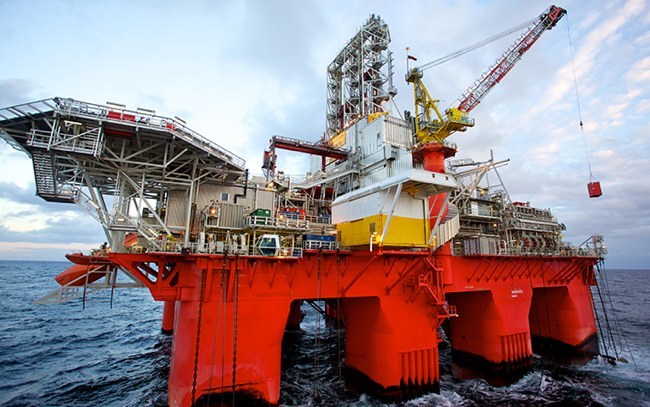
The Offshore Drilling Contractor Transocean Has Implemented What Is Said to Be the World’s First Hybrid Energy Storage System Aboard a Floating Drilling Unit. The System Is Now Operational on the Transocean Spitsbergen, Involved in Drilling Operations in the Snorre Field, Norway.
Transocean said on Wednesday that its patented hybrid power technology, developed in partnership with Aspin Kemp and Associates, reduces fuel consumption and increases the reliability of maintenance of a dynamically positioned platform by capturing energy generated during the platform’s normal operations that would otherwise be wasted and storing it in batteries.
See Also
- Transocean Accumulates US$ 158 Million in Contracts for 2 Semi-Submersibles and 3 Drill Ships
- Transocean Gains More Work with Petrobras and Other Companies, Adding US$ 373 Million in New Contracts
- Former Schahin Drill Ship to Be Scrapped by Transocean
This energy is then used to power the platform’s thrusters. This significant operational and safety enhancement aims for a 14% reduction in fuel usage during normal operations, leading to a significant reduction in NOx and CO2 emissions, according to the platform’s owner.
Transocean’s investment is partially funded through fuel-saving incentives under its contract with Equinor and the Norwegian NOx Fund.
-
Government unlocks R$ 554 million for a highway that has been requested for decades and accelerates the duplication of BR.
-
Without bricks, without cement, and without endless construction: the cardboard house that is assembled in modules and can be moved.

-
Billions of barrels on the equatorial margin could lead Amapá to double its oil production in Brazil — the state aims to enter the route of companies in the Campos Basin, attract investments, and boost jobs and businesses in the oil and gas sector.

-
Without bricks, without cement, and without endless construction: the cardboard house that is assembled in modules and can be moved.

“This first hybrid energy upgrade will further enhance the reliability of our operations, while simultaneously reducing fuel consumption, operational costs, and our environmental footprint”, said Jeremy Thigpen, President and CEO.
“We are pleased and proud to work together with Equinor to identify and jointly implement more efficient and sustainable technologies to provide high-value wells to the sector”.
It is worth noting that Siemens said last December it would provide a battery energy storage solution for the semi-submersible West Mira and transform it into “the world’s first hybrid offshore drilling platform”.
Siemens stated that BlueVault, the company’s advanced lithium-ion battery-based solution, would be installed on Northern Drilling’s offshore drilling platform West Mira, which is set to operate in the Nova Field, approximately 120 kilometers northwest of Bergen, in the North Sea.
Additionally, last May, Maersk Drilling would convert its Maersk Intrepid jack-up into a hybrid platform. The jack-up underwent a series of upgrades to convert it into a hybrid platform with low NOx emission levels, adding data intelligence to further reduce energy consumption and CO2 emissions.
The Maersk Intrepid, in September, signed an extension with Equinor for more work in the Martin Linge field. During the contract period, Maersk Drilling said it would complete the series of upgrades on the Maersk Intrepid to transform it into low-emission hybrid equipment.








Seja o primeiro a reagir!