





 Portuguese
  English
  Spanish
  3 min of reading
  0 comments


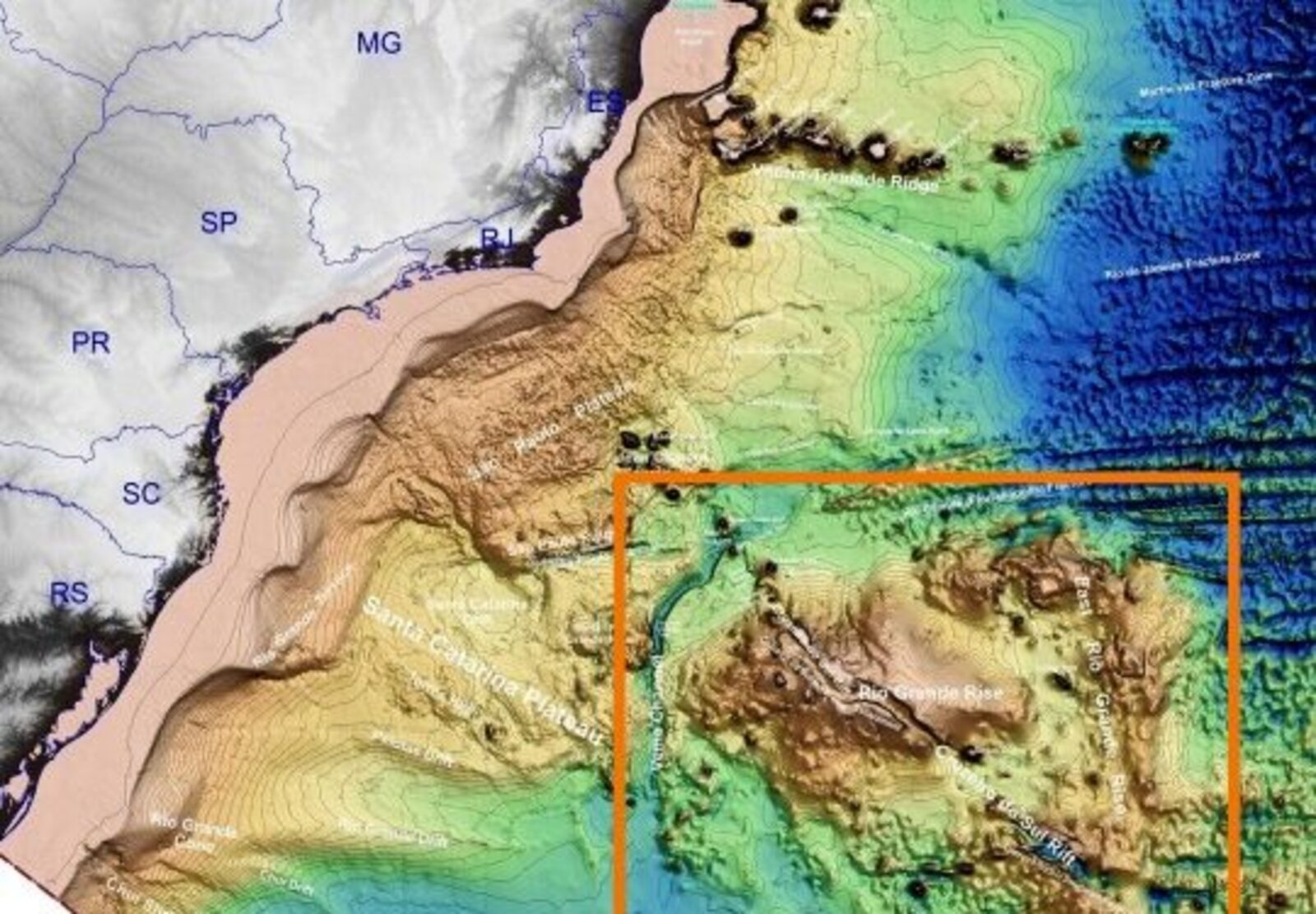
Study on the Elevation of the Rio Grande indicates that the submerged formation was once a tropical island and is now in the dispute for critical minerals
The Elevation of the Rio Grande, in the South Atlantic, about 1,200 kilometers off the southeastern coast of Brazil, has been confirmed as an ancient tropical island and has become the center of a dispute over critical minerals, a topic that involves batteries, territorial rights, deep-sea mining, and environmental impacts.
Red clay confirms past above sea level
The confirmation came from the red clay taken from the seabed, a material that could only have formed after long exposure to air and rain.
Today submerged at a depth of 650 meters, the Elevation of the Rio Grande remained above sea level for millions of years.
-
Specialists are urging residents to eat as many wild blackberries as they can because the invasive plant is destroying native species and causing billions of dollars in damages in the United States.

-
At 93 years old, Mr. Francisco completes a 5 km run, is cheered as he crosses the finish line, moves the city, and gives an emotional lesson in strength, discipline, and the will to live.

-
With 96 rooms, 37 bathrooms, and five kitchens, the mansion of the heir to Pernambucanas is worth R$ 50 million, featuring a pool and two terraces.
-
An old error in the property registry may force a resident to demolish the kitchen and bathroom and also incur expenses to rebuild everything.


The most decisive data is in the chemical weathering index of the clay, which is 93 out of 100. Such a level does not form underwater or through transport from distant continents.
It arises when volcanic rock decomposes over long periods in a warm and humid environment.
Expeditions gathered samples and minerals
The research was published in the journal Scientific Reports in November 2023.
The work brought together the University of São Paulo and the National Oceanography Centre of the United Kingdom, with deep-sea expeditions conducted aboard the RRS Discovery and the Brazilian ship Alpha Crucis.
On these trips, scientists collected samples of reddish-brown clay among horizontal lava flows.
These flows date back to the Eocene, approximately 44 million years ago, reinforcing that the ancient tropical island existed in a distant past before disappearing beneath the ocean.
The clay found between the layers contains kaolinite, hematite, and goethite. These minerals form through intense chemical weathering in tropical conditions.
Luigi Jovane from the University of São Paulo stated that the position and mineral composition confirm formation in situ.
Dispute over critical minerals hurdles in regulations
The discovery reinforced a dispute over critical minerals linked to electric vehicle batteries. At the same time, it opened a legal battle.
The Elevation of the Rio Grande is in international waters under the jurisdiction of the International Seabed Authority, a United Nations body responsible for regulating deep-sea mining.
To obtain territorial rights, Brazil needs to demonstrate that the area is a natural extension of its continental shelf, and not an independent geological formation.
The request is expected to take years to be analyzed by the ISA and the United Nations.
Environmental impact enters the center of the debate
The ISA requires extensive environmental impact studies before approving any deep-sea mining operations.
Brazil has already begun these assessments, but there is concern among researchers because deep-sea ecosystems are still poorly understood.
Jovane warned that it is necessary to know how extraction will affect animals, fungi, and corals.
Scientists are dealing with ancient marine systems, developed in isolation for millions of years, and haste in exploration could impact habitats that have never been studied.
From tropical island to the bottom of the South Atlantic
At its peak, during the Eocene, the ancient tropical island likely reached between 180 and 2,000 meters above sea level.
Then, tectonic subsidence slowly pushed it beneath the waves, until it was covered by marine sediments and volcanic ash.
Now, the same red clay that proved the existence of this tropical island occupies a central position in an international debate about critical minerals, environmental protection, and the future of green energy supply chains in the world.
With information from Daily Galaxy.






Seja o primeiro a reagir!