





 Portuguese
  English
  Spanish
  6 min of reading
  0 comments


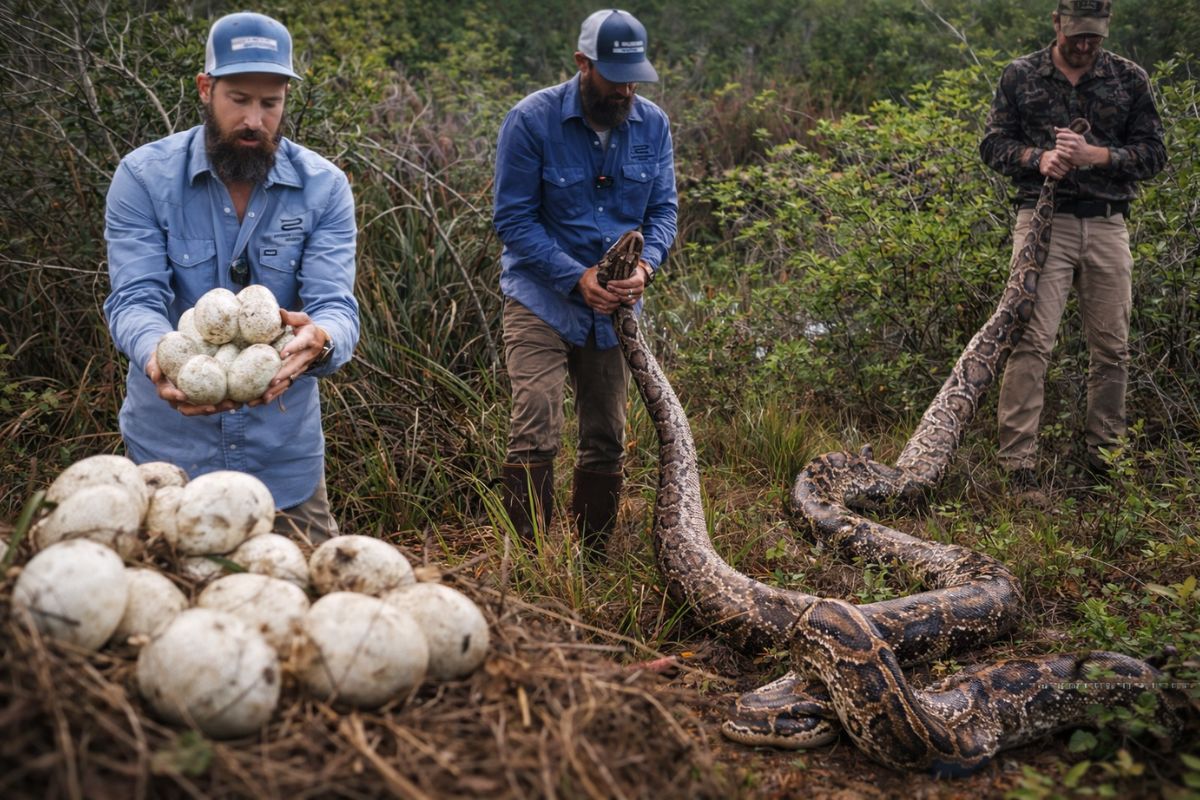
In A Single Island, Field Teams Located Three Active Nests And Four Pythons Hidden In Dense Vegetation In The Everglades. The Rare Pattern Includes Overlapping Nests And Signs Of Ongoing Laying. The Hypothesis Is That The Drought May Have Adjusted Reproductive Timing And Extended The Challenge For Native Wildlife.
The invasive pythons have returned to the center of environmental debate in Florida after a finding that combines three hard-to-ignore elements: concentration, reproduction, and camouflage. On a single island, three active nests and four animals were identified hidden in dense vegetation, a set that reinforces the potential for expansion even under continuous control actions.
The episode also exposes a layer little discussed outside the technical field: it’s not enough to locate a python; it’s necessary to locate the nest, because that is where population growth multiplies without attracting attention. When there are signs of ongoing laying and reuse of old areas, the risk ceases to be isolated and begins to resemble a pattern.
An Island Known As Bear Island, Several Nests: Why Does This Type Of Finding Change The Diagnosis

Finding pythons is not, by itself, a novelty in regions where the species has already established itself as invasive.
-
Mr. Mário reveals the technique of the caipira papaya: he cuts the fruit in half, discards the seeds from the tip, and plants the ones from the back to increase the chance of a productive female tree.

-
Few remember, but the submarine that disappeared in 1968 with 52 crew members was found after 51 years at the bottom of the sea at more than 2,000 meters, intriguing the entire world.

-
With 1,200 tons suspended, the Japan mega-structure in a grid shape with a floating sphere from Fuji TV features two 25-story towers connected by elevated walkways, titanium panels, and impresses the world with its ability to reduce wind impact.

-
The village where two rivers run side by side without mixing in Santarém and Alter do Chão reveals some of the most beautiful freshwater beaches on the planet.

What makes this case especially sensitive is the combination of numbers: three active nests in the same and four animals in the immediate surrounding area, suggesting that that island functioned as a reproductive “hotspot,” rather than an isolated encounter.
In terms of invasion dynamics, the nest is the indicator that really matters. An adult animal can circulate and disappear for weeks, but an active nest represents a concentrated bet on reproduction, with potential impacts on native wildlife.
When the same area hosts more than one nest, the reading is of environmental efficiency: the microhabitat offers protection, stability, and enough conditions to sustain the reproductive cycle.
Overlapping Nests And Old Eggs: What The Repetition Of “Addresses” Suggests

A relevant detail of the finding is the presence of overlapping nests and signs of a “history” of nesting, with mention of old eggs at the same location.
This points to the reuse of areas where reproduction may have been successful in the past, a strategy that, from an ecological standpoint, saves energy and reduces exposure: instead of seeking a new and uncertain place, the female returns to a tested point.
This repetition of addresses creates an operational problem for any control plan. If certain microenvironments become preferred, they begin to require recurring monitoring, because the location ceases to be merely “where an event occurred” and becomes “where events tend to happen.”
When the nest rests upon a previous nest, the environment becomes layers of risk, which increases the chance of new lays in the same season.
Drought And Reproductive Window: How Climate Can Favor Pythons

In the field, the study raised the possibility that drought may have contributed to the observed reproductive behavior.
The hypothesis is that drier conditions favor a “window” for nesting, allowing pythons to wait for the most appropriate moment to lay and choose more stable shelters, especially in areas where water and humidity variation quickly alters the level of exposure.
Climate doesn’t explain everything, but it can adjust the reproductive clock. In environments with dense vegetation and islands of grass, small changes in the microclimate alter the availability of hiding places, thermal comfort, and predictability of the location.
If the dry season reduces flooding and increases land stability, the likelihood of the female remaining in the same spot for longer grows, decreasing movements and, consequently, the chance of detection.
Tracking In Dense Vegetation: Why Locating Pythons Is More Difficult Than It Seems

The technical difficulty is not just in “finding a big snake.” The challenge is that pythons can remain practically invisible in tall grasses, holes, and natural structures, even just a few meters from a trail. This makes human detection limited, especially on islands with dense grass, where visibility is short and any movement can be silent.
In this context, the use of trained dogs appears as a key element: the team cited a dog, Otto, as responsible for signaling the presence of hidden animals and facilitating findings that could otherwise go unnoticed.
The strategic point is simple: tracking does not depend only on luck, it depends on method. And, when the goal is to locate nests, the method needs to be repeatable and continuous, because the window of opportunity can be short.
The Size And Maturity Of The Animals: What This Indicates About The Stage Of The Invasion
Among the pythons found, a considerably larger specimen was described, estimated to be about 4.5 meters long, with an approximate age of 14 years.
Even with estimates always subject to a margin of error, this type of record is important because it suggests prolonged presence and reproductive maturity; that is, these are not just newly arrived individuals, but animals capable of sustaining reproduction cycles over time.
There is still a critical point: one of the snakes was treated as “still full of eggs,” a sign that laying might not have been completed.
This changes the weight of the finding, because it indicates that the location was not just a “completed nest,” but an ongoing reproductive scenario, with potential to generate new nests in the same area. In terms of control, this amplifies the urgency: when laying is underway, each day can represent a silent advance of the problem.
Recovery Of Native Wildlife And The Limit Of Effort: Why The War Continues
The field team reported signs of recovery of native wildlife in areas where searching and removal are constant, suggesting that persistent actions may yield local effects. But the very scale of the Everglades imposes a ceiling: islands, channels, and dense vegetation create a huge mosaic, in which monitoring “everything, all the time” is practically impossible.
It is here that the finding of three nests and four pythons on the same island gains symbolic and practical weight. It serves as a reminder that progress is not linear: even with success in some areas, others may be accumulating reproduction without being noticed.
The invasion sustains itself on what is not seen — and, when what appears already comes in a group, the chance of there being more, in other points, ceases to be a distant hypothesis and becomes a plausible concern.
The encounter of three active nests and four pythons on a single island reveals a dilemma: controlling individuals is important, but controlling reproduction is decisive.
Among overlapping nests, reuse of old areas, and the possible influence of drought on reproductive timing, the scenario reinforces that the problem is resilient and adaptable; and that each season can reopen the dispute on new terms.
In your opinion, what is the most realistic measure when an invasive species is already established — intensify control, focus on preventing new outbreaks, or invest heavily in continuous monitoring? And have you seen, in your region, any case where an “environmental problem” was only taken seriously when it started affecting people’s routines?







-

-

-

-

-

-

34 pessoas reagiram a isso.