





 Portuguese
  English
  Spanish
  6 min of reading
  2 comments


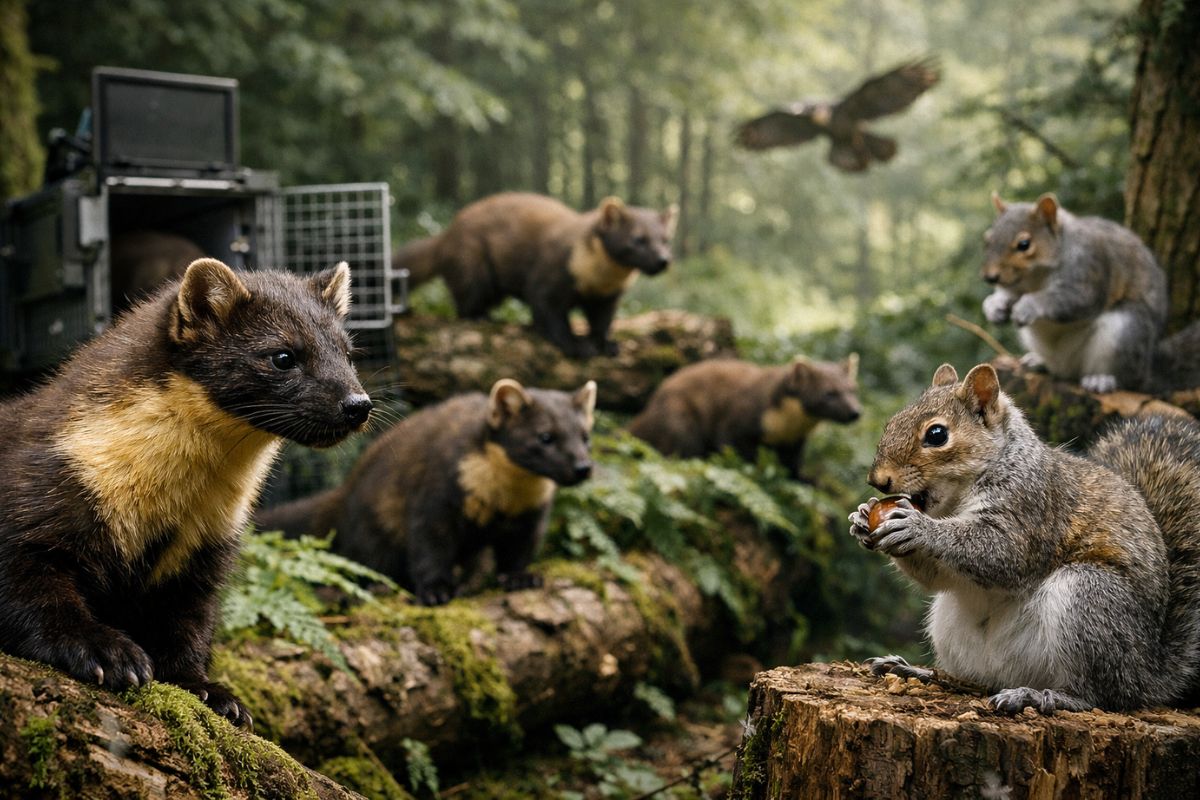


British Wildlife Gains New Chapter in Cumbria with 13 Pine Martens from Scotland Reintroduced in Grizedale and the Rusland Valley to Form a Viable Population, Restore Forest Ecosystems, and Favor Native Red Squirrel
Wildlife in Northwest England has once again recorded a predator that disappeared from the region in the late 19th century: thirteen pine martens have been released in the Lake District, in Cumbria, returning to the forests where they were once common and reactivating an ecological balance interrupted for over a century.
The reintroduction involves eight females and five males transferred from established populations in Scotland, now living in areas like Grizedale Forest and the Rusland Valley, with monitoring to understand how they move, hunt, choose shelters, and begin to form a stable population in the landscape of Cumbria.
Where the Pine Martens Were Released and How They Integrate into the Landscape

The thirteen pine martens were reintroduced in 2024 in the Lake District, in Cumbria, in Northwest England.
-
Something is happening around the Earth: Inside the huge explosion of fireballs in 2026

-
A hot air bubble coming from Argentina expands over Brazil, causing thermometers to exceed 38 degrees with a thermal sensation of 40 degrees in late March, affecting 6 states at once.

-
The radish leaf that almost everyone throws away has more polyphenols, flavonoids, and fiber than the consumed root, and a 2025 study showed that the leaf contains compounds that protect the intestine, combat inflammation, and may inhibit the growth of cancer cells.

-
A planet that seemed to defy the laws of physics has intrigued scientists for decades, until the James Webb revealed what is really affecting Saturn’s rotation.


The release was concentrated in two forest areas identified as key points: Grizedale Forest and the Rusland Valley.
These areas function as natural corridors and refuges, providing vegetation cover, shelter locations, and routes for nocturnal movement.
The return of the species is not treated as a one-time event but as the beginning of a continuous presence.
The expectation is that the pine martens will start to roam woodlands, forest edges, and different habitat patches, gradually occupying a territory that had been without this predator for over a century.
What Are Pine Martens and Why Do They Attract So Much Attention

The pine marten is a mammal with a long, slender body, brown-chocolate fur, and a light-yellow patch around the throat.
In size, it is similar to a small domestic cat: measuring between 60 and 70 cm and weighing up to 2 kg.
It is related to other mustelids, such as badgers and otters, and is described as ecologically important for playing the role of a mesopredator.
This means it regulates smaller populations and helps maintain the functioning of the forest ecosystem without necessarily being at the absolute top of the food chain.
Pine martens are primarily nocturnal, hunting from dusk until dawn.
This discreet routine, combined with agility and the ability to climb and move in dense environments, makes the species difficult to see but very influential in the balance of local wildlife.
Diet, Behavior, and Why They “Sew” the Forest from Within


Pine martens are described as omnivorous and opportunistic, consuming whatever is seasonally abundant. This includes small mammals, insects, fungi, wild fruits, small birds, eggs, and carrion.
This broad diet is central to understanding why the species is seen as a reinforcement of food chains.
By alternating between different food sources throughout the year, the pine marten adapts to what the forest provides and maintains constant predatory pressure on certain prey, as well as contributing to ecological cleanup when consuming carrion.
In broadleaf woodlands and coniferous forests, it feels equally at home, which is relevant because the Lake District features varied forest landscapes.
This increases the chance of the species using multiple environments, expanding its range.
Why They Disappeared from Cumbria and Why the Return Is Historic
The pine marten was common in Cumbria until the late 19th century but became locally extinct due to deliberate eradication and habitat loss.
For decades, the region functioned without this predator, which alters the balance of prey and competitors within the ecosystem.
In 2022, a pine marten was recorded by camera trap in southern Cumbria, showing that natural recolonization was occurring, albeit slowly.
The current movement accelerates this process, placing enough individuals back into the landscape to increase the chance of reproduction and formation of a viable population.
The Most Anticipated Effect: Pressure on Invasive Grey Squirrels
One of the central points of the return of pine martens is the impact on squirrels.
The species is one of the few agile animals capable of hunting squirrels, and while it may feed on both red and grey squirrels, the material highlights that the primary target tends to be the grey squirrel.
Grey squirrels are non-native to the UK and were introduced in the 19th century from North America.
They spread into the northern parts of the country, competing with red squirrels for food and carrying the squirrel pox virus, which is harmless to greys but fatal to reds.
In practice, the presence of pine martens creates a predatory pressure that may reduce the advantage of the grey squirrel, helping to rebalance a competition that, without effective predators, tends to favor the invader.
How This May Favor the Native Red Squirrel
In Cumbria, researchers believe that as the number of pine martens increases, the local red squirrel population, currently in decline, may benefit.
The expected mechanism is indirect: with more pine martens in the forest, the pressure on grey squirrels increases and, consequently, the red squirrel gains space and reduces exposure to a dynamics dominated by the invader.
This type of effect is called an ecological cascade: a change at one level of the food chain causes impacts at other levels, altering the structure of the ecosystem.
How the Pine Martens Will Be Monitored on a Day-to-Day Basis
The released pine martens were monitored by academic and veterinary teams, as well as volunteers and students.
The monitoring includes radiotelemetry to track movements and remote camera traps to check for presence, behavior, and activity patterns.
This monitoring aims to answer practical and decisive questions: where the pine martens move after release, how they choose resting areas, what routes they use to cross the landscape, how they react to more open areas, and how they explore dense forests.
Additionally, a network of den boxes has been installed throughout the region, providing safe locations for shelter and reproduction in the upcoming spring.
These shelters play a crucial role because the reproduction and survival of offspring are direct indicators that the reintroduction is solidifying.
Why Eight Females and Five Males Matter in the Goal of Creating a Stable Population
The composition of the released group, with eight females and five males, is an important detail because a viable population depends on consistent reproduction over the years.
Without a sufficient reproductive base, the presence of pine martens could remain fragile or disappear again.
The expectation of reinforcing the species’ presence includes a second release in 2025, aiming to reach around 30 translocated animals in total. This increases the chances of diversity, territorial occupation, and the creation of a more resilient population base.
A Discreet Species but Capable of Reorganizing Regional Wildlife
Pine martens are discreet, nocturnal, and rare to see, but their effect does not depend on visibility.
The impact occurs when they settle, hunt, reproduce, and return to play an ecological role that has been absent since the 19th century.
The return in the Lake District is portrayed as a concrete step toward rebuilding forest functionality, strengthening food chains and altering the balance between native and invasive species in Cumbria.
In your opinion, can the return of pine martens to the Lake District become the strongest example of wildlife recovery in the UK, or is it still too early to bet that they will establish themselves for good?







Ingleses e seu hábito exótico de carregar animais de um continente para outro!
Achei interessante essa medida e aposto muito nos resultados esperados.