





 Portuguese
  English
  Spanish
  4 min of reading
  0 comments


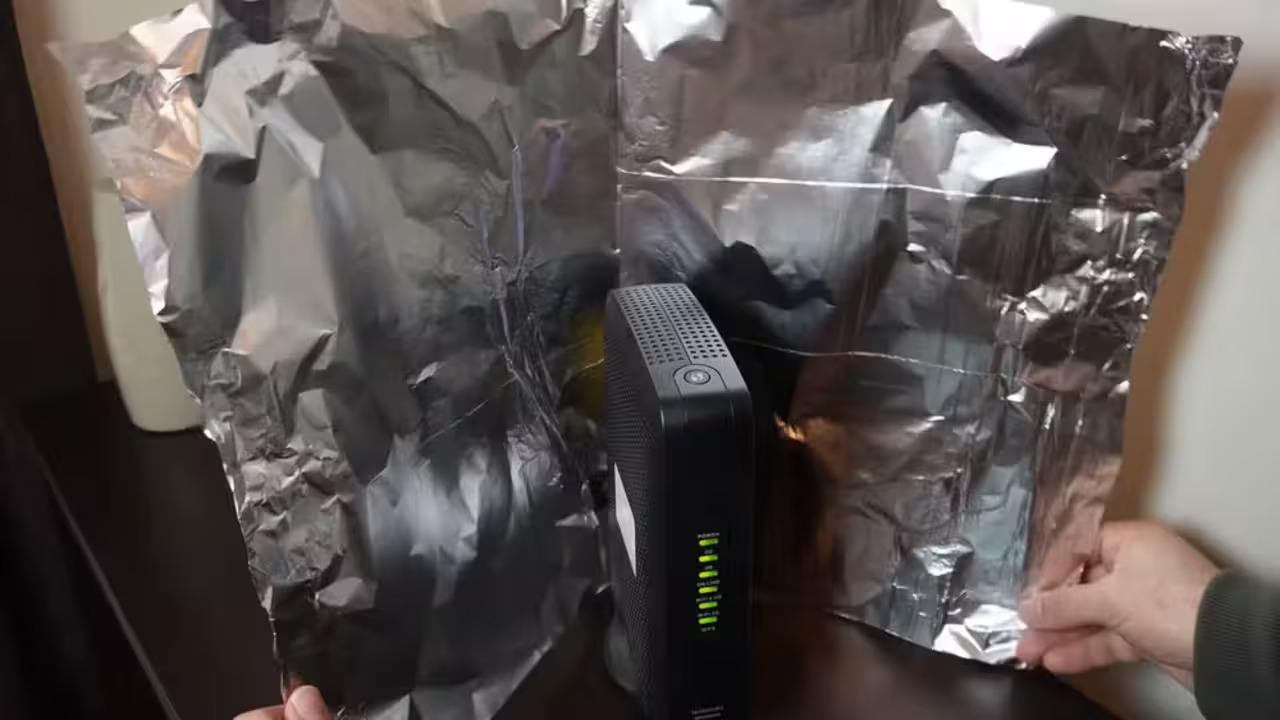
Trick With Aluminum Foil Can Improve Wi-Fi Signal in Some Areas of the House, But Does Not Replace More Effective Solutions
In the search for better internet at home, many people try quick and cheap solutions. One of the most popular tricks is to use aluminum foil to improve Wi-Fi signal. The idea is simple: shape the foil and place it behind the router, as if it were an antenna. But does this hack really work?
How Aluminum Foil Could Help
Aluminum foil has conductive and reflective properties. This means it can redirect the radio waves that make up the Wi-Fi signal.
These waves spread through the air and can suffer interference from obstacles like walls or appliances.
-
These living root bridges and ladders are over 700 years old and help indigenous people survive in one of the rainiest regions in the world.

-
From sertanejo star to international investor: Ana Castela invests millions in a mansion in the USA, creates a themed accommodation in Orlando, and shows that the “boiadeira” also wants to grow away from the stage.

-
The 10 most stunning motorhomes in the world: a $3 million trailer with a rooftop nightclub and garage for a Ferrari, “palaces on wheels” with Italian marble, private cinema, and five-star hotel luxury for billionaires.

-
Trump wanted to spend $400 million on the White House, but the courts prohibited the million-dollar construction.


By placing the aluminum foil strategically, it acts as a kind of directional antenna. Instead of letting the signal spread out in all directions, the idea is to concentrate it in one spot. This way, it would be possible to enhance the connection in a specific area of the house.
What Studies Say
Some websites claim that the technique has been scientifically proven. They cite a study from Dartmouth College that indeed mentions the use of metallic materials to improve signal.
But there’s an important detail: the scientists used supports made with 3D printers, with well-defined shapes and coated with aluminum sheets. It wasn’t just a common piece of aluminum foil shaped by hand.
Even so, this doesn’t totally invalidate the homemade trick. It may not have the same effect as a lab-made solution, but it can still have some impact. This is what TechTudo decided to test.
Practical Tests at Home
To test it, a piece of aluminum foil measuring 30 cm by 30 cm was used. It was shaped into a “U” and placed behind the router. The open direction of the “U” was aimed toward the area where the signal was to be improved.
In the bedroom, about 4 meters from the router, the signal without aluminum foil was −48 dBm. With the trick, it went to −43 dBm.
This shows a small improvement, between 2 and 5 points. This variation is not considered a drastic change in connection, but it’s an indication that the trick may have some effect.
The test was repeated on the balcony, 15 meters from the router. Without the foil, the signal was −98 dBm. With it, it improved to −85 dBm.
In other words, a considerable improvement. Even with fluctuations over time, the numbers indicate that aluminum foil helped.
Speed: Does It Improve or Not?
Signal strength is one factor, but what many people really want to know is: does speed improve? This is what TechTudo tried to verify using the same testing app.
In the download speed tests, the results were mixed. Sometimes, the internet was faster with aluminum foil. Other times, it wasn’t.
Upload showed a clearer pattern: in almost all tests, the speed was better with the foil. This is expected since the upload channel usually experiences less interference and congestion.
In one test, the download speed even dropped with the aluminum foil, but the upload speed increased significantly.
Therefore, the trick may be useful in situations where sending files is more important than receiving, such as during video calls.
Conclusion of the Tests
At the end of the day, aluminum foil does not work miracles. It won’t turn a bad connection into an excellent one. But it can, yes, help a little.
Especially to improve strength in specific areas of the house or upload performance.
It’s important to remember that the results were obtained with a common router, in a residential environment, using a free app.
In other words, there is room for variations and inaccuracies. Still, the tests showed that the technique is not entirely useless.
Other Ways to Improve Wi-Fi
If the idea is to truly improve Wi-Fi quality, there are other, more efficient options. The main one is to position the router in a central location in the house. This helps distribute the signal better.
Avoiding metallic objects or mirrors near the router also makes a difference. These items deflect waves and can create “dead zones” in the house.
Another alternative is to invest in a signal repeater. It picks up the Wi-Fi from the router and amplifies coverage. This is what was done in the back house, with satisfactory results.
It’s also worth considering changing the router’s transmission channel if there is a lot of interference from neighbors.
And, of course, check if anyone is using your internet without permission. As a last resort, buying a more powerful router can solve the problems.
Aluminum Foil Helps, But Does Not Solve Everything
The aluminum foil trick can be fun and might even boost the connection a bit. But it does not replace structural solutions.
It serves as a temporary measure and can improve the signal in specific spots. For a definitive solution, it’s better to invest in equipment or reevaluate the router’s position.
With information from Tech Tudo.







Seja o primeiro a reagir!