





 Portuguese
  English
  Spanish
  8 min of reading
  2 comments


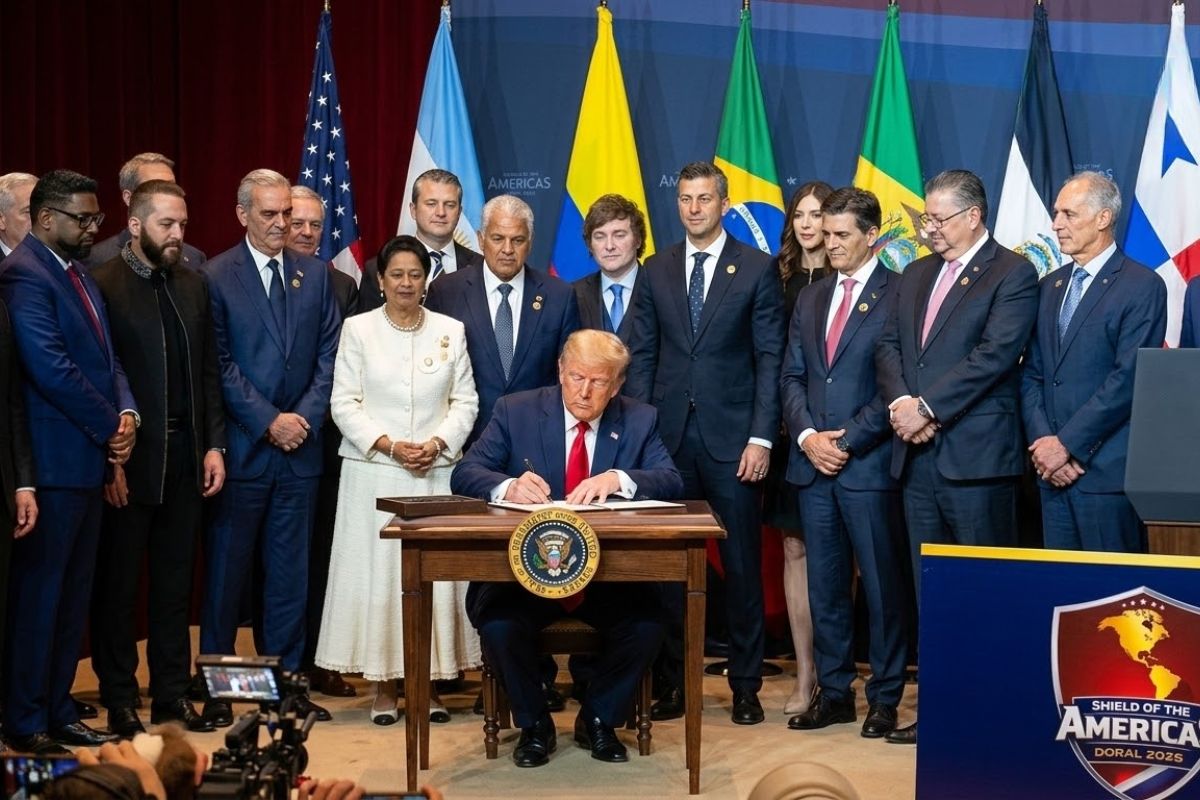


The Alliance Launched by Donald Trump at a Golf Club in Florida Gathered Latin American Leaders Under the Speech of Fighting Cartels, but the Meeting Went Beyond Security, Exposed Ideological Affinities, Expanded Messages to Regional Adversaries, and Reinforced the Geopolitical Weight of the American Agenda in the Americas.
The new alliance presented by Donald Trump in Florida was designed as a harsh response to the advance of cartels in the Americas, but the meeting quickly took on a broader meaning. By bringing together leaders from 17 countries in a symbolic power setting, the President of the United States transformed a security agenda into a public display of regional influence.
The event, dubbed the “Shield of the Americas,” was not limited to the launch of a coalition. Alongside figures such as Javier Milei, Nayib Bukele, José Antonio Kast, Daniel Noboa, and Nasry Asfura, Trump built a political stage to advocate for a more aggressive approach to organized crime, while at the same time sending signals about the role Washington intends to occupy once again on the continent.
The Summit in Florida and the New Power Design in the Americas
Held in Miami, Florida, the meeting brought together leaders from Central America, South America, and the Caribbean around an officially common goal: to confront drug cartels and transnational networks that, according to Trump, have begun to control parts of the territory of countries in the Western Hemisphere. The choice of location was not neutral. A golf club linked to Trump’s personal and political image helped reinforce the idea of command, centralization, and American prominence.
-
Elderly individuals aged 65 or older who have never contributed to the INSS can receive R$ 1,621 per month in 2026 without having paid any contributions in their lifetime: learn how the benefit works that already supports nearly 7 million Brazilians.

-
The gaucho city reduced the number of Bolsa Família beneficiaries by almost 40% in just a year and a half with active outreach that connects each registered person directly to job vacancies in Bento Gonçalves in Rio Grande do Sul.
-
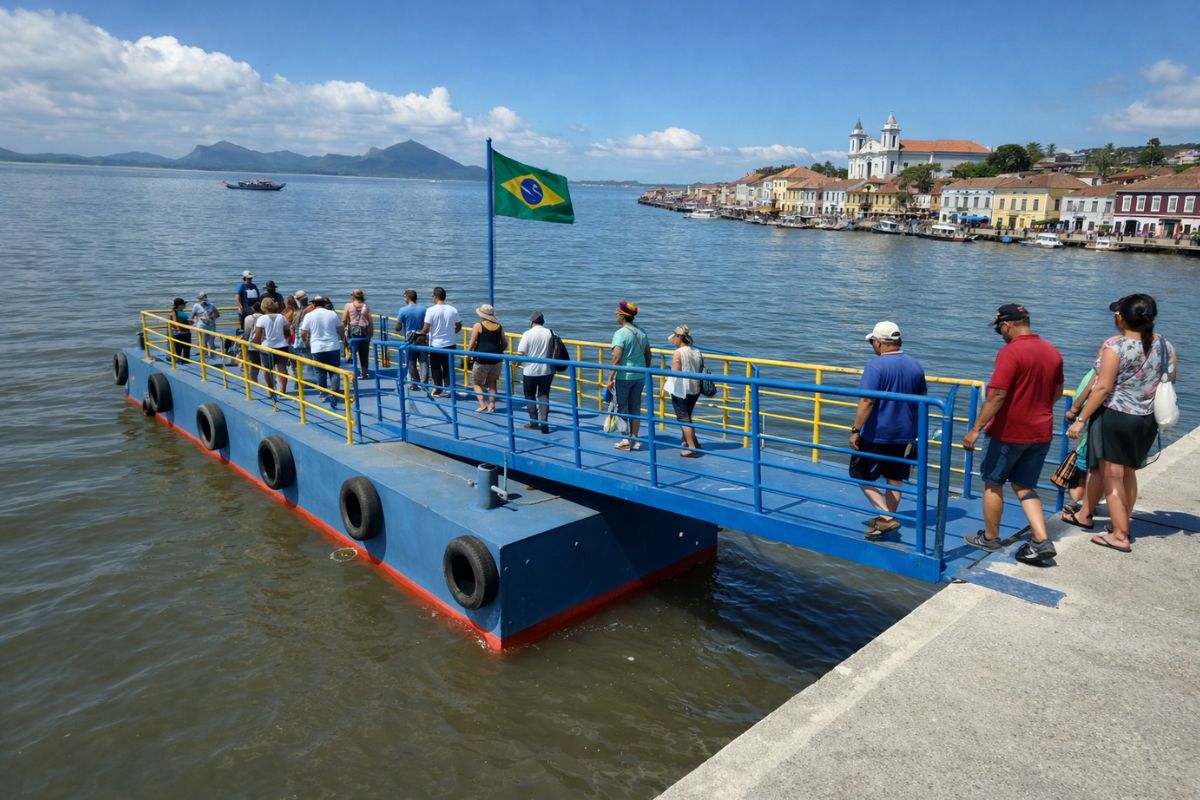
The bluest city in Brazil has just gained a new floating bridge for the free crossing between the island and the mainland, connecting residents and visitors to the historic center of São Francisco do Sul every day of the week.
-
In a silent race, Shopee signs a mega contract in Guarulhos and accelerates the e-commerce war with faster deliveries, pressured shipping, and a new threat to rivals in Brazil.


By signing the proclamation that launched the coalition, Trump sought to present the United States as the center of a new regional security architecture. The gesture was calculated to demonstrate leadership at a time of broader international tension and, at the same time, to bring together Latin American governments that share a vision of tougher penalties, accelerated repression of crime, and a strong association between internal security, territorial control, and political stability.
The Speech Against the Cartels and Trump’s Forceful Rhetoric
During more than 30 minutes of speech, Trump presented the cartels as the main justification for deepening U.S. involvement in Latin America. The central message was clear: Washington would no longer tolerate transnational gangs consolidating territorial control in countries in the region. This framing placed drug trafficking at the center of a narrative of sovereignty, order, and strategic intervention.
The tone adopted, however, went well beyond traditional diplomatic cooperation. Trump even suggested that the United States might use missiles against cartel leaders if regional partners requested such actions.
The statement elevated the level of rhetoric and gave the meeting an overtly coercive character. Instead of emphasizing gradual mechanisms of coordination, intelligence, or prevention, the summit began to convey the image of a high-impact offensive, based on intimidation and projected force.
Milei, Bukele, and the Formation of a Hardline Political Block
The presence of Javier Milei and Nayib Bukele on stage gave ideological contour to the meeting. They were not just prominent guests at an international summit. The two acted as symbols of a political current that has gained ground in the region and advocates for rapid, centralized, and punitive responses to security crises, governance issues, and social disorder. The alliance, in this sense, was not just operational; it was also political.
Bukele emerged as a particularly important reference in this arrangement. His crackdown on gangs in El Salvador, despite criticism from human rights groups, has become a model admired by segments of the Latin American right. Meanwhile, Milei reinforced the association between economic liberalism, tough stances against crime, and alignment with Washington. The composition of the stage showed that Trump was not just seeking institutional partners, but leaders capable of publicly embodying a regional shift to the right.
Public Security, Organized Crime, and the Expansion of the Role of the United States
In defending the coalition, Trump made it clear that he does not see the issue of drug trafficking as an isolated police or border matter. In the logic he presented, the growth of the cartels would justify a more active American presence throughout the region, allowing for diplomatic pressure, military articulation, and direct accountability from local governments. This expands the scope of the security agenda and repositions the United States as a central actor in regional decision-making.
The case of Venezuela was treated as part of this same movement. Trump referenced the pressure campaign against the country and associated this escalation with the arrest of Nicolás Maduro in January. By including this episode in the context of the meeting, he signaled that the war against the cartels, in his political formulation, intertwines with the competition for influence, the containment of hostile governments, and the attempt to redefine power balances on the continent.
Mexico, Cuba, and Verbal Pressure on Sensitive Points in the Continent
Trump pointed to Mexico as the center of cartel activity, which helps to understand why the drug trafficking agenda was used as the focal point of the meeting. The country occupies a strategic position both because of the magnitude of its routes and its proximity to American territory. By highlighting it in this way, the U.S. president sought to give a concrete focus to the alliance, indicating where Washington perceives the greatest urgency and risk.
Cuba also entered the radar of the speech, but in another register. Trump stated that the country was “practically at the end of the line” and again mentioned negotiations involving Cuban authorities, himself, and Marco Rubio. By doing so, the summit was no longer just a meeting about cartels but became a space for sending messages about governments considered problematic, repositioning the security debate within a broader regional pressure agenda.
A Meeting on Drug Trafficking That Became a Geopolitical Message
Even though the official speech focused on combating organized crime, Trump addressed topics that broadly exceeded this focus. Iran, Ukraine, Pakistan, India, Dominican sugar, shipbuilding, American domestic politics, and even personal remarks about present leaders emerged in the address. This thematic dispersion was not casual. It helped to show that the summit served as a stage for a more ambitious repositioning of the United States.
By doing this, Trump linked the Latin American meeting to a tense international scenario. The war with Iran, mentioned in the same context, reinforced the attempt to project authority on multiple fronts simultaneously. The meeting, therefore, functioned as a piece of multi-layered foreign policy: combating drug trafficking, demonstrating regional strength, aligning with ideologically similar governments, and reaffirming Washington’s role amid broader global disputes.
The Symbolic Dimension of the Speeches and the Diplomatic Impact of the Adopted Tone
Trump’s remarks about language and Latin American leaders also carried their own political weight. By joking that he didn’t have time to learn the language of those present, mostly Spanish speakers, the president marked a cultural distance precisely in a meeting that aimed to promote strategic proximity. This contrast between formal cooperation and verbal disdain helps to understand the asymmetric nature of the proposed alliance.
Comments from Pete Hegseth and jokes involving names of present authorities reinforced an environment where diplomacy appeared subordinated to a confrontational political style. This may enhance Trump’s image among allies who value assertiveness, but it also exposes an important aspect of the summit: the partnership offered is not based on full political equality, but on adherence to a defined agenda verbally dominated by Washington.
The Turn to the Right and the Consolidation of Aligned Regional Partners
The list of leaders present helps to explain why the meeting went beyond technical cooperation. José Antonio Kast, Milei, Bukele, Noboa, and Asfura represent, in varying degrees, a political field that views security, immigration, and public order through the lens of repression and concentrated state authority. This affinity reduced resistance and facilitated the construction of a regional platform aligned with Trump.
The case of Daniel Noboa clearly illustrates this movement. The Ecuadorian president has echoed points from Trump’s economic agenda and announced joint operations with the United States in military repression of drug trafficking.
Nasry Asfura emerged as an example of leadership whose political rise also resonates with American support. Together, these figures show that the coalition seeks to establish itself not only as an immediate response to crime but as a political bloc of convergent orientation.
China on the Horizon and the Quiet Competition for Influence in the Western Hemisphere
Trump did not directly mention China when discussing the coalition, but he warned against “hostile foreign influences” in the Western Hemisphere, including the Panama Canal. This framing immediately expanded the meaning of the meeting.
The alliance against cartels began to be seen as a tool for strategic containment within a broader competition for economic, logistical, and political space in the Americas.
The backdrop is the growing Chinese presence in the region, evident in trade, loans, infrastructure, and economic support to specific governments.
In this scenario, combating drug trafficking can serve as a legitimizing language for a repositioning of American policy in ports, energy, logistics chains, and sensitive routes. Thus, security serves as an entry point for a much larger geopolitical competition.
What the New Alliance Reveals About the Future of the Region
The Miami summit showed that the word security can be used to stitch together very different objectives simultaneously. On the most immediate level, Trump is trying to organize regional partners to toughen the fight against cartels and organized crime.
On a political level, the meeting strengthens a network of right-wing governors and offers them an endorsement of proximity with Washington. On a strategic level, the initiative helps the U.S. compete for space with rivals and reaffirm authority on the continent.
Therefore, the new alliance should not be seen merely as a pact against drug trafficking. It reflects a power model that combines repression, political spectacle, demonstration of leadership, and pressure on adversaries.
The message was issued from Florida, in front of heads of government and regional leaders, but its effects could spread throughout the hemisphere. In practice, Trump transformed a meeting about cartels into a platform to reshape influence, loyalties, and priorities in the Americas.
What weighs more in this movement for you: the fight against crime, the formation of a right-wing political bloc, or the power struggle between the United States and its rivals in the region?






Quanto lixo humano numa só foto. Um tirano e seus bajuladores vira latas
Apoiador de ****,tá em qual prisão,ou vc é daqueles que estupra e apedreja mulhere,ou melhor,traficante?kkkkk