





 Portuguese
  English
  Spanish
  4 min of reading
  1 comment


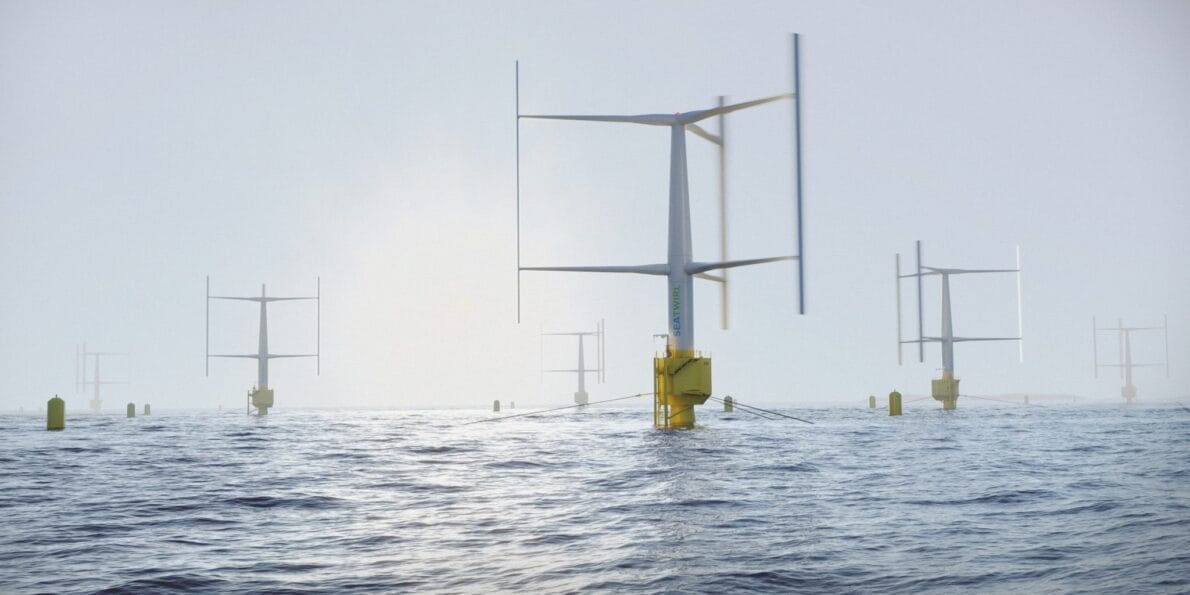

Vertical Axis Wind Turbines Promise to Revolutionize the Offshore Wind Energy Market. The Reason Behind the Big Bet by Investors Is That These Turbine Models Generate Energy at Sea More Cheaply and Efficiently.
A new wind turbine can revolutionize production in terms of wind energy as it can be relocated to the sea. These are vertical axis wind turbines, which promise to change the offshore wind energy market, and a new offshore wind farm with these turbines may emerge soon.

What Are the Advantages of Offshore Wind Energy? – Offshore Wind Energy?
The winds offshore are stronger and more consistent, enabling a more stable energy generation. The relationship between wind speed and energy production is nonlinear, doubling the amount of energy generated with the increase in speed.
For example, at a wind speed of 25 km/h, an offshore wind turbine can operate for 50 to 60% of the time, compared to 35% in coastal areas and even less in continental regions. However, it is important to note that offshore wind turbines are significantly larger than onshore ones, which, while allowing for greater energy production, limits the development of even larger models due to physical constraints.
-
The Brazilian state accelerates industrial competitiveness with a focus on the extraction of strategic minerals to boost the energy transition in Goiás.

-
A Canadian retiree creates a hydroelectric system on a real river, generating energy continuously throughout the day and demonstrating how the power of water can supply a house with stability even in a simple structure.
-
Giant of the winds in Rio Grande do Norte: Serra do Tigre Wind Complex receives new investments and accelerates the expansion of clean energy generation to supply millions of Brazilian homes.
-
Petrobras reaffirms its commitment to the market and ensures that it will carry out the energy transition safely to maintain national sovereignty.


Additionally, the manufacturing, installation, and maintenance of these structures represent high costs. In this context, the startup SeaTwirl has emerged as a promise of innovation. This Swedish company was founded after its founders decided to carry forward an idea that had been tested on an industrial scale in 2007.

The result of this effort was the launch in 2015 of a 30 kW prototype called S1, consisting of vertical axis wind turbines with a revolutionary design. This prototype was installed at sea near the Swedish city of Lysekil, where it remains operational to this day.
Startup Develops New Design for Vertical Axis Wind Turbines
Over these seven years, the vertical axis wind turbines have not only demonstrated their ability to withstand hurricane winds and storms but also their tolerance for faults and formidable efficiency.
The basic difference in its development is that it is a vertical axis wind turbine, not a horizontal axis wind turbine. The surface area of the S1 structure is 13 meters. Three vertical blades are fixed by spacers to the central mast, and the stability of the structure is ensured by a long and heavy submerged section of 18 meters in height that functions as a keel.
The generator ring is located around the central mast and anchored to the sea surface. When the blades of the offshore wind turbine are struck by the wind, they begin to move, and it is the central mast that rotates around its axis. At this moment, the generator collects the generated energy and sends it to the shore via cables. Thus, this design is easier and cheaper.
For example, the bearings of the generators do not need to support the weight of the entire structure; they can be lighter, smaller, and cheaper. Moreover, such wind turbines do not require the construction of an expensive and complex foundation, as the generating substation is located on the sea surface, meaning cranes and helicopters are not needed for maintenance and repair as is the case with horizontal wind turbines.
New Vertical Axis Wind Turbines Can Last 30 Years
The duration of uninterrupted operation of the installation is estimated at 25 to 30 years. They can also be placed at great depths and are capable of capturing wind from different directions. These two factors allow for the permanent exploration of the potential of offshore wind energy, maximizing the load of the generator.
Traditional large wind turbines must be placed far apart for optimal performance, while these vertical axis wind turbines need a much smaller air footprint, allowing for more energy to be collected in the same area.
The company is now preparing to launch an S2 plan of 1 MW off the coast of Norway in the coming years. It is expected to operate for about five years and ultimately prove the feasibility of the idea. To generate this amount of offshore wind energy, the structure will be much larger than the S1 prototype. The surface part will be about 50 meters, and the underwater part will be 85 meters, but above all, it will likely be competitive.










Muito interessante! Parabéns!