





 Portuguese
  English
  Spanish
  3 min of reading
  0 comments


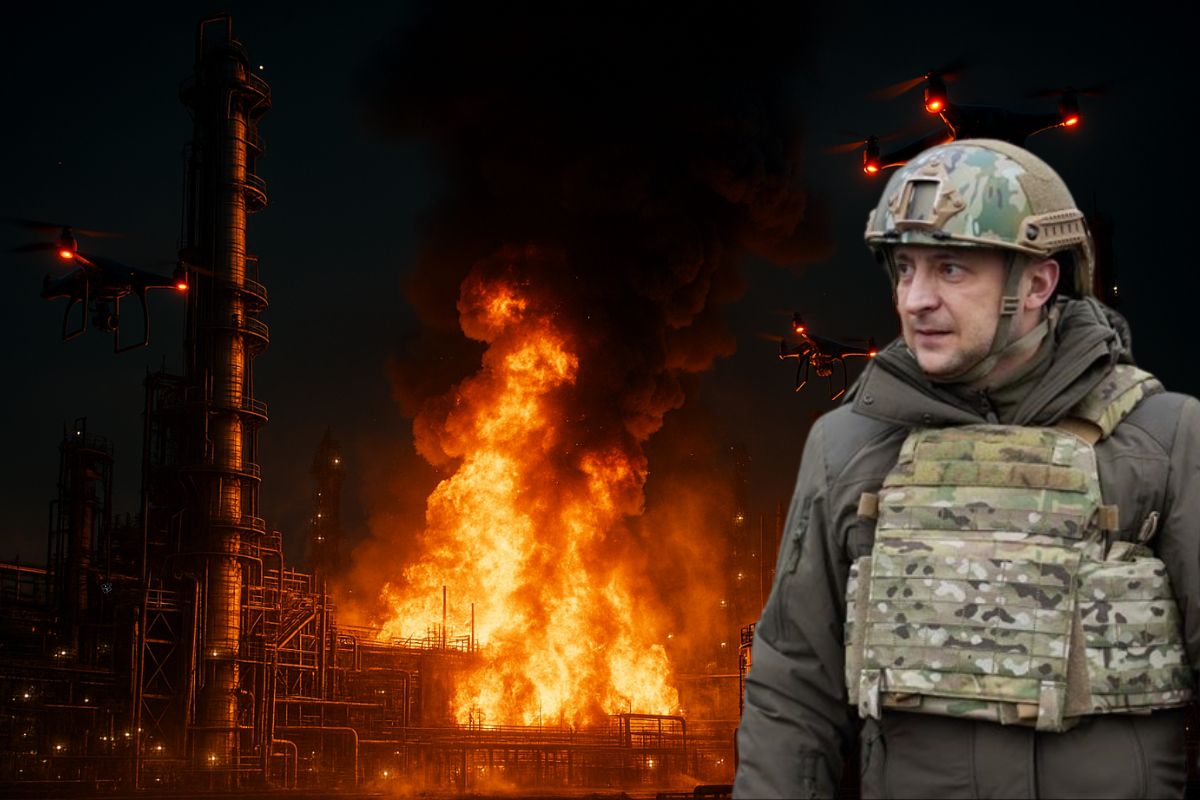
The Target Was the Refinery in Ufa, in the Bashkortostan Region, One of the Largest in the Country, Responsible for More Than 150 Petroleum Derivatives in Russia, According to Information from UOL.
The war in Eastern Europe took a new turn this Saturday, September 13, 2025. Ukraine Attacked One of the Largest Oil Refineries in Russia, owned by the state-run Bashneft, located in Ufa, 1,400 kilometers from the front lines. The attack exposed the vulnerability of Russian energy infrastructure, which had until now been considered safe due to its distance from the conflict zone.
According to regional governor Radiy Jabirov, one of the drones managed to hit the facilities and caused a fire, which was controlled a few hours later. Another was shot down by anti-aircraft defenses before reaching the complex. There were no fatalities or injuries, but the action revealed that even industrial centers in the Russian interior are not immune to Kyiv’s long-range operations.
Why the Bashneft Refinery Is Strategic
The Ufa refinery was described by the Kremlin in 2016 as “one of the largest in the country”, with the capacity to produce more than 150 types of petroleum derivatives.
-
Spain challenges the USA and closes its airspace for operations against Iran, raising global tension and provoking the threat of a trade rupture.
-
While no other country manufactures tanks in Latin America, Argentina activates the TAM 2C-A2 and raises a curiosity about the technological lag in the region.
-
A Russian ship with 730,000 barrels of oil has just arrived in Cuba while Mexico negotiates fuel sales through private companies: the communist island is desperately seeking alternatives after losing its supply from Venezuela due to American military action.
-
Iranian drones and missiles destroyed a 270 million dollar American spy plane in Saudi Arabia, splitting the E-3 Sentry aircraft in half and injuring 12 military personnel in an attack that exposes the vulnerability of U.S. bases in the Persian Gulf.
This means that the attack had not only a symbolic effect but also practical impact on the internal production and distribution of fuels.
According to analysts, hitting an energy hub of this magnitude reinforces Kyiv’s strategy to wear down the Russian economy, as Russian oil is one of the key pillars of funding for Moscow’s war machine.
Each interruption, even if temporary, represents million-dollar losses and strains military logistics.
Kyiv’s Strategy with Long-Range Drones
Sources from the GUR, Ukraine’s military intelligence agency, confirmed to the British newspaper The Guardian the authorship of the operation.
Since 2022, attacks on refineries and fuel depots have become a central part of Ukrainian tactics, aiming to undermine Moscow’s ability to sustain its troops.
What stands out is the distance: 1,400 kilometers from the front lines, highlighting that Kyiv now masters drones with the range to reach the heart of Russian territory.
This technological advancement increases Moscow’s vulnerability and forces the Kremlin to bolster defenses in regions previously considered safe, raising military costs.
Russia’s Diplomatic Reaction
On the same date, during a UN Security Council meeting, Russian ambassador Vasily Nebenzya accused Kyiv of acting to “prolong the conflict” and rejecting negotiations proposed by Vladimir Putin.
He stated that the Ukrainian president, Volodymyr Zelensky, would be using the attacks as a political strategy in light of his declining popularity, supported by “Western manipulators.”
This statement is part of Moscow’s effort to turn strategic losses into political narratives.
By shifting the debate to the diplomatic field, the Kremlin seeks to justify the prolongation of the war and accuse the West of encouraging the Ukrainian offensive.
Impacts for the War and for Russian Oil
Even though the fire was controlled and the damages classified as minor, the attack on Bashneft represents a direct blow to Russian oil, both for the symbolism of hitting one of the largest refineries in the country and for the immediate economic impact.
Experts state that each attack of this nature increases repair costs, pressures defense systems, and compromises the flow of fuels used on the battlefield.
It creates uncertainties in the international energy market, as Russia remains one of the largest global exporters of oil and derivatives.
The attack on the Ufa refinery shows that the war has entered a phase of strategic depth, where Ukraine is capable of reaching critical targets deep inside Russia.
Striking Russian oil means directly pressuring the economy that sustains the Kremlin’s war effort, increasing both military and diplomatic risks.
Do you believe that attacks of this nature are decisive in weakening Russia or could they further escalate the conflict? Share your opinion in the comments — we want to hear your thoughts on this topic.










Seja o primeiro a reagir!