





 Portuguese
  English
  Spanish
  3 min of reading
  0 comments


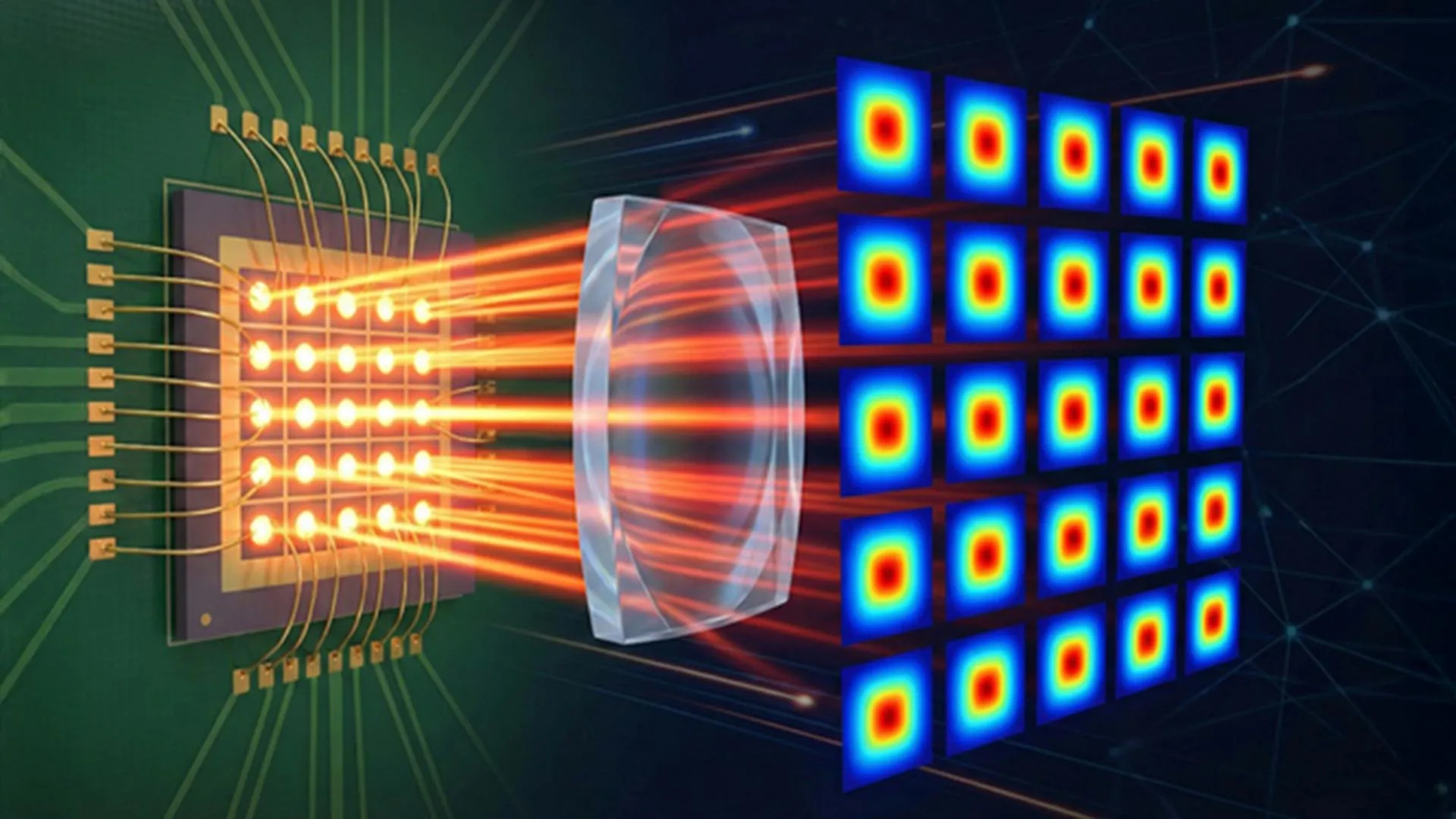
Infrared light as the future of high-performance home and corporate connections The development of chips with VCSEL laser arrays allows data to be transmitted accurately and without interference, surpassing the physical limitations of conventional radio waves.
Researchers have developed a new wireless system powered by laser that uses light to transmit data at speeds exceeding 360 Gbps. The innovation in optical communication promises to enable faster and more efficient internal networks, significantly reducing interference and energy consumption compared to traditional radio-based systems.
The study, published in the journal Advanced Photonics Nexus, presents a compact transmitter built around a tiny silicon chip. This device contains an array of semiconductor lasers and an optical system that controls the distribution of light. The solution emerges as an alternative to alleviate congestion in the radio spectrum, which faces limitations as the number of connected devices grows globally.
VCSEL laser architecture and data capacity
At the core of this new optical communicationphysics platform is a custom arrangement of 5 × 5 vertical cavity surface-emitting lasers, known as VCSELs. These infrared lasers are widely used in data centers due to their high operating speed and inherent efficiency. The complete arrangement occupies less than a millimeter of space, allowing for future integration into smartphones and compact access points.
-
Scientists find gigantic lava fields in an active underwater volcano, and the discovery draws attention to what is happening on the ocean floor.

-
Geologists finally solve the great 150-year mystery of the formation of the incredible rocks and fossils of the Green River Formation!

-
Scientists develop a new water filter capable of capturing even the smallest particles of dangerous forever chemicals that no one could catch!

-
Scientists have found a new “neighbor” in space: meet the Earth-sized planet that could be the key to uncovering whether life exists and how atmospheres survive on alien worlds.


Each laser in the array can be controlled independently, transmitting its own data stream simultaneously. By operating multiple lasers at the same time, the system drastically increases the total data capacity compared to single light sources. Initial tests conducted by the team demonstrated that the lasers operate consistently, maintaining a stable output for high-speed modulation.
To validate performance, scientists created a free-space optical link with a distance of two meters. Using a modulation method that divides data into multiple frequency channels, the system achieved a mark of 360 Gbps.
The researchers noted that this speed was limited only by the commercially available photodetector, suggesting that faster receivers could further elevate the performance level of optical communication.
Beam control and simultaneous multiuser operation
One of the main challenges of using multiple light beams is to prevent overlap from causing interference in the data streams. To address this issue, the team designed a compact optical system that uses microlenses to align and direct light precisely. This setup ensures that each beam covers a specific square illumination zone on the receiver, minimizing conflicts between signals.
Distribution tests showed that the light achieved over 90% uniformity across the target area at a distance of two meters. This structured approach allows different light beams to serve different users or devices within the same environment without loss of quality. Connection stability was demonstrated in practical tests of optical communication with four active beams simultaneously.
During multiuser demonstrations, the system achieved a combined data rate of about 22 gigabits per second. The results confirm that multiple optical connections can operate in parallel without significant interference between them. This spatial control is one of the great advantages of light over radio waves, which spread in all directions and congest busy indoor environments.
Energy efficiency and integration with existing networks
Energy consumption efficiency is one of the pillars of this new system, consuming only 1.4 nanojoules per bit transmitted. This value represents approximately half the consumption of current leading Wi-Fi technologies under similar usage conditions. As laser sources are efficient and do not require complex amplification for high speeds, optical communication positions itself as a sustainable solution for the growing demand for data.
The researchers emphasize that this technology does not aim to completely replace Wi-Fi or cellular networks but to act as a strategic complement. Optical links can be installed in locations that require extremely high capacity, such as hospitals, data centers, and offices, reducing the load on radio frequencies. In the future, integration could occur directly in light fixtures and ceilings, providing secure and fast connections.
Combining the small size of the chips with precise optical control, the technology offers a practical path for the next generation of wireless networks. The advancement represents a paradigm shift by providing greater technical performance without increasing environmental impact or energy costs. Optical communication indoors is expected to transform how homes and public places manage massive information traffic.
Click here to see the study.






Seja o primeiro a reagir!