





 Portuguese
  English
  Spanish
  5 min of reading
  0 comments


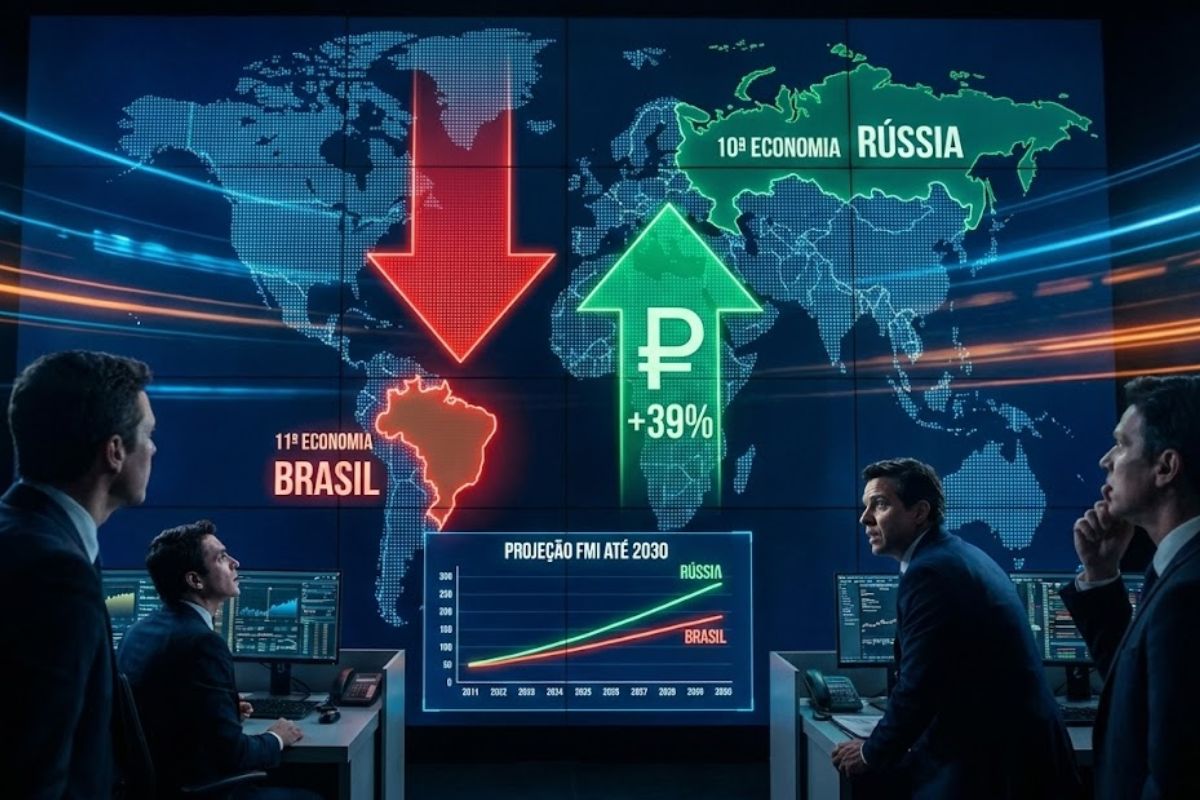
With IMF Projections And Exchange Rate Favoring Russia, Brazil Leaves Group Of Ten Largest Economies In The World In GDP In Dollars, Becomes 11Th Largest Economy In The World And Exposes Structural Weaknesses That May Limit Growth In Competitiveness, Investments, Productivity And Political Weight In The Current Global Economy
On December 4, 2025, Brazil was officially presented by a report from Austin Rating as the 11Th Largest Economy In The World In GDP Measured In Dollars, surpassed by Russia after an appreciation of more than 39% of the ruble this year, according to projections from the International Monetary Fund. The change removes it from the group of the ten largest global economies, the so-called G10 of GDP in dollars.
The downgrade in the ranking occurs even with upward revisions of growth projections for the country in 2025 and after a third quarter in which the Gross Domestic Product grew 0.1% compared to the second quarter, according to data released by IBGE also on December 4. The decisive factor, point out the IMF and Austin Rating, is not an abrupt worsening of activity, but the behavior of exchange rates that repriced the value of GDPs national in dollars.
How The Exchange Rate Took Brazil Out Of The G10 Of The World Economy
In the ranking of the largest economies in the world in dollars, the IMF’s calculation combines projections for real GDP growth with currency trends against the dollar.
-
Larger than entire cities in Brazil: BYD is building a 4.6 km² complex in Bahia with a capacity for 600,000 vehicles per year, but the discovery of 163 workers in conditions analogous to slavery has shaken the entire project.

-
With an investment of R$ 612 million, a capacity to process 1.2 million liters of milk per day, Piracanjuba inaugurates a mega cheese factory that increases national production, reduces dependence on imports, and repositions Brazil on the global dairy map.

-
Brazilian city gains industrial hub for 85 companies that is equivalent to 55 football fields.

-
Peugeot and Citroën factory in Argentina cuts production by half and opens a layoff program for more than 2,000 employees after Brazil drastically reduced purchases of Argentine vehicles.


In 2025, the strong appreciation of the ruble changed the picture.
According to the Austin Rating report, the Russian currency accumulated an appreciation of more than 39% in 2025, supported by capital controls implemented after the economic sanctions imposed by the United States and European countries since the invasion of Ukraine in 2022.
In terms of GDP converted to dollars, this rise caused Russia to surpass not only Brazil but also Canada, which held the ninth position in 2024.
In practice, this means that by converting the Russian GDP to dollars with a more appreciated exchange rate, the size of the economy measured in U.S. currency grows more rapidly, even if the real production growth is not that significant.
It is this exchange rate effect that pushes Brazil to 11Th place in the world economy in 2025, even though the Brazilian economy has shown some resilience and appreciation of the real throughout the year.
Brazil Remains In 11Th Place And Should Stay Until The End Of The Decade
The IMF’s long-term projections, cited by Austin Rating, indicate that Brazil will not surpass Russia and Canada again until 2030.
In the current scenario outlined by the multilateral organization, the country remains the 11Th largest economy in the world in dollars until the end of the decade.
The report highlights that Brazil, Canada, and Italy did not suffer a sudden economic “derailment” between early 2025 and the present moment.
On the contrary, the text records appreciation of the real, improvement in growth expectations, and reduction of the gap compared to the Canadian and Italian GDP.
Still, the more intense exchange changes in other economies, especially Russia’s, reorganized the ranking in dollars.
In political and symbolic terms, leaving the group of the ten largest economies in the world occurs at a time when the country is trying to reinforce its role in multilateral forums and global negotiations.
Even if the direct economic impact is limited, the loss of position tends to fuel the internal debate about competitiveness, productivity, and dependence on the commodities cycle.
Real Growth: Brazil In The Middle Of The Table Among 51 Countries
When the analysis shifts from exchange rates to the actual growth of activity, the picture changes but remains modest.
In the third quarter of 2025, the Brazilian GDP grew 0.1% compared to the second quarter. In the list compiled by Austin Rating with 51 countries that have already released their data, Brazil ranks 34Th in quarterly expansion rate.
At the top of the table, the report cites Israel, with a 3.0% increase, followed by Malaysia and Singapore, both with 2.4%, in addition to Denmark, Indonesia, and Peru, with results ranging from 2.3% to 1.4%.
At the other end, Thailand recorded a retraction of 0.6% compared to the previous quarter, ranking as the worst performance among tracked economies.
This picture reinforces that the country is not in recession, but grows little compared to other emerging economies.
In combination with the exchange rate effect, this moderate pace helps consolidate Brazil’s position outside the group of the ten largest economies in the world in dollars.
The Role Of The Exchange Rate And Russian Capital Controls
One of the central points of the report is the explanation for the appreciation of the ruble.
Austin Rating attributes the movement to the capital controls adopted by Russia after the Western sanctions that followed the military offensive in Ukraine in 2022.
By restricting the outflow of funds, requiring the conversion of export revenues into local currency, and imposing barriers to certain financial operations, the Russian government artificially sustained the demand for rubles.
In the IMF’s accounting, this stronger exchange rate inflates Russia’s share in the world economy in dollars, even under a troubled geopolitical environment and internal challenges.
Brazil, on the other hand, saw the real appreciate in 2025, but to a lesser extent.
Austin Rating itself underscores that the gap between Brazil and Canada and Italy has narrowed, and that growth projections for the Brazilian GDP were even revised upwards by the IMF in October.
Despite this, the combined effect of severe controls in Russia and the new parity of the ruble was enough to reorder the global ranking.
What The Downgrade In The Ranking Signals For Brazil
From a technical standpoint, being in 10Th or 11Th place in the world economy, measured by GDP in dollars, does not alone alter trade flows or the productive structure. But the movement carries important signals:
It Highlights Brazil’s Sensitivity To The Exchange Rate In International Comparison, as a significant portion of GDP in dollars depends on the exchange rate between the real and the American currency.
It reignites the discussion about how much the country depends on favorable external commodity cycles to climb the ranking.
It exposes the need for stronger sustained growth to compensate for exchange movements in other jurisdictions.
It puts additional pressure on the agenda of structural reforms, productivity, investments, and business environment, themes that influence medium and long-term growth.
Experts consulted by Austin Rating observe that, even without an acute crisis, the combination of merely moderate growth and relatively unstable exchange rates limits Brazil’s weight gain in the world economy, opening space for other emerging markets to reorganize the top positions in the ranking when there are local shocks in their currencies.
In the face of this scenario, with Brazil outside the ten largest economies in the world in dollars until at least 2030, do you think the main focus for regaining ground should be a more competitive exchange rate, acceleration of economic growth, or deep structural reforms to gain productivity?







-

-

2 pessoas reagiram a isso.