





 Portuguese
  English
  Spanish
  5 min of reading
  1 comment


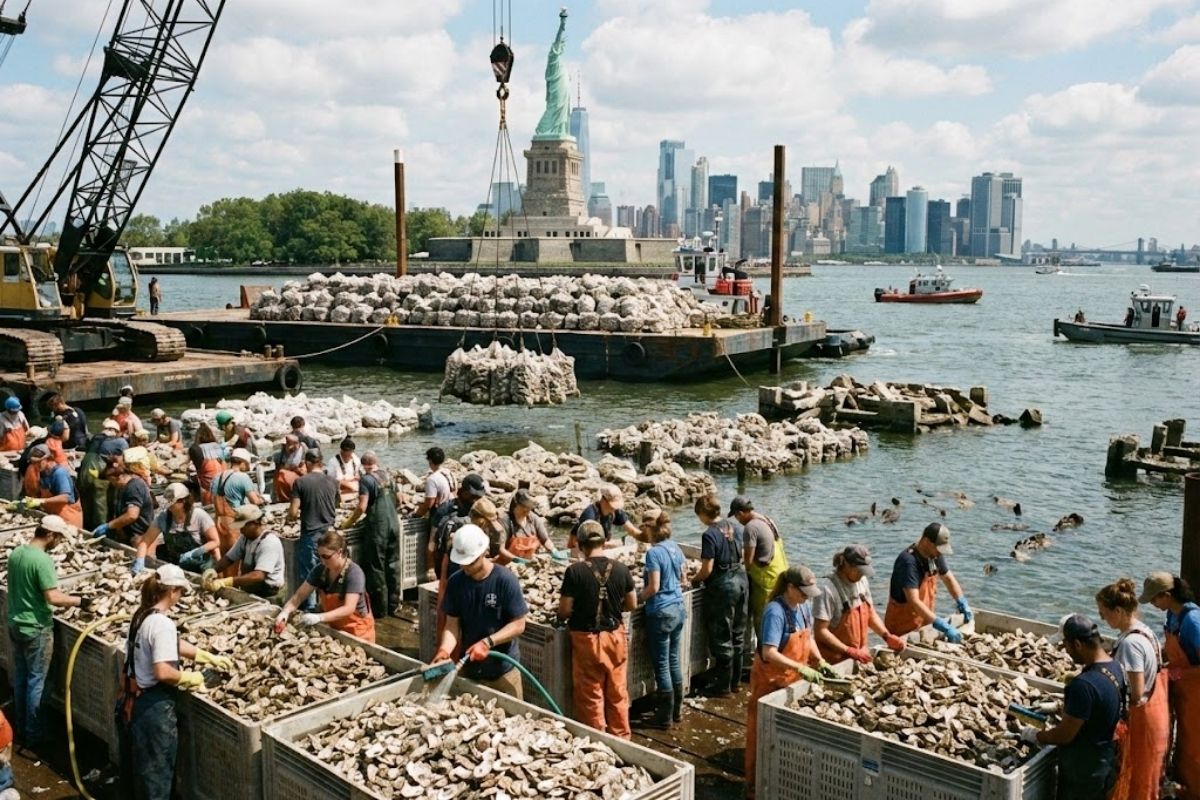


In The Port Of New York, The Billion Oyster Project Collects Shells From 80 Restaurants, Cures For A Year And Sets Larvae On Reef Spheres. 17 Acres Restored And 150 Million Oysters In The Water, Filtering Up To 50 Gallons Per Day, But Without Consumption By Sewage Even Today.
In the port of New York, volunteers gather on weekdays for a task that seems unlikely: washing millions of oyster shells. It’s the front line of the Billion Oyster Project, an environmental restoration plan that aims to bring back reefs to the port and thereby improve water quality and reactivate an underwater urban ecosystem.
The stated goal is ambitious: to put 1 billion oysters back into the port. The project already claims to have approximately 17 acres of restored reef and over 150 million oysters returned to the water, with signs of biodiversity returning, despite a problem that limits enthusiasm: the port remains polluted, and the restored oysters cannot be consumed.
Why The Port Lost The Oysters And What They Do For The Water
Before New York became the “Big Apple,” the project material describes the city as a “big oyster,” with abundant reefs that were overexploited and then dredged as maritime traffic increased.
-
Something is happening around the Earth: Inside the huge explosion of fireballs in 2026

-
A hot air bubble coming from Argentina expands over Brazil, causing thermometers to exceed 38 degrees with a thermal sensation of 40 degrees in late March, affecting 6 states at once.

-
The radish leaf that almost everyone throws away has more polyphenols, flavonoids, and fiber than the consumed root, and a 2025 study showed that the leaf contains compounds that protect the intestine, combat inflammation, and may inhibit the growth of cancer cells.

-
A planet that seemed to defy the laws of physics has intrigued scientists for decades, until the James Webb revealed what is really affecting Saturn’s rotation.


The loss was not just economic: the impact was also environmental because adult oysters function as natural filters.
An adult oyster, the size “of a palm,” can filter 50 gallons of water per day or more.
In the calculation presented, one billion oysters could filter the permanent volume of New York Harbor every 3 days, acting as a natural treatment plant that operates continuously.
It is this filtering gain that supports the idea that the plan is working now.
Living Reefs Also Become Nurseries And Can Protect The Coast
The oysters are described as colonial: they grow together, attracted by the calcium carbonate in the shells, and build organic reef structures.
These reefs become habitat and nursery for various species from the port of New York, including small fish and crabs.
In sufficient quantity and coverage on the seabed, these structures can also function as natural walls, reducing wave energy, helping to protect the coastline from erosion and storm surges.
The material cites Hurricane Sandy in 2012 as a moment when the importance of this coastal protection became especially clear.
The Step By Step: From Restaurant Shells To The Bottom Of The Port
The process begins with discarded shells.
The project states that it partners with 80 restaurants in the city: people eat oysters, workers collect the shells, and they head to the project’s base, where they remain for about a year outdoors, receiving sun, wind, and rain, to “clean” naturally before use.
So far, the project reports having collected about 3 million pounds of shells, which then go through a rotary drum machine to remove remaining debris.
Next, oyster larvae, called “spat,” are introduced into tanks on Governors Island, settled on structures, and then taken by boats to restoration sites throughout the port of New York.
The Innovation Of Reef Spheres And The Work Of Volunteers
The material describes an evolution: initially, the project used metal cages that rusted and degraded; then, it began to manufacture and deploy concrete reef spheres, artificial structures designed to last in the water.
The logic is simple: the shape favors water and, “situated with a bunch of oysters,” becomes very good for the environment.
At every stage, volunteers are treated as key players.
The participation of people from high school students to retirees, united by a common point: caring for the community and making a practical contribution to what is described as a local effort to mitigate climate change.
17 Acres, 150 Million And A Living Laboratory Of Biodiversity
The project claims to maintain a monitoring network with research stations, described as a network of 200 cages that function as windows to the recovering port of New York ecosystem.
These stations allow for the observation of growth, recruitment, and mortality of oysters, as well as the biodiversity surrounding them.
The material reports findings considered “notable” within the cages: blue crabs, hydroids (related to jellyfish and corals), sea squirts, and tunicates; and describes a symbolic moment when a small fish was seen making the cage its home and guarding eggs.
Records of blue crabs, butterfly fish, striped species, and even American eels are also mentioned, reinforcing the narrative of returning marine life.
The Problem Of “Black Mayo” And Why Structures Matter
The bottom of the harbor has a low-oxygen mud called “black mayo,” where “nothing can live.”
In this scenario, the cages and reef spheres become habitat platforms “on top” of this mud, creating a viable space for invertebrates and species that would otherwise not establish themselves.
By placing oysters in the water, the project claims to encourage the accumulation of biodiversity in the port of New York, which surprises many residents precisely because of the common disconnection with the idea that the city is, also, a coastal city.
Education, Global Showcase And International Visits
Besides restoration, there is an educational focus. The material describes partnerships with schools and community programs that take students and residents to see and investigate what lives below the surface, using the cages as a learning tool.
The work has reportedly attracted international recognition: the model of the port of New York is being studied by other cities, and the project reports visits and interest from leaders, including mentions of the King of Jordan and Prince William.
Would you support an expensive plan to expand reefs in the port of New York, even knowing that these oysters cannot be eaten due to pollution?







sim,com toda certeza e convicção de que é um nicho ecológico crucial descoberto !