





 Portuguese
  English
  Spanish
  4 min of reading
  7 comments


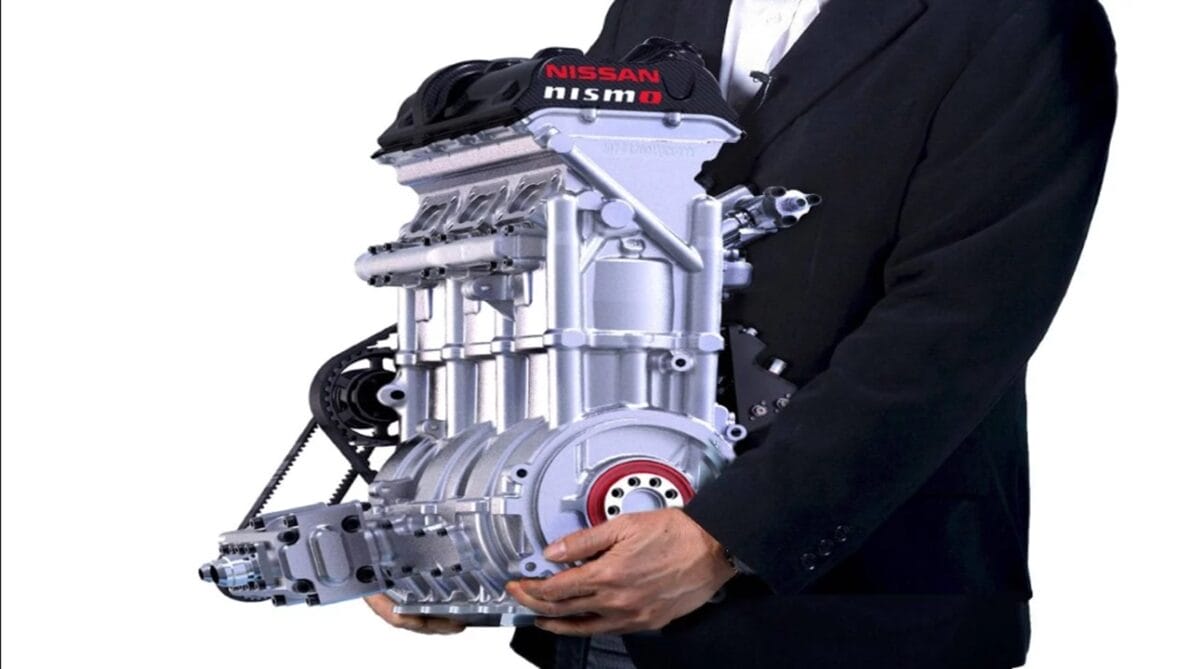


Nissan Redefines Power With Its 3-Cylinder Turbo Engine, Weighing 40 kg and 400 HP. Compact Like a Suitcase, Ideal for Competitions. Learn More!
Proud and smiling, Shoichi Miyatani, CEO and President of NISMO – Nissan – posed holding a combustion engine that, with just three cylinders, delivers over 400 HP of power
In a world where automotive innovation is advancing rapidly, Nissan has once again stood out with its revolutionary engine. This is not just any engine; we are talking about a true engineering gem: a three-cylinder engine that, despite its lightweight of 40 kilograms – equivalent to a carry-on suitcase – is capable of delivering a surprising power of over 400 horsepower.


Designed to challenge the known limits of efficiency and performance, this compact yet powerful engine was created with a focus on high-level competitions, such as the 24 Hours of Le Mans. Its power-to-weight ratio even surpasses that of Formula 1 vehicles of its time, highlighting Nissan’s commitment to exceptional innovation and performance
-
The car stored for 38 years: when opening the barn door, what appears is breathtaking and looks like a scene from a movie!

-
Fiat works miracles in the Brazilian market, lowers the price of its 0 km hatch to R$ 69,990, reestablishes the model as the cheapest car in the country, and reignites the battle against Kwid and C3.
-
Chevette with cooking gas: How the gas cylinder ends up being used in cars clandestinely and why this makeshift solution can result in leaks, explosions, damaged engines, and seized vehicles.
-
Fiat launches the new 2027 Toro hybrid with 48V, 176 hp, an electric motor of 15.5 hp, a 0.85 kWh battery, up to 7% fuel savings, 8% fewer emissions, and possible exemption from IPVA.


The Size of a Carry-On Suitcase
I wouldn’t bet my hand on the photo not being a trick. What we know is that this engine, due to its dimensions, could be carried as if it were a suitcase, like our carry-on luggage on a plane. If it weren’t for the fact that its 40 kilograms exceed the restrictions imposed by most airlines for onboard luggage. In any case, 40 kilograms is a spectacular number for an engine that not only delivered immense power but was designed for a competitive experience, nothing more and nothing less than for participation in the 24 Hours of Le Mans.
Nissan created an engine that with just three cylinders, 40 kilograms of mass, could deliver over 400 HP of power. A power-to-weight ratio greater than that of the Formula 1 cars of the time.
This Engine Weighed 40 Kilograms and Delivers Over 400 HP of Power
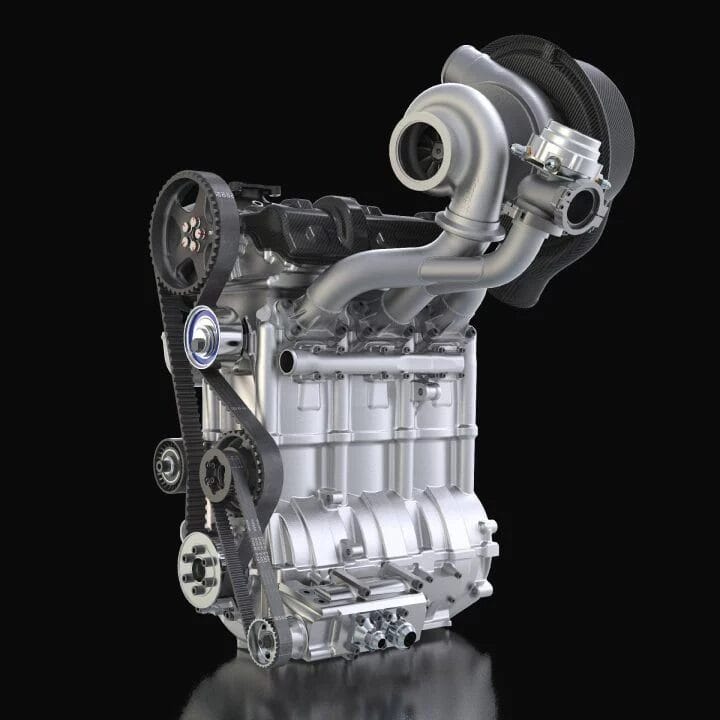
A 3-Cylinder Engine Weighing 40 kg and Delivering 400 HP of Power
What we see is a 3-cylinder inline engine with 1.5 liters of displacement, with four valves per cylinder, and a massive turbocharger working at 2 bars, capable of spinning up to 100,000 rpm. But the most impressive part is that this engine, with a height of 50 centimeters, a length of 40, and a width of 20, the size of a carry-on suitcase, and 40 kilograms of mass, delivers over 400 HP of power at 7,500 rpm and a maximum torque of 380 Nm.
Nissan designed this engine from scratch. Although 3-cylinder engines are common today, this engine did not share any components with any other engine in the group. It was designed for its application in a hybrid configuration. A configuration in which this engine would be directly coupled to a transmission, which would also couple two electric motors of 110 kW each.
So that this car could move in fully electric mode, without the intervention of this 3-cylinder engine, or in combustion mode, using the engine in question.
Nissan Designed This Engine for a Special Project That Would Be Tested at the 24 Hours of Le Mans in 2014
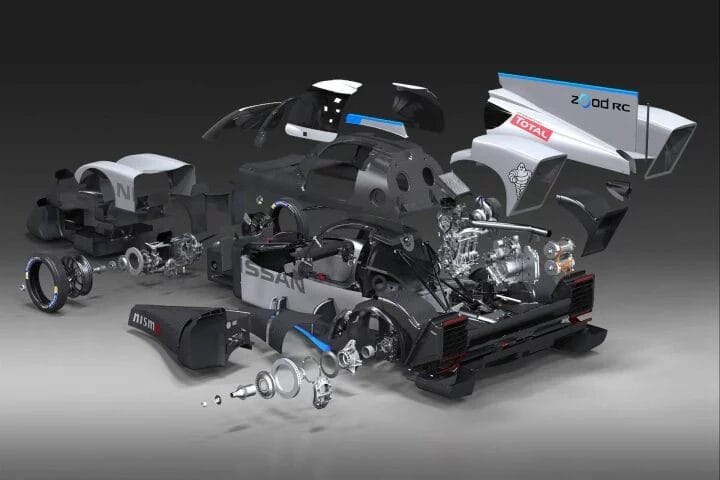
A Three-Cylinder Engine at Le Mans
This engine would be one of the elements of which Nissan would feel most proud when presenting its project for the 24 Hours of Le Mans in 2014. For a time, Nissan was immersed in the most exotic and outrageous “competition” projects, which had no goal of competing and consequently winning races, but rather investigating new solutions on the stage of Garage 56 at Le Mans.
First was the Deltawing. Then came the ZEOD RC that equips this 1.5-liter engine with 400 HP of power. Nissan had estimated that every eleven or twelve laps in combustion mode, regeneration would allow for one complete lap in electric mode on the La Sarthé circuit, which is not trivial at all.
Finally, Nissan achieved a feat. It recorded a fast lap in fully electric mode in 4 minutes and 22 seconds, a respectable time, although distant from those achieved by prototypes. And reached a maximum speed in electric mode of 300 km/h.
The Challenge of Making an Engine of This Type Viable But, Above All, Making It Reliable and Durable, or Meeting Minimum Consumption and Emission Standards Made It Difficult to See Something Like This in a Street Car
Remembering the Nissan Engine Weighing 40 kg and Delivering 400 HP
In those moments many of us dreamed about the possibilities of this engine, outside the circuits. And we dreamed of some eccentricity with the NISMO signature that we could enjoy on the street. But, evidently, the possibilities of this engine beyond the experience of Le Mans and the ZEOD RC were minimal. And ten years after the ZEOD RC with three cylinders and 40 kilograms with 400 HP would only be a beautiful story to remember.
We could talk extensively about the difficulties that a project like this would encounter to reach the streets, starting with the cost of its industrialization and the challenges to make it viable. But we should not forget how complicated it can be to make an engine like this durable and reliable enough for a street car or to achieve acceptable efficiency and emissions.
In fact, Nissan has always emphasized its collaboration with Total and how important proper engine lubrication was to ensure the management of internal friction and the stress that the components had to endure.









Notícia só tem 10 anos de atraso.
cabe no uno?
quanto custa?
100.000 rpm?!?!