





 Portuguese
  English
  Spanish
  3 min of reading
  0 comments


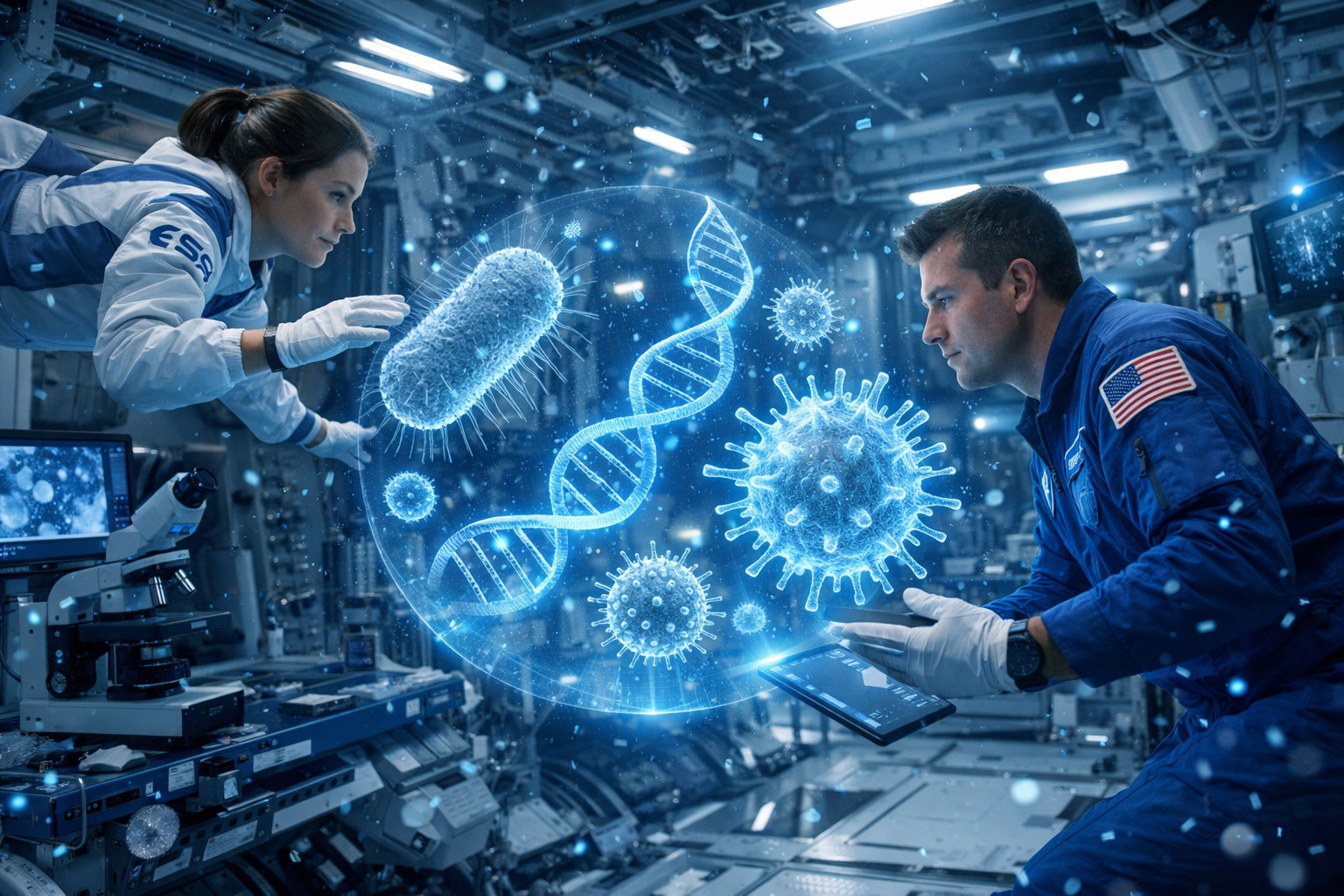
Research Conducted at the International Space Station Shows That the Absence of Gravity Radically Alters the Dynamics Between Viruses and Bacteria, Opening New Possibilities for Medical Therapies and Long-Duration Space Missions
A recent experiment conducted aboard the International Space Station (ISS) revealed that the evolution of microscopic life can take completely different paths when it occurs off-Earth. By infecting bacteria in a microgravity environment, scientists observed unprecedented mutations that would never be recorded under the influence of Earth’s gravity, indicating that space can operate as a true “evolutionary laboratory.”
The research analyzed the interaction between the bacterium Escherichia coli (E. coli) and the T7 bacteriophage, known for infecting and destroying this type of microorganism. Under normal conditions on Earth, these organisms frequently encounter each other due to fluid convection, a physical phenomenon driven by gravity. However, in space, this dynamic simply does not exist.
Without the natural mixing caused by gravity, viruses and bacteria remain virtually suspended, relying only on slow and random molecular movements to find each other. As a result, infections occur much more rarely and unpredictably, creating an entirely new scenario for biological evolution.
-
With a cost per shot close to zero, the DragonFire laser could change naval warfare in 2027 and provide British ships with nearly unlimited defense against drones.

-
A British startup creates tires that generate electricity in electric vehicles when passing over potholes, speed bumps, and cracks.

-
Scientists have created robots made with living cells that have their own nervous system, swim on their own, explore the environment, and self-organize without any genetic engineering, and now they want to do the same with human cells.

-
Students create a solar-powered ambulance that operates without a plug, without fuel, and still keeps medical equipment running in remote areas.

Microgravity Transforms the Microscopic War Between Viruses and Bacteria
In this extreme environment, the predator-host relationship entered a kind of “genetic war in slow motion.” As encounters became less frequent, both viruses and bacteria needed to adapt to survive.
The T7 bacteriophages underwent mutations that made them significantly more efficient at the moment of contact. When they finally managed to reach a bacterium, they became faster and more precise in attaching to its surface, drastically increasing their chances of success in infection.
On the other hand, E. coli also reacted. The bacteria modified their external receptors, making it more difficult for the virus to enter and creating a new form of resistance. This equilibrium forced by microgravity generated adaptations that never appeared in the control groups maintained on Earth.
Genetic sequencing confirmed that these mutations are exclusive to the space environment. None of them were detected in samples cultivated under normal gravity, proving that space induces completely distinct evolutionary trajectories.
The information was disclosed by researchers from the University of Wisconsin-Madison, according to a scientific article that thoroughly analyzed the effects of microgravity on microscopic evolutionary processes aboard the ISS.
Unexpected Discovery Could Revolutionize Medical Treatments on Earth
The impact of the experiment was not limited to the space environment. When the “trained” viruses returned to Earth, scientists conducted new laboratory tests—and the results were even more surprising.
These modified bacteriophages proved to be much more effective against strains of bacteria responsible for urinary infections, including those that show high resistance to traditional antibiotics. Compared to common viruses, space phages destroyed bacteria more quickly and efficiently.
This discovery paves the way for advancements in phage therapy, a promising alternative in addressing the global crisis of bacterial resistance. In a scenario where antibiotics are losing effectiveness, “reprogrammed” viruses in extreme environments could become valuable allies of modern medicine.
Moreover, the study also has direct implications for astronaut safety. With increasingly longer missions planned for the Moon and Mars, understanding how microorganisms evolve in space is essential to prevent infections and ensure the health of crews far from Earth.
Source: Xataca






Seja o primeiro a reagir!