





 Portuguese
  English
  Spanish
 6 min of reading
  9 comments





In Uruburetama (CE), A Retaining Wall Made With About 5,000 Tires, Concrete, Sand, and Gravel Shows How Simple Techniques Can Turn Into Heavy Engineering and Real Environmental Solutions.
In a region where traditional public works do not always arrive with the necessary speed, an unconventional construction has begun to attract attention in Uruburetama, in the interior of Ceará. This is not a project signed by large construction companies nor is it a university experimental work, but a practical solution executed on-site that transformed an environmental liability into a heavy engineering structure. A retaining wall built with approximately 5,000 used tires, reinforced with concrete, sand, and gravel, now serves a real and permanent structural function.
The existence of the work, its location, the construction method, and the numbers involved are confirmed by a video recorded by one of the workers who participated in the execution. In the footage, he reports that the wall took about four months to complete, used thousands of discarded tires, and employed a construction system that combines internal filling, compaction, and vertical concrete columns to ensure stability.
Where Is the Work Located and Why Does It Attract Attention
The wall was built in the city of Uruburetama, in Ceará, a region marked by irregular terrain and the constant need for slope and embankment containment solutions.
-
The lack of welders, electricians, and operators becomes a structural threat in 2025, with the construction industry and manufacturing already suffering from delays, cost pressures, and labor shortages in Brazil.
-
Brazil and Paraguay are just 46 meters away from a historic union on the bioceanic bridge that promises to revolutionize trade between the Atlantic and the Pacific.

-
With 55 km over the sea, a cost of US$ 20 billion, and enough steel to build 60 Eiffel Towers, China’s largest project has connected Hong Kong, Zhuhai, and Macau in a colossal bridge that defies the logic of engineering.

-
A trick with joint compound transforms a Styrofoam ceiling into a plaster-like ceiling: leveled panels, wires and mesh at the joints, sand, paint, and change the environment while spending little today.

Unlike conventional reinforced concrete walls, this structure was erected using stacked tires, filled and tied together by concrete columns, creating a hybrid system that combines weight, flexibility, and strength.
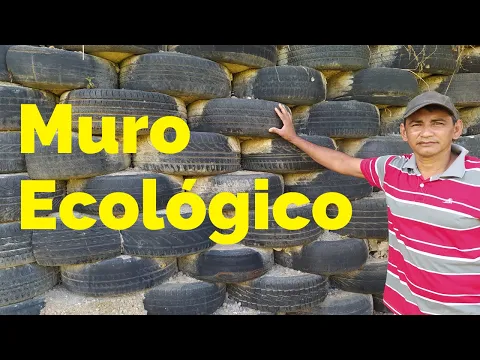

What makes this case especially relevant is the volume of repurposed material. Five thousand tires represent tons of rubber that, under normal conditions, could end up in landfills, vacant lots, or improperly discarded, bringing environmental and sanitary risks. In this case, the material gained structural function and became part of a permanent structure.
How the Technique Used in the Tire Wall Works
The method employed follows principles known in geotechnical engineering and the construction of gravity walls, even though it is executed in an artisanal manner. According to the report from the worker recorded in the video, the process followed well-defined stages.
The base of the wall was prepared with cement and concrete, creating a foundation capable of distributing the loads of the structure. On top of this base, the tires were positioned in successive layers. Each tire was internally filled with sand and gravel, ensuring weight and stability. After filling, the material was compacted before the next layer was placed.
Between the tires, vertical concrete columns were executed, described in the video as “columns of cement all filled with concrete.” These columns act as structural tying elements, reducing lateral displacement and helping to integrate the whole into a single resilient block.
The result is a wall that combines:
- the weight of the filled tires, which acts as a retaining force,
- the flexibility of rubber, which absorbs small movements of the soil,
- and the rigidity of the concrete columns, which ensure structural cohesion.
Quantity of Material and Execution Time
The numbers involved help to quantify the scale of the project. According to the account in the video, about 5,000 tires were used throughout the construction. The execution took approximately four months, with ongoing work on-site.

Even without exact data on the height or total length of the wall, the number of tires indicates a structure of large extent.
Considering the average size of a passenger car tire, stacking thousands of units requires planning, logistics, and constant labor, as well as care to maintain the alignment and stability of the layers.
Why Tires Work as Retaining Material
The use of tires in containment works is not an isolated invention. In different parts of Brazil and the world, the technique known as tire-soil has been studied and applied in slope containment, embankments, and access in areas of difficult mobility.
From a physical standpoint, the tire has interesting characteristics for this type of application. Rubber has high lateral compression resistance, great durability when buried, and a natural ability to absorb small deformations without rupture.
When filled with soil, sand, or gravel, the tire acts as a heavy block, similar to a gravity wall element.
In addition, the voids between tires and the internal granular material favor water drainage, reducing hydrostatic pressure, one of the main failure factors in poorly sized retaining walls.
A Simple Work, But Far From Being Improvised
Although the worker himself describes the construction as “a somewhat complex work”, the method applied reveals a clear structural logic. This is not about tires simply stacked randomly. There is a foundation, adequate filling, compaction, elevation in layers, and vertical tying with concrete.

This set of precautions differentiates the work from improvised solutions and helps to explain why the wall remains stable. Even without a formal project disclosed, the execution respects basic principles of containment engineering, albeit adapted to local reality.
Direct Environmental Impact of Repurposing
Repurposing 5,000 tires in a single project has a significant environmental impact. Improperly discarded tires are one of the most problematic types of waste in urban areas, as they accumulate water, favor the proliferation of disease-carrying insects, and have an extremely slow decomposition rate.
By being incorporated into a permanent structure, these tires cease to be an environmental liability and begin to serve a useful function for decades.
The worker himself highlights in the video that the work also represented a contribution to the environment, precisely for providing a proper destination for a problematic waste.
Why This Type of Work Rarely Appears in Large Projects
Solutions like the one adopted in Uruburetama rarely appear in large infrastructure contracts. This is because large-scale public works typically follow strict norms, standardized specifications, and conventional construction systems.

In local contexts, where access to heavy machinery and large volumes of concrete is limited, alternative techniques based on repurposing materials can be more viable. They require more manual labor but reduce costs with industrialized inputs and solve immediate containment problems.
An Example of Applied Popular Engineering
The tire wall in Uruburetama fits into what many call popular engineering: solutions built by local workers, with empirical knowledge, practical observation, and adaptation of known techniques to the real conditions of the terrain.
These works rarely make it into technical books but serve important structural functions and, in many cases, remain stable for years.
The fact that the worker himself states he had never seen a similar work in the region reinforces the innovative nature of the solution in the local context.
When Waste Becomes Infrastructure
The case of Uruburetama shows how urban waste can stop being a problem and transform into a solution. Tires, normally associated with irregular disposal, gained structural function in a work that required months of labor and planning.
More than just a simple wall, the construction became an example of how simple techniques, when well executed, can achieve heavy engineering results. Instead of concrete and steel in large volumes, the work utilized creativity, repurposing, and structural logic to solve a real problem.
In times of debate around sustainability, waste repurposing, and low environmental impact works, the tire wall in Ceará stands out as a concrete case — in the literal sense — of how engineering and the environment can walk together, even outside major centers and multi-million-dollar projects.










Comprobado una vez más que hay personas que no les falta capacidad sino oportunidades.Felicitaciones
QUE COISA MARAVILHOSA ALGUNS BRASILEIROS USAM A INTELIGENCIA PRA MELHORAR A VIDA DAS COMUNIDADES PARABENS
Espero que alguém da Prefeitura de São Paulo, leia esta minha postagem: já fazem quase 2 anos, que reclamo da montanha de pneus, empilhados ao tempo, na av Ricardo Jafet, 2423, por meio dos canais competentes da Prefeitura. A resposta é sempre as mesmas que devido ao elevado número de solicitações, será programada vistoria em breve com esta resposta, a Prefeitura considera que o munícipe foi atendido
E tudo continua igual. É muito triste..