





 Portuguese
  English
  Spanish
  4 min of reading
  0 comments


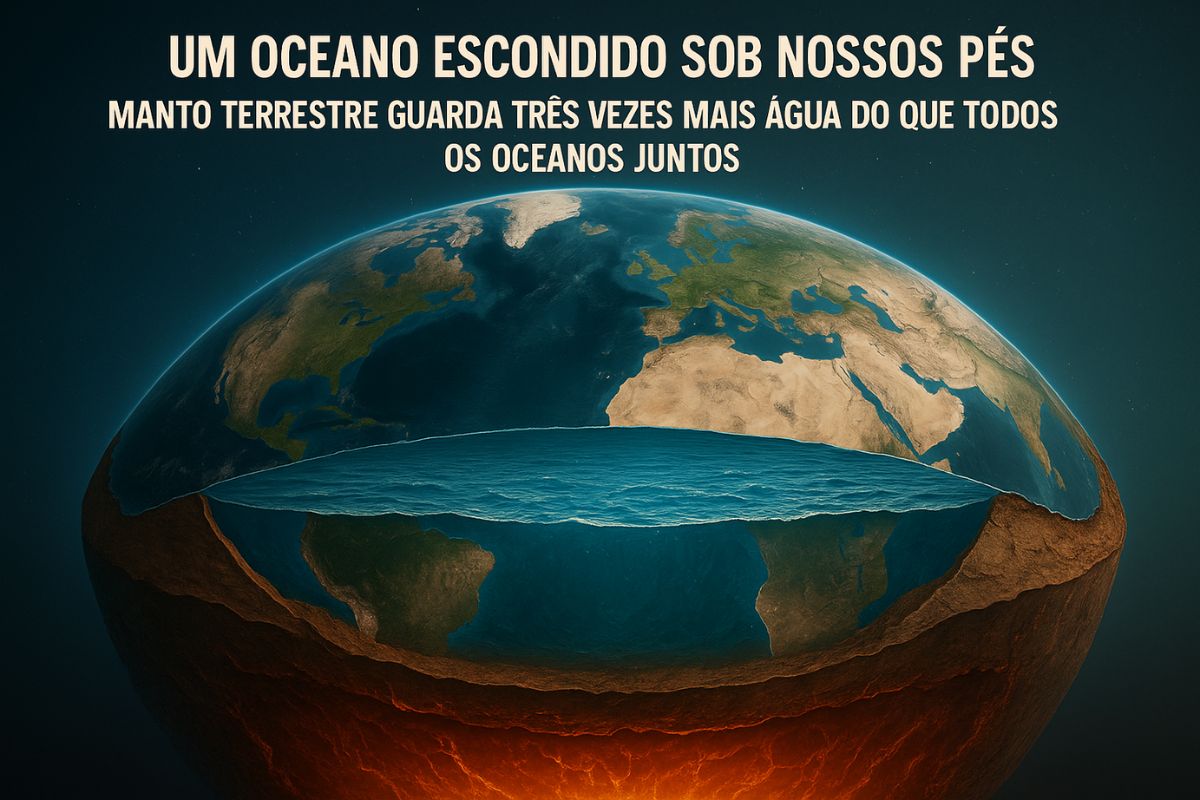
Impactful Discovery: There Is More Water Inside the Earth Than in the Oceans. Understand How a Diamond from Botswana Proved This
Get ready to rethink everything you know about the planet you live on. Hidden hundreds of kilometers deep, beneath the Earth’s mantle, lies a colossal reserve of water — invisible, inaccessible, and, until recently, unknown. We’re not talking about flooded caves or underground rivers but rather a gigantic “invisible sea” trapped within minerals under extreme pressure. And the first to imagine this possibility was none other than Jules Verne, in his classic Journey to the Center of the Earth.
The Echo of Earthquakes Revealed the Secret of the Mantle
For decades, scientists wondered how the Earth sustains so much water on its surface without it simply evaporating or being lost to space. One of the most intriguing hypotheses was the existence of a “deep water cycle” — a subterranean system capable of storing water for millions of years and releasing it slowly through volcanic activity.
This theory gained momentum in 2014 when geophysicist Steve Jacobsen and seismologist Brandon Schmandt made a surprising discovery. Using a network of more than 2,000 seismometers spread across the United States — called USArray — they captured the echo of earthquakes that reverberated 660 km below the Earth’s crust. There, they found clear evidence of magma at a depth where it should not exist.
-
He started running at 66 years old, broke records at 82, and is now a subject of study for having a metabolic age comparable to that of a 20-year-old, in a case that is intriguing scientists and inspiring the world.

-
With a cost per shot close to zero, the DragonFire laser could change naval warfare in 2027 and provide British ships with nearly unlimited defense against drones.

-
A British startup creates tires that generate electricity in electric vehicles when passing over potholes, speed bumps, and cracks.

-
Oldest tree on the planet reappears after 130 years of searches: Wattieza, 385 million years old, was 10 meters tall and had no leaves or seeds; Gilboa fossils in New York solved the mystery in 2007.

The explanation? A phenomenon known as dehydration melting, where water trapped in certain minerals is released, causing the rock around it to melt.
Ringwoodite: The Mineral That “Drinks” Water
The key player in this story is called ringwoodite, a mineral with a deep blue color that only forms under extraordinarily high pressures. It acts like a mineral sponge, capable of absorbing and retaining large volumes of water — not in liquid, ice, or vapor form, but integrated into its crystalline structure. Ringwoodite only appears at depths greater than 500 km and at temperatures above 1,100 °C.
When this mineral is pushed even deeper by tectonic plates, the pressure reaches a point where ringwoodite can no longer hold onto the H₂O. It is at this moment that the mineral “squeezes,” releasing the water that helps form the magma detected by Jacobsen and Schmandt.
How Much Water Exists Down There?
If only 1% of the weight of the rock in the so-called transition zone of the mantle contains water, that would be enough to triple the volume of all the oceans we know. It’s as if the Earth literally has a hidden ocean in its depths.
The Physical Evidence Came from Botswana — Inside a Diamond
The definitive confirmation of this hypothesis came in 2022, from an unlikely place: inside a diamond. Extracted from a mine in Botswana, the crystal contained fragments of ringwoodite with clear evidence of mineral hydration.
Diamonds are like capsules of geological time. They form at immense depths and under extreme conditions, and often trap pieces of minerals around them. A study conducted by gemologist Tingting Gu revealed, in this case, inclusions of ringwoodite, ferropericlase, and, crucially, hydrated minerals — which only form in the presence of water.
More than a mineralogical curiosity, this discovery proved that the Earth’s mantle breathes water. And most impressively, this water is not isolated but distributed in large internal expanses of the planet.
A Cycle That Has Shaped the Earth for Millions of Years
The deep water cycle operates in slow motion. Water from the oceans is pushed deep into the Earth through subduction of tectonic plates, becomes trapped in minerals like ringwoodite, and then is released through eruptions and seismic activity.
This process not only influences the behavior of volcanoes and earthquakes but also explains where all the water goes that disappears from the oceans over the centuries. According to the United States Geological Survey, this hidden cycle is essential for understanding the internal dynamics of the planet and the events that directly affect the Earth’s crust.
The conclusion? Jules Verne’s fiction was closer to reality than previously thought. No, you cannot navigate this hidden ocean. But it is there, pulsating beneath our feet, and its existence changes the way we understand the Earth.







-

-

-

5 pessoas reagiram a isso.