





 Portuguese
  English
  Spanish
  5 min of reading
  0 comments


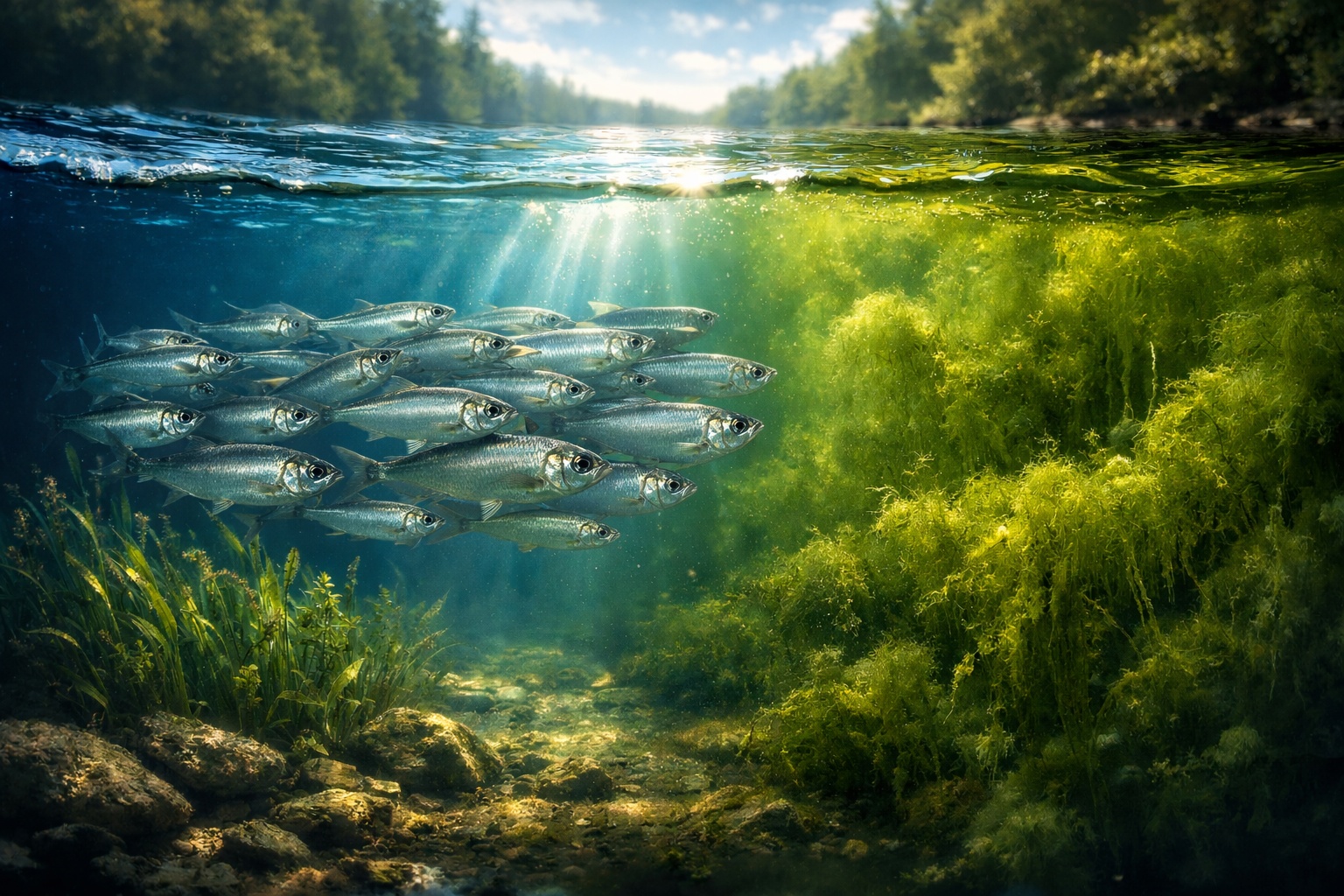
A Small Forage Fish Is Controlling Algae and Deciding If Lakes Are Clear or Cloudy; the Freshwater Sardine Exercises Silent and Powerful Ecological Engineering.
In many lakes and freshwater reservoirs, the difference between clear water and a permanently turbid system does not solely depend on sewage, fertilizers, or industrial pollution. In several cases, the decisive factor is swimming silently in the water column, without attracting the attention of environmental managers or the public. It is a small, forage fish, often seen only as food for larger species: the Alosa, popularly known as freshwater sardine.
Despite its modest size, this fish plays a disproportionate role in lake dynamics. Its intense feeding on plankton, its schooling behavior, and its enormous biomass make it an invisible ecological engineer, capable of clearing water, favoring submerged plants, and stabilizing ecosystems, or, at the opposite extreme, pushing the system into persistent algal collapses.
Why A Small Fish Can Control An Entire Lake
The key to understanding the impact of the freshwater sardine lies in the base of the aquatic food chain. Healthy lakes depend on a delicate balance between nutrients, microscopic algae (phytoplankton), zooplankton, submerged plants, and fish.
-
With a cost per shot close to zero, the DragonFire laser could change naval warfare in 2027 and provide British ships with nearly unlimited defense against drones.

-
A British startup creates tires that generate electricity in electric vehicles when passing over potholes, speed bumps, and cracks.

-
Scientists have created robots made with living cells that have their own nervous system, swim on their own, explore the environment, and self-organize without any genetic engineering, and now they want to do the same with human cells.

-
Students create a solar-powered ambulance that operates without a plug, without fuel, and still keeps medical equipment running in remote areas.


The Alosa operates precisely at this sensitive point. It primarily feeds on zooplankton, microscopic organisms that, in turn, consume algae. Depending on its population density, this fish can:
- drastically reduce zooplankton
- release algae from biological control
- increase water turbidity
- or, in certain contexts, directly consume particles that would sustain algal blooms
In other words, the same fish can save or destroy water clarity, depending on quantity, species, life stage, and lake characteristics.
The Invisible Logic of Trophic Cascades
Ecologists use the term trophic cascade to describe this type of chain effect. In the case of the freshwater sardine, the logic works as follows:
When Alosa populations grow too large, they consume large amounts of filtering zooplankton. Without this zooplankton, microscopic algae proliferate rapidly, turning the water into a green and opaque broth. Light cannot reach the bottom, submerged plants die, and the lake enters a stable turbid state.
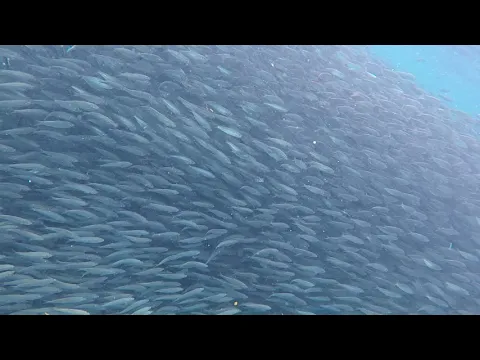

On the other hand, when fish density is moderate or when there are enough predators controlling their schools, zooplankton remains active. In this scenario, algae are kept in check, water remains clear, and the ecosystem balances itself.
All of this happens without explosions, without construction, and without visible signs, merely through the feeding pressure of a small fish.
Schools, Biomass, and Physical Impact on Water
In addition to the trophic effect, the freshwater sardine influences lakes physically. In many reservoirs, it represents one of the largest animal biomasses in the system, with millions of individuals moving in dense schools.
This continuous movement:
- keeps particles suspended
- interferes with natural sedimentation
- redistributes nutrients in the water column
Thus, even without digging the bottom like carp or worms, the Alosa contributes to keeping water turbid when in excess. In shallow lakes, this effect is even more pronounced.
Why Artificial Lakes Are Especially Vulnerable
Urban reservoirs and lakes provide perfect conditions for the population explosion of the freshwater sardine. They often have:
- few natural predators
- great availability of plankton
- higher temperatures
- absence of structural refuges
Additionally, many of these environments were created recently, without a balanced biological community. The Alosa takes advantage of this ecological void and becomes dominant rapidly.
In several documented cases, sanitation programs reduced external nutrients, but the water remained turbid because the internal trophic structure remained imbalanced.
When The Same Species Becomes Allied With Clarity
Interestingly, in some systems, the freshwater sardine can have the opposite effect. In juvenile phases or in certain species of the genus, it directly consumes fine particles and algae, reducing turbidity.
This shows that the problem is not the species itself, but the ecological context. The silent engineering of the Alosa is not intrinsically negative or positive; it is powerful.
Small changes in abundance, average age of the population, or the presence of predators can completely reverse the fish’s effect on the lake.
The Common Mistake In Water Management Policies
Many lake restoration projects fail because they ignore this type of internal biological control. Traditional logic focuses only on reducing phosphorus, nitrogen, and sewage. While this is essential, it does not resolve systems that have already collapsed trophically.
Without understanding the role of the freshwater sardine, managers:
- underestimate the impact of selective fishing
- ignore the importance of predators
- fail to restore submerged plants
The lake remains turbid, and the reason seems “mysterious.”
Predators, Fishing, and The Domino Effect
In lakes where large predators like pike, black bass, or native carnivorous fish have been reduced, the freshwater sardine finds room to multiply unchecked. The removal of these predators triggers an invisible domino effect, culminating in algal collapse.
On the other hand, projects that restore predators or adjust fishing pressure have managed, in some cases, to reverse turbid states without dredging or chemicals, simply by reorganizing the food chain.
Climate Change Amplifies The Effect
Global warming adds a new factor to the equation. Warmer waters accelerate the metabolism of the freshwater sardine, increase its reproductive rate, and prolong the annual activity period.
As a result, lakes that previously tolerated moderate populations begin to suffer from constant feeding pressure, favoring increasingly frequent algal blooms. The fish remains small, but its impact grows.
The freshwater sardine does not “try” to control lakes. It simply feeds, reproduces, and moves in schools, following simple evolutionary rules. Still, the cumulative effect of these actions transforms entire ecosystems.
This is the essence of silent ecological engineering: common species shape environments without any intention, merely through their massive presence and routine behavior.
An Uncomfortable Reminder About Environmental Control
The story of the Alosa shows that controlling ecosystems is not just a matter of infrastructure or technology. Sometimes, the fate of a lake depends on small, cheap, and ignored organisms that never appear in public debates.
While policies focus on treatment plants and hydraulic works, the real lever of the system may lie in a few-centimeter fish.
When Clarifying Water Requires Understanding Who Is Eating Who
Restoring lakes requires more than removing pollutants. It requires understanding who controls whom within the water. The freshwater sardine makes it clear that the base of the food chain is where invisible decisions are made.
Ignoring this fish means accepting that lakes continue to alternate between clarity and collapse without apparent explanation. Understanding it, on the other hand, paves the way for cheaper, more effective, and lasting solutions.
In the end, the freshwater sardine is an uncomfortable symbol of modern ecology. Small, common, and almost invisible, it demonstrates that it is not just major works or large animals that shape the environment.
Sometimes, the future of an entire lake is decided by a fish that almost no one notices—but that works, silently, every day.







-

-

-

10 pessoas reagiram a isso.