





 Portuguese
  English
  Spanish
  5 min of reading
  1 comment




How Deep Could We Dig a Hole? Check Out The Depth Records Reached On Earth And Learn About The Deepest Hole Ever Made, Over 12 Km!
Who has never imagined digging a hole to the center of the Earth? It’s an almost universal thought. But, of course, it remains an impossible dream, even with all current technology. The question remains: if we, as a species, decided that excavating the Earth would be our greatest goal, how deep could we really go?
The answer is fascinating and full of impressive milestones, some of which you might not have imagined were ever reached.
The First Layers: Where Most People Stop
If you start digging from any point on the surface, you will quickly pass through some depths that are part of our daily lives.
-
A barrier made with hair strands is used to clean the Guanabara Bay and employs simple technology to contain oil and waste.
-
Finland, the happiest country in the world, wants to hire 140,000 technology professionals and is eyeing Brazilians: visas are issued in just two weeks and salaries with a 37-hour workweek are surprising.

-
Mr. Mário reveals the technique of the caipira papaya: he cuts the fruit in half, discards the seeds from the tip, and plants the ones from the back to increase the chance of a productive female tree.

-
Few remember, but the submarine that disappeared in 1968 with 52 crew members was found after 51 years at the bottom of the sea at more than 2,000 meters, intriguing the entire world.

At just over 1.8 meters, you reach the so-called “standard burial depth” in many Western countries. If you ever wondered how a zombie apocalypse could start, this is the depth that would be used in movies.
Going down a little further, at 4 meters, archaeologists found the tomb of the pharaoh Tutankhamun in Egypt. At 6 meters, we reach the limit that most metal detectors can identify objects.
If you continue on to 12 meters, you will be at the depth of the deepest known animal burrows, such as those made by Nile crocodiles. At 20 meters, you reach the famous Catacombs of Paris, an underground labyrinth that houses the remains of over 6 million people.
Ever Deeper Human and Natural Structures
Now we start to dig a little deeper, towards impressive human structures and natural formations.
At 40 meters, we have the deepest swimming pool in the world, located in Poland and called Deepspot. To give you an idea, if the pool were drained and you jumped from the top, it would take almost 3 seconds to reach the bottom.
At 100 meters, we begin talking about nuclear safety: this is roughly the depth at which nuclear waste is stored in many countries. Just below that, at 105.5 meters, is the world’s deepest metro station, located in Kiev, Ukraine.
Plant roots are also impressive. The Wild Fig tree in South Africa has roots that reach 122 meters deep, a natural record.
At 220 meters, we find the deepest point of the Congo River, the deepest river on the planet. At 240 meters, you would be crossing the world’s deepest railway tunnel, which connects the Japanese islands of Honshu and Hokkaido.
Road tunnels also go deep. At 287 meters, we have the Ryfylke Road Tunnel in Norway, the deepest of them all.
Now, a curious and frightening fact: a penetrating nuclear bomb like the B83 from the United States can destroy structures located up to 305 meters below ground, according to information from the Federation of American Scientists.
The Deepest Hand-Dug Hole…
Incredibly, a hole dug by hand reached 392 meters. This is the Woodingdean Well in the United Kingdom, dug in 1862. An impressive feat for the time.
But there’s more: at 603 meters, you find the deepest vertical drop ever recorded inside a cave. If someone fell into this abyss, the fall would be longer than jumping from the top of the One World Trade Center in New York and would last over 11 seconds.
At 700 meters, we have a case that marked the world: it was the depth at which 33 Chilean miners were trapped for 69 days in 2010 during the famous San José mine accident.
At 970 meters, we find the largest open-pit mine in the world, the Bingham Canyon Mine in Utah (USA). Its hole is so deep that you could fit an entire Burj Khalifa inside and still have over 100 meters to spare.
Music, Caves, and Extreme Mining
At 1,410 meters, the deepest concert ever held took place, performed by the Finnish band Agonizer. The Baikal Lake in Russia reaches 1,642 meters in depth, making it the deepest in the world.
The bottom of the Grand Canyon is 1,857 meters deep. And the deepest cave ever explored by humans, the Veryovkina Cave in Georgia, reaches an impressive 2,197 meters.
Even deeper, at 3,132 meters, is the Moab Khotsong Mine in South Africa. If you fell from the top, you would have 25 seconds of free fall. A trip in the elevator to the bottom takes about 4.5 minutes.
Another curious fact: at 3,600 meters, scientists discovered one of the deepest multicellular organisms ever found, a type of worm that survives in these extreme conditions.
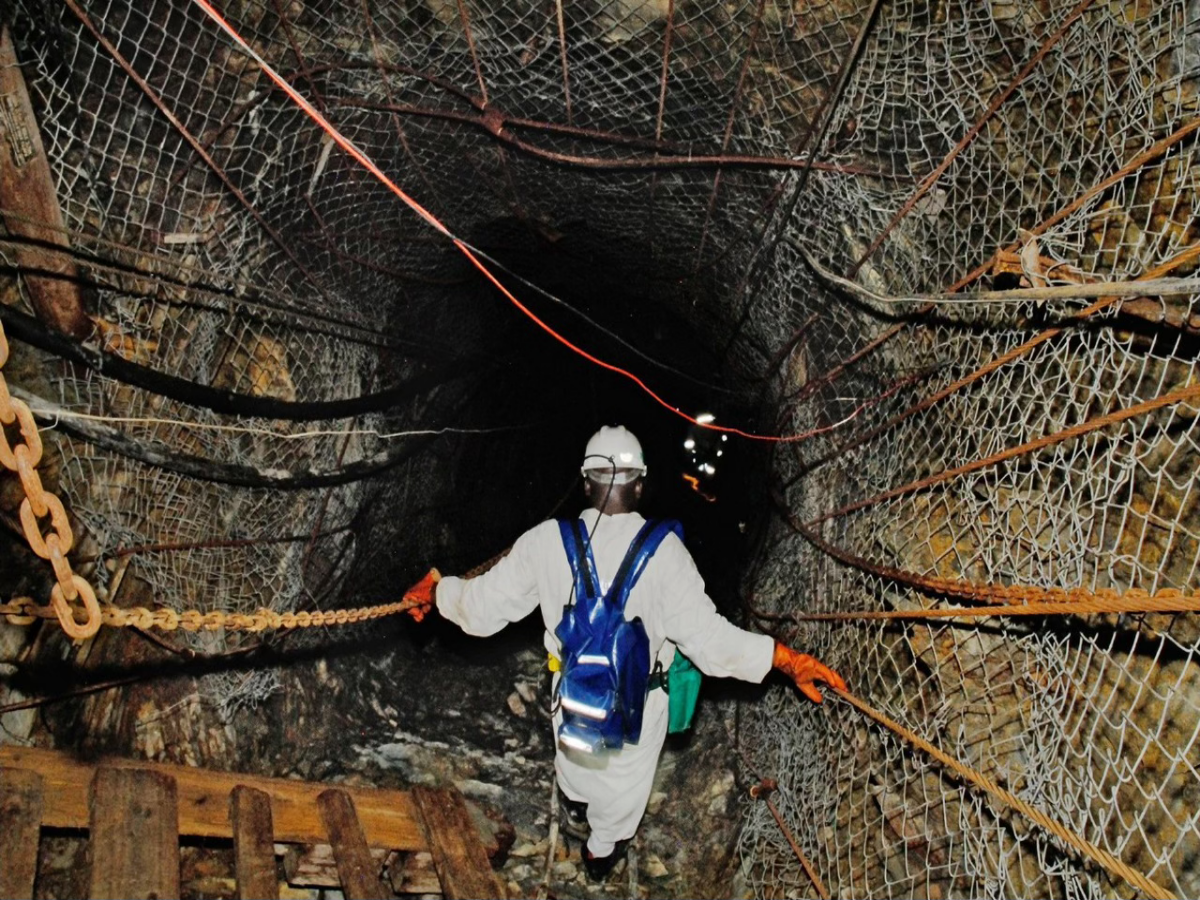
But humans have gone further. The deepest mine ever operated by humanity, also in South Africa, reaches a depth of 4,000 meters. The elevator ride to the bottom takes over an hour, and the temperature there can exceed 66 degrees Celsius.
And What If We Want To Go Even Deeper?
The oceanic crust, beneath the ocean floor, has an average depth of 6,000 meters. If you put the entire Mount Everest inside a hole, with its 8,848 meters, you still wouldn’t be anywhere near the center of the Earth.
The deepest point of the ocean, the Mariana Trench, reaches 10,994 meters. But guess what? We have already dug deeper than that.
The famous Soviet project Kola Superdeep Borehole in Russia reached 12,262 meters. The drilling was stopped when the temperature reached 180 degrees Celsius, making it impossible to continue.
More recently, an oil well called Z-44 Chayvo in Russia surpassed this record by reaching 12,376 meters, according to the company Rosneft. To visualize this, it would be like stacking 15 Burj Khalifas on top of each other.
However, the Earth’s crust can reach up to 70,000 meters in depth, and the center of the Earth is about 6,371 kilometers from our surface. If we compare this with a map, it would be like starting from Lisbon and trying to reach Astana in Kazakhstan, and so far, we have only managed to scratch the surface.
Despite incredible advancements, our journey to the center of the Earth is still in the first centimeters. Deeper drillings encounter extreme temperatures, colossal pressures, and enormous technological challenges.
But who knows? If humanity ever really makes this a priority, perhaps we can go deeper than we ever imagined.







Por que fazer isso? Criança destruindo o brinquedo! Prova de inteligência inferior. Parabéns pelo excelente artigo.