





 Portuguese
  English
  Spanish
  4 min of reading
  0 comments


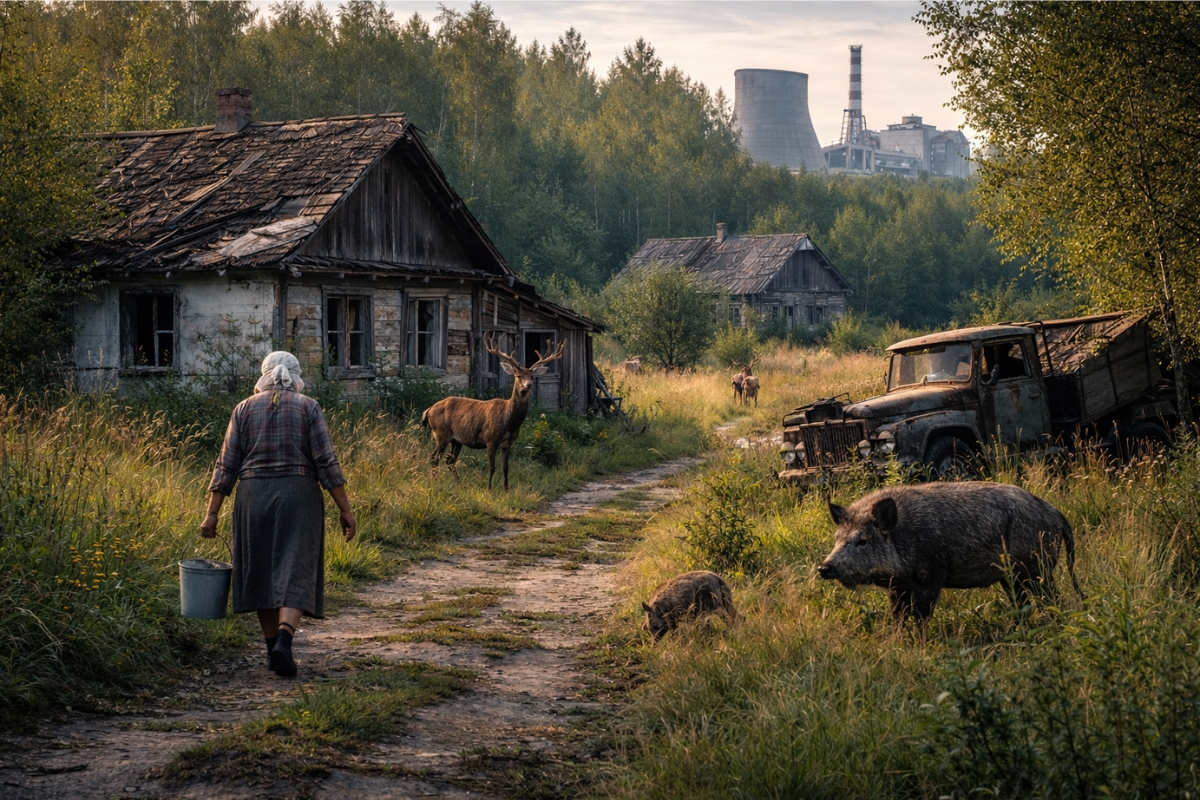
The Area of 2,600 Km² Still Has Residents, Strict Control, and Points of Irregular Contamination That Changed Life and the Environment Around
The Chernobyl exclusion zone became known as a deserted territory, but there are permanent residents in small villages surrounded by forests and ruins.
The restricted perimeter emerged after the 1986 accident and took shape as a radius of 30 km, creating a vast area with controlled access and minimal human presence.
This scenario opened space for a phenomenon that still draws attention today: large animals began to occupy the territory with much less pressure from hunting, agriculture, traffic, and noise.
-
Archaeologists find a colossal 2,000-year-old vessel at the bottom of the sea near Alexandria linked to the elite of Egypt and reveal a pleasure barge from the last dynasty of the pharaohs that the sea has hidden for centuries.

-
United Kingdom clears 40 tons of shells and concrete into the sea in an innovative project that promises to restore a marine ecosystem lost for over 200 years and improve water quality.
-
With emergency diversion to abandoned mining craters, engineers save villages from a devastating flood that was advancing through the desert and threatening to destroy entire communities in a matter of hours.
-
It seems simple, but it enriches: from R$ 500 to R$ 6,000 per piece and up to 10 days of handcrafted production, how is the couple from Praia Grande making a high income with hyper-realistic miniatures and turning a hobby into a money-making machine?


How the Exclusion Zone Emerged and Why It Still Has Residents
The exclusion zone occupies about 2,600 km² and maintains restrictions that limit permanent residence and free circulation. Nevertheless, some villages remain inhabited, generally by older people who returned after evacuation.
A concrete example is Opachychi, a locality recorded with 15 inhabitants in 2019. This type of presence tends to be scattered across various points, not concentrated in a single village.
Recurring estimates indicate around 180 to 200 permanent residents spread across 11 villages and the city of Chernobyl, not including Pripyat.

Why Radiation Still Matters Almost 40 Years Later
Contamination is not uniform, and this changes everything in practice. There are areas with very different levels, including critical points that require more caution.
Some radionuclides grab attention because of their half-lives and persistence in the environment. Iodine-131 has a half-life of 8 days, which explains its significance in the initial phase. Meanwhile, strontium-90 has about 29 years, and cesium-137 approximately 30 years.
These timeframes help explain why the risk hasn’t disappeared but has merely changed form. Prolonged exposure varies depending on the location, soil type, and particle movement.
Wildlife Has Thrived Without Human Pressure, But the Scenario Is Not Simple
The reduction in human presence eliminated many factors that typically push wildlife away. With less agriculture, fewer active roads, and less hunting, large mammals gained more space.
Field studies compared the relative abundance of moose, roe deer, deer, and wild boars within the zone to nearby protected areas, finding similar values. The data that stood out the most was with wolves, whose abundance was more than 7 times greater than in neighboring reserves.
At the same time, science continues to measure the effects of chronic exposure on different groups. There is no single answer, as species, habitats, and doses vary considerably within the territory.
The Return of an Unlikely Symbol, the Przewalski Horses

One of the most striking images of the place involves the Przewalski horses, introduced in 1998 as part of a reintroduction effort.
There have been recorded births in the territory, with 86 births counted between 1998 and 2007. This data reinforces how the area has become a refuge for certain populations, despite environmental limitations.
The presence of these animals has also become a reference for understanding how populations respond when the dominant factor is no longer human.
What Exists Today Within the Perimeter and How the Area Is Maintained
The exclusion zone is not a completely abandoned place. It combines small numbers of permanent residents with monitoring activities, environmental control, and maintenance of structures.
The most emblematic part of the modern engineering at the site is the New Safe Confinement, positioned in 2016 to contain and isolate what remains of reactor 4. The structure is part of the ongoing effort to reduce risk and enable long-term work.
This arrangement shows a territory that is neither free tourism, nor completely empty, nor a resolved scenario. The area remains a controlled zone, with technical and environmental challenges that continue to evolve.
Where the Risk Remains and Why It Varies Within the Area
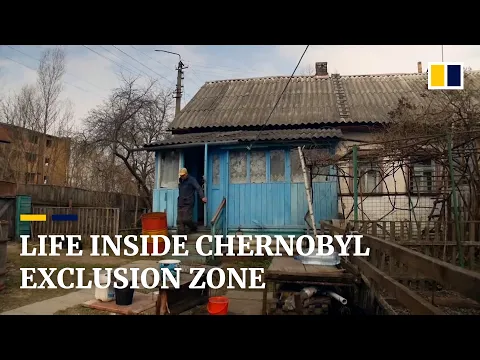

The expression “villages with fewer than 300 residents” often reflects the total number of permanent residents across different villages, rather than a single urban core.
Contamination remains a practical issue because there are critical points and because some relevant radionuclides have half-lives of 29 years and 30 years, keeping the discussion active.
The presence of abundant wildlife does not eliminate radiological risk. It mainly shows the effect of decades with less human interference, while the biological impacts vary depending on the location and species.
The territory of Chernobyl remains a rare case of coexistence between human restriction, technical monitoring, and a nature that has rapidly advanced in previously occupied areas.
The result is a place where the landscape has changed, wildlife has thrived, and engineering has needed to create lasting solutions to deal with an accident that marked 1986.






-

-

3 pessoas reagiram a isso.