





 Portuguese
  English
  Spanish
  3 min of reading
  18 comments




‘The Loch Ness Monster’ Surfaces in California! 3-Meter Creature Associated with Earthquakes Intrigues Experts
In recent months, a curious detail occurred along the California coast: the increase in the number of strandings of the oarfish, nicknamed The Loch Ness Monster, is an impressive-looking creature still shrouded in mystery.
This fish, which can reach lengths of up to 30 feet, has generated fascination and intrigue among scientists and the public. Recently, a specimen was found north of San Diego, bringing to light a series of questions about its biology and why it appears in such isolated areas.
-
In a flooded well, archaeologists found a 1,700-year-old Roman egg that still contains clear and yolk intact inside the very thin shell.

-
Something is happening around the Earth: Inside the huge explosion of fireballs in 2026

-
A hot air bubble coming from Argentina expands over Brazil, causing thermometers to exceed 38 degrees with a thermal sensation of 40 degrees in late March, affecting 6 states at once.

-
The radish leaf that almost everyone throws away has more polyphenols, flavonoids, and fiber than the consumed root, and a 2025 study showed that the leaf contains compounds that protect the intestine, combat inflammation, and may inhibit the growth of cancer cells.

The oarfish, also known as ribbon fish, earned the nickname “The Loch Ness Monster” due to its threatening appearance and association with ancient tales involving natural disasters.
In 2011, the discovery of oarfish off the coast of Japan, shortly before a major earthquake and tsunami, led many to believe that these fish could be precursors to disasters.
However, scientific studies, such as the one conducted in Japan in 2019, found no connection between strandings and seismic activities, although the mystery surrounding the fish continues to fascinate.
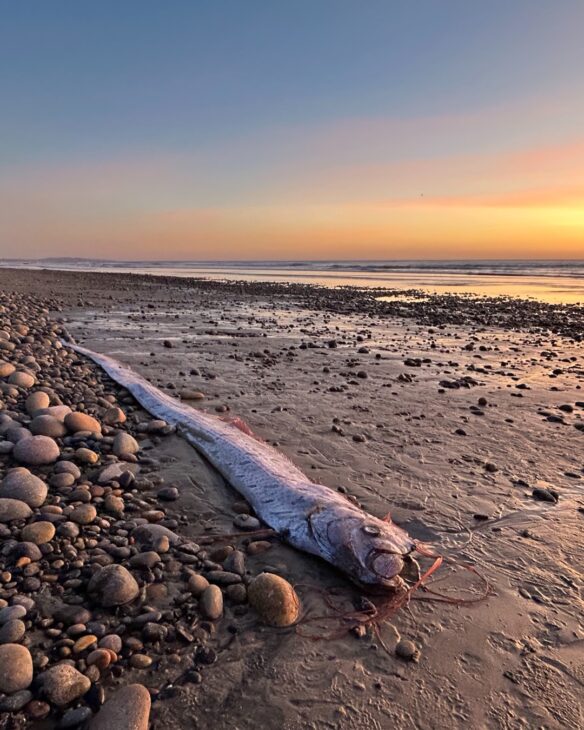
The Stranding of the “Loch Ness Monster”
The oarfish, which was found in the city of Encinitas, weighed about 10 feet and was discovered by Alison Laferriere, a researcher from the Scripps Institution of Oceanography.
According to Ben Frable, manager of the Marine Vertebrate Collection at the institution, the specimens were frozen for further studies, allowing an in-depth analysis of the biology, anatomy, and life history of the oarfish.
“We collected samples and froze the specimen awaiting more in-depth studies,” Frable commented. The oarfish is one of the most elusive creatures of the deep sea, inhabiting deep waters, about 300 to 3,300 feet deep, a zone where sunlight barely reaches.
This characteristic makes studying its biology difficult, especially when it comes to observing them in their natural habitat.
An Increase in Sightings
Interestingly, the recent discovery of an oarfish in California is the third in a few months. In August, a fish measuring 11.8 feet was found, and at the end of September, another oarfish was located in Huntington Beach, though this one was in very deteriorated condition for study.
The increase in sightings is something that intrigues researchers. Historically, since 1901, only 22 oarfish strandings have been recorded along the California coast.
This number seems to be growing, which led Frable to suggest that changes in oceanic conditions may be playing an important role. Factors such as El Niño characteristics, red tides, and strong winds may be contributing to the increase in strandings.
“It may have to do with changes in oceanic conditions and the increase in the number of oarfish along our coast,” Frable explained, although he noted that variations are often poorly understood.
Diving into the Mystery
Despite the curiosity surrounding the oarfish, much about its biology is still unknown. For example, the feeding of the oarfish is a mystery in itself.
It primarily feeds on small crustaceans, using a powerful mouth to attract its prey.
Additionally, underwater footage revealed intriguing behavior: the oarfish swims vertically, upside down, using its dorsal fins to help spot its prey against the dim light.
In August, the discovery of an oarfish in La Jolla provided researchers with its first high-quality genome, an important milestone for understanding the biology of this mysterious species.
However, studying its anatomy, behavior, and ecology remains a challenge, especially since it is rare to find live specimens, making it difficult to study in their natural environment.








Tá um Remo! Essa matéria!
Na realidade, esse peixe costuma pegar algumas réguas até inteirar 03 metros e leva pra pesar…
Só uma curiosidade ele pesa 3metros ou ele tem trêis metros 🤔🤔🤔tô tentando entender