





 Portuguese
  English
  Spanish
  5 min of reading
  6 comments


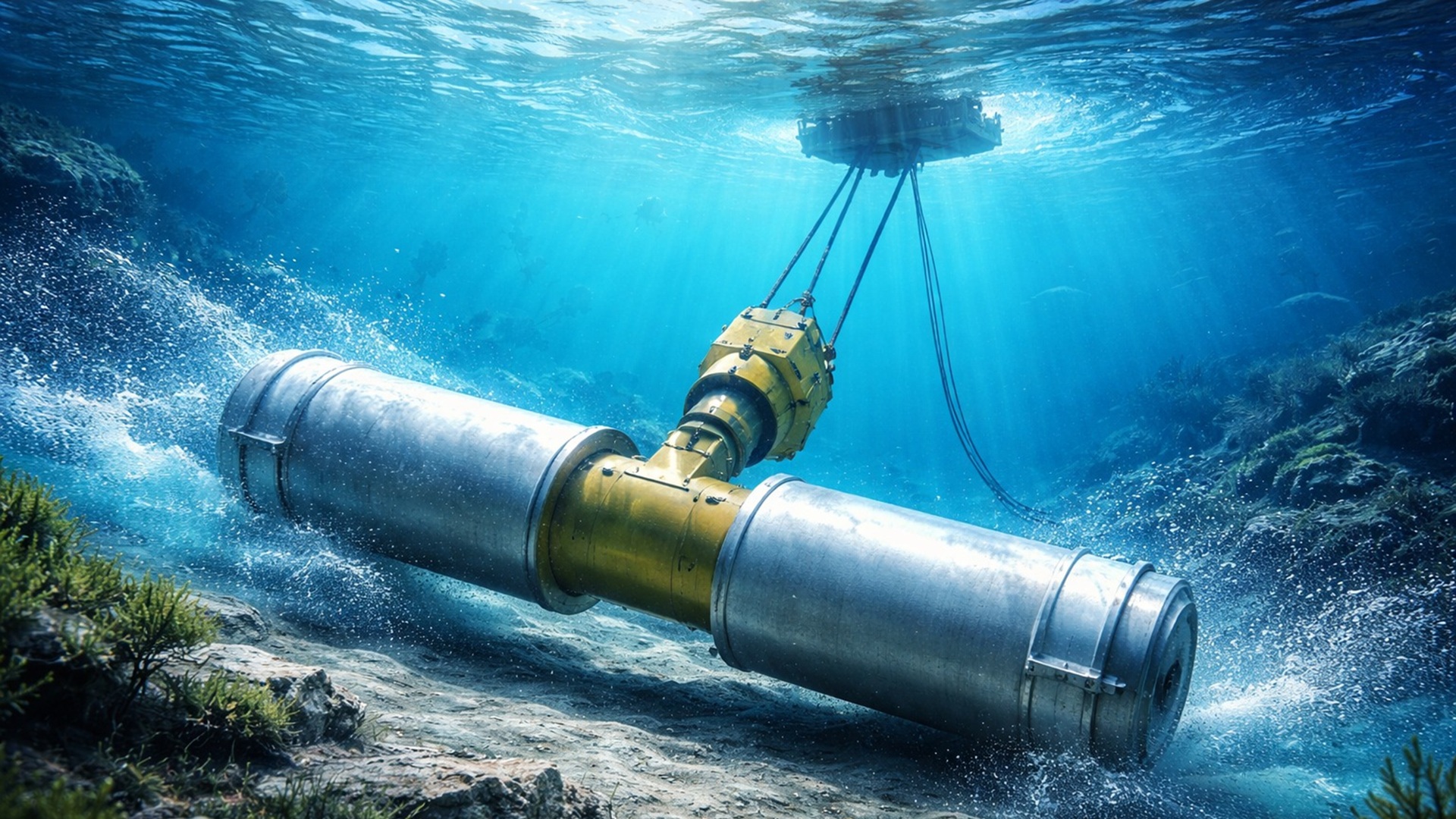


Developed By Spanish Researcher, The Experimental System Uses A Submerged Cylinder That Oscillates With Ocean Currents, Converts Vibrations Into Electricity, Reaches 15% Efficiency In Controlled Tests And Reduces Costs By Keeping Critical Components Out Of Water
The Spanish researcher Francisco Huera, from Universitat Rovira i Virgili, in Catalonia, southern Spain, developed an energy system based on a pendulum that uses vibrations induced by ocean currents to generate electricity.
The invention can achieve about 15% efficiency in laboratory tests while drastically reducing the complexity of submerged equipment.
A Known Physical Principle Applied In An Unprecedented Way
The extraction of energy from the ocean is usually associated with large turbines installed underwater, with rotors, blades, and complex structures.
-
With a cost per shot close to zero, the DragonFire laser could change naval warfare in 2027 and provide British ships with nearly unlimited defense against drones.

-
A British startup creates tires that generate electricity in electric vehicles when passing over potholes, speed bumps, and cracks.

-
Scientists have created robots made with living cells that have their own nervous system, swim on their own, explore the environment, and self-organize without any genetic engineering, and now they want to do the same with human cells.

-
Students create a solar-powered ambulance that operates without a plug, without fuel, and still keeps medical equipment running in remote areas.

The system proposed by Huera follows a different path by exploring a well-known physical phenomenon that is rarely used as an energy source: the vibrations induced by flow.
When a water current flows around a cylindrical body, alternating vortices are formed that generate periodic oscillations. Historically, this effect has always been treated as a problem in naval and offshore engineering, due to causing structural fatigue. In the new system, it becomes the central element of energy generation.
The device consists of a submerged cylindrical tube, suspended by an axis, that oscillates like a pendulum when interacting with the ocean current. This mechanical oscillation is then converted into energy through a transmission and generation system located out of the water.
Only One Submerged Component And Reduced Maintenance
One of the central aspects of the proposal is that only the cylinder remains in direct contact with the water. The axis, mechanical transmission, and generator can be positioned externally, even on floating platforms.
This configuration significantly reduces problems associated with corrosion, biofouling, and wear of critical components.
The structural simplification represents a relevant difference compared to conventional turbines. Systems with multiple submerged moving elements require frequent, costly, and technically complex maintenance, in addition to long periods of inactivity.
In the oscillating model, the majority of interventions can occur outside the underwater environment.
According to the researcher, it is essentially “just a tube hanging on an axis”, a simple description that summarizes the proposal to minimize components and failure points without abandoning energy conversion.

In part (b), there is a schematic drawing that explains how the system works: the cylinder oscillates within a container, subject to the action of weight, medium resistance, and forces that slow down the movement. Sensors record the angle and rotation over time.
In part (c), the results of the air test are shown. The left graph indicates that the oscillations start large and gradually decrease until stopping, following a regular pattern of energy loss. The right graph shows the main frequency of this oscillation, which was around 1.6 oscillations per second.
Controlled Tests And Scientific Validation
The study results were obtained from tests conducted in a hydraulic channel of the fluid-structure interaction laboratory at the Spanish university.
During the experiments, an electromagnetic brake was coupled to the system to measure the amount of mechanical energy extracted as a function of the intensity of the oscillations.
The data were subsequently published in the scientific journal Journal of Fluids and Structures, validating the performance of the device under controlled conditions.
The tests showed power coefficients close to 15%, a value compatible with other systems based on vibrations induced by flow.
Although lower than the maximum potential of ocean turbines, this level of efficiency was achieved with a structurally simpler system, without rotors or blades, and with reduced exposure of sensitive components to the marine environment.
Direct Comparison With Traditional Ocean Turbines
Axial or cross-flow turbines are currently the standard for harnessing energy from ocean currents. Under ideal conditions, they can exceed 50% theoretical efficiency, but in practice, they rarely exceed 25% to 35%.
In addition to the real performance limitations, these turbines present significant operational challenges. They are large structures, with multiple submerged moving components, subject to continuous wear and high maintenance costs. Many projects remain in pilot phase, without large-scale commercial deployment.
The pendulum system does not seek to directly compete with these maximum efficiency levels.
The proposal is based on accepting a more discreet, yet constant, generation, with gains in simplicity, reliability, and operational feasibility in locations where conventional turbines would be impractical or economically unfeasible.

Moderate Efficiency And Context Advantages
The experimental results indicate that the efficiency of the oscillating system corresponds to about half of what is achieved by a well-designed turbine. Still, the context of application changes the performance assessment.
These devices occupy less space, present lower construction complexity, and can be installed in environments where large rotors are not suitable.
The transfer of the most complex part of the system out of the water also allows for quicker interventions, reduced downtime, and potentially longer lifespan.
From an engineering perspective, the approach shifts the focus from maximizing absolute efficiency to optimizing the set of efficiency-operationality-maintenance, a relevant balance in distributed applications.
Potential Applications And New Research Directions
The system is of particular interest for tidal currents, where water movement is predictable and continuous. It can also be adapted for rivers with sufficient flow, without the need for dams or diversions, reducing environmental impacts on the river ecosystem.
The research also explores the application of the same principle to wind, broadening the concept to other fluids and energy contexts.
This versatility reinforces the modular nature of the technology, which can be combined with other renewable sources.
Current research focuses on the analysis of the dynamic behavior of the pendulum and the quantification of the available mechanical power. It does not yet include the complete design of a commercial generator or a detailed economic assessment, which is still lacking.
Next Steps And Conceptual Change In Engineering
The next steps involve optimizing energy extraction, adjusting the braking torque according to hydrodynamic load, and studying the interaction between multiple devices to increase the energy generated per unit area.
There is also a relevant conceptual change. For decades, flow-induced vibrations have been treated as a silent enemy of engineering, responsible for failures and structural fatigue. Huera has even developed solutions to mitigate them and holds a European patent in this area.
Now, the same phenomenon is seen as an energy resource.
Even if it is not an isolated solution to the climate crisis, the system contributes a low-impact technical alternative, capable of providing local energy for oceanographic buoys, monitoring stations, and small coastal installations, helping to diversify the portfolio of renewable sources pragmatically and efficiently.







Pode ser usado com vários pontos ao longo de um rio a ponto de manter ou a ponto de criar uma reserva de energia para uma comunidade?
Ora, ora, mas quem não sabe que a pressã subaquática oceânica é um grande e infinito gerador de energis?
Parabéns pelo artigo! 👏🏻👏🏻👏🏻 Mas por favor, mudem a gravura de apresentação. Essa arte não tem nada a ver com o invento do engenheiro espanhol.