





 Portuguese
  English
  Spanish
  6 min of reading
  0 comments


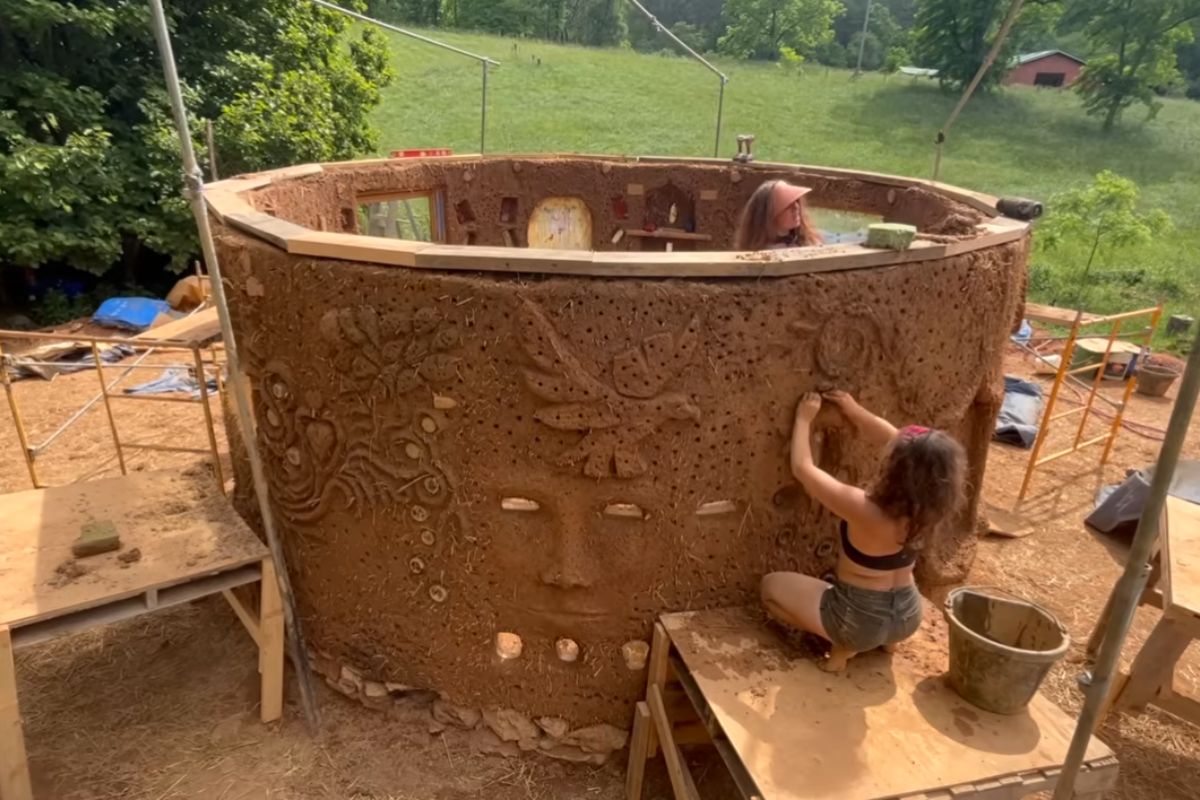
In The North Carolina Mountains, A Five-Week Workshop Condensed Into Timelapse Follows An Adobe House Made With Clay, Sand, Straw, And Local Wood, From Floor To Roof. The Draining Foundation And Clay Plaster Reveal Why Every Decision Defines Performance, Not Aesthetics In Daily Life.
The adobe house was built over five weeks in a workshop in the North Carolina mountains, with an accelerated recording that compresses the entire process into 10 minutes. What seems like a direct leap from mud to a finished wall actually depends on repeated and measurable choices, especially in the foundation and moisture control.
The mixture of clay, sand, straw, and local wood appears as a low-impact and highly adaptable solution, but it only delivers performance when the site works as a system. Each step interacts with the next, from the earthen floor to the clay plaster, until reaching the roof and the final details that define durability and comfort.
Foundation, Drainage And The Rule Of Keeping Adobe Dry

The foundation stage begins with a drainage trench dug at a slight downward slope.
-
Mr. Mário reveals the technique of the caipira papaya: he cuts the fruit in half, discards the seeds from the tip, and plants the ones from the back to increase the chance of a productive female tree.

-
Few remember, but the submarine that disappeared in 1968 with 52 crew members was found after 51 years at the bottom of the sea at more than 2,000 meters, intriguing the entire world.

-
With 1,200 tons suspended, the Japan mega-structure in a grid shape with a floating sphere from Fuji TV features two 25-story towers connected by elevated walkways, titanium panels, and impresses the world with its ability to reduce wind impact.

-
The village where two rivers run side by side without mixing in Santarém and Alter do Chão reveals some of the most beautiful freshwater beaches on the planet.


The verification is done directly by pouring water at the highest point and observing if the flow confirms proper drainage.
Only after that do landscaping fabric and compacted gravel come in, creating a stable bed.
On top of this bed, the stone foundation is stacked to elevate the base of the walls.
The goal is twofold: to lift the adobe house away from contact with moist soil and to support the weight of the monolithic wall system.
The same logic appears later in the roof, when large overhangs are treated as essential protection against rain.
Earthen Floor, Simple Insulation And The Logic Of The Compacted Layer

With the foundation completed, the floor begins with a compacted layer of gravel aimed at drainage.
After compacting and leveling, layers of insulation made from discarded cardboard pieces are added.
The surface receives clay slip to improve the bond between the layers before filling.
The foundation of the floor is poured and leveled with a mixture of clay, sand, gravel, and straw, reaching about 4 inches in depth in the described stage.
The work is repetitive by necessity: integrating the mixture into itself, leveling, and correcting weak points.
An improperly compacted floor becomes stored moisture, and moisture is a permanent risk for an adobe house.
Cob, Mixture In The Canvas Method And The Search For Consistency
The cob phase, described as the first batch, starts from dry mixed clay and sand.
Next, water is added before kneading with the feet, in a procedure known as the canvas method.
As it is stomped and rolled, the mixture becomes homogeneous and reaches a shape similar to a burrito, a practical signal of consistency.
Straw is added at the end to provide tensile strength in the wall system, and the mixture is stomped again until fully integrated.
Then, the mass is shaped into loaves to facilitate transportation and application.
The technical detail is that consistency and repetition replace haste, because variations in moisture and proportion later appear as cracks, loss of shape, or clay plaster with irregular adhesion.
Monolithic Walls, Seaming Between Layers And Frame Fittings


The construction of the walls advances by laying clay slabs in sequence and stitching them by hand to form a monolithic mass without seams.
The priority is to eliminate visible joints, integrate each layer into the previous one, and keep the wall working as a single body.
A tool called a cobbler’s thumb is used to stitch and incorporate the layers as the height increases.
The logistics of the site are also treated as part of the method.
To carry the mixture to the application area, the group forms a line and passes the loaves of cob hand to hand, maintaining the rhythm and integration of the mass.
With enough layers, levels and saws come in to trim the wall and seek the desired shape, especially after installing doors and window frames.
At this point, the adobe house rises in height, but the stitching discipline continues because the roof depends on a leveled top.
Sculpture, Adhesion And Clay Plaster As Functional Finishing
With the walls completed, the sculpture phase uses a similar mixture of clay, sand, and straw to create details such as shapes, niches, shelves, and elements around windows.
Before applying the sculpture, the wall is dampened so that the new material connects to the existing base.
In the end, intentional perforations are made in the sculptures to facilitate the clay plaster’s adhesion.
The clay plaster is prepared with different combinations of clayey soil, coarse sand, fine sand, and manure, tested in small batches before full application.
After choosing the proportions, teams mix the components until achieving a homogeneous mass.
The wall is dampened again, and the clay plaster is spread and shaped with hawks and trowels, as well as rigid and flexible spatulas to vary the finish.
The application proceeds from top to bottom, with continuous refinement of details and shapes.
For thin areas, yogurt lids and spoons are used as precision tools, while final polishing smooths the exterior.
On the interior, the clay plaster is reapplied to adjust sculptures, level with doors and windows, and integrate tile and marble mosaics.
Here, the finish is performance, because the clay plaster also helps control dust, microcracks, and the tactile feel of the environment.
Reciprocal Roof, Structural Tie And Layers Of The Green Roof
Before the roof, a tie beam is installed, fixed to the embedded connection pieces in the wall.
This system creates structural continuity between the roof and walls, preventing the covering from working as an isolated element.
With this ready and the clay plaster finalized, the assembly of the reciprocal roof enters, where the beams mutually support each other without a permanent central support.
The installation begins with the first beam resting on a temporary support, and the others are secured with threaded rods and screws as the sequence advances around the axis.
The final beam requires slightly lifting the set to slide into place, at which point the geometry of the roof no longer depends on the temporary support.
Next, secondary beams reinforce the set and support the covering boards, with shims used to level planes before contour cutting with chalk lines.
The upper layers build the green roof. First, the insulation is made with discarded carpet pieces, followed by a waterproof membrane.
Then come sand, straw, and local clay soil, in addition to the drainage system.
A skylight is installed in the center of the roof, and the final closure requires new batches of clay and clay plaster to eliminate gaps between the top of the walls and the roof, protecting the adobe house from infiltration and thermal variation.
Closures, Finished Floor And What The Process Reveals About Natural Construction
With the covering resolved, the floor receives the finishing stage.
The floor is dampened, and a mixture of clay, sand, and manure is poured over the base, then leveled with boards and spatulas in sections.
The advance through areas reduces variations, maintains the level, and improves the cohesion of the floor, which dialogues with the same logic of the cob and clay plaster: homogeneity as risk control.
In the end, the front door is installed, and the cob cabin becomes a usable adobe house, with molded walls, integrated niches, and a roof that combines reciprocal structure and vegetated layers.
The synthesis of the process is simple yet demanding: well-drained foundation, moisture control in every layer, and honest decisions that avoid shortcuts. When this fails, aesthetics may survive, but durability does not.
The question that remains is not whether the adobe house looks charming, but what choice you consider decisive for an earth construction to function for years. In your view, what weighs most in trusting an adobe house: the foundation with drainage, the well-adhered clay plaster, or the roof with large overhangs and complete layers? And why?







-

-

5 pessoas reagiram a isso.