





 Portuguese
  English
  Spanish
  4 min of reading
  0 comments


On the Border of Mato Grosso and Goiás, a Small Brazilian City, Araguainha, Lies Over a Colossal Scar 40 km in Diameter. This is the Stage of the Largest Meteorite Impact in South America, an Event That May Have Had Global Consequences Millions of Years Ago.
In the heart of Brazil, between the states of Mato Grosso and Goiás, lies a landscape that bears witness to a cosmic event of cataclysmic proportions: the Araguainha Dome. This is the largest meteorite impact crater in South America, and within it, or on its edges, live communities, including the small Brazilian city of Araguainha (MT), which lends its name to the structure.
Formed about 254.7 million years ago, the Araguainha crater is not only a geological wonder but a site that holds secrets about the history of Earth. There are even possible connections to the largest mass extinction on the planet. Let’s explore this amazing Brazilian city and the monumental geology that defines it.
The Araguainha Impact: The Genesis of the Largest Meteorite Crater in South America, Where This Brazilian City is Located
The Araguainha Crater, with its impressive 40 kilometers in diameter, was formed by the violent collision of a celestial body, estimated to be between 2 and 3 kilometers wide, with Earth. This event occurred approximately 254.7 million years ago, at the boundary between the Permian and Triassic periods, in a region that was likely a shallow sea.
-
How 5,000 Indian dabbawalas manage to deliver around 200,000 lunchboxes a day in Mumbai for over 130 years using bicycles, crowded trains, and a manual system that continues to operate with impressive accuracy.

-
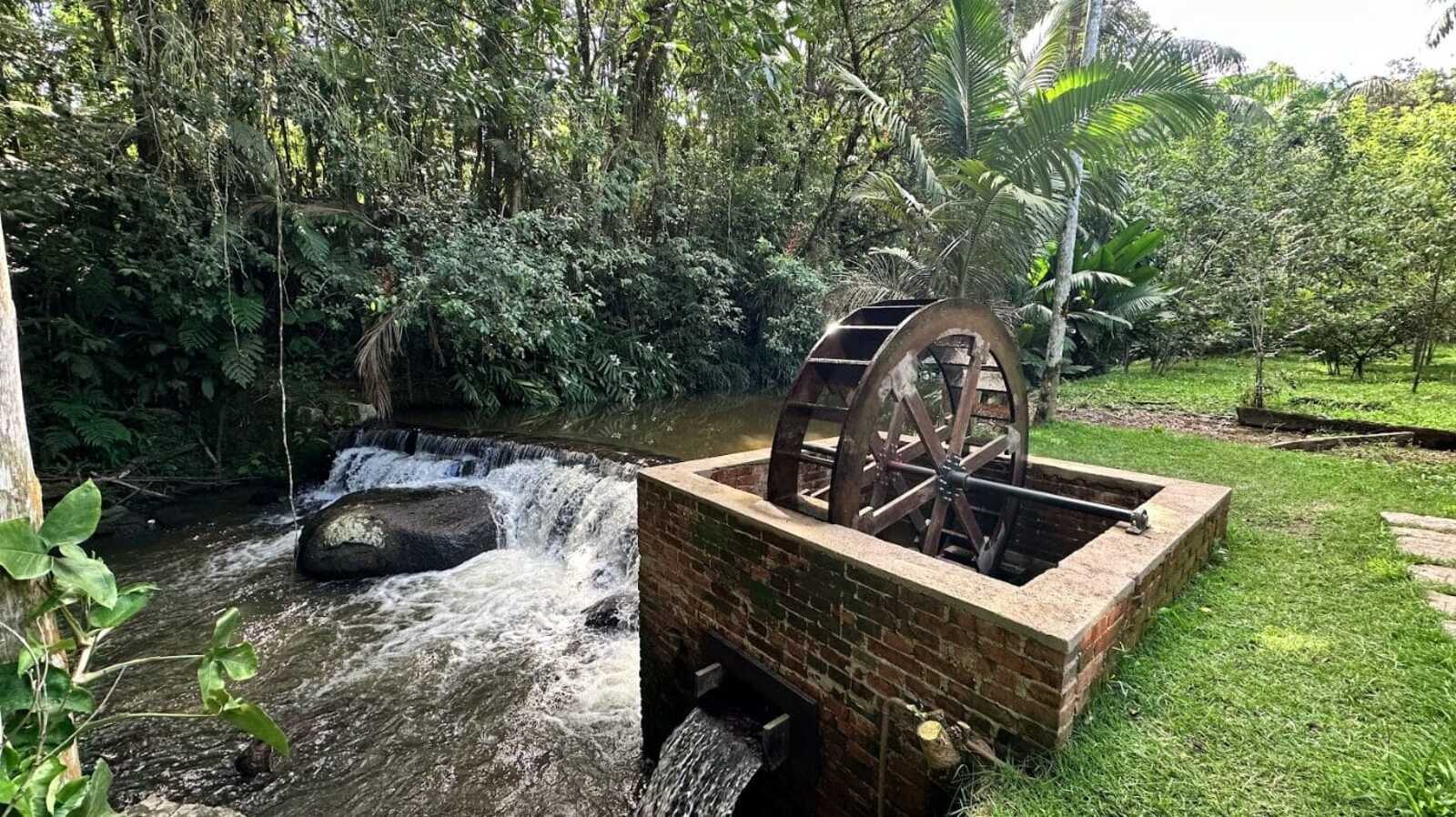
While restoring a historic mansion from 1910, a brick structure with an old turbine that generated energy from the Rio do Testo emerged, along with a hidden door and a rare floor concealed under layers of wax.
-
Italian researchers have detected what appears to be a second Sphinx buried under the sands of Egypt, and satellite scans reveal a gigantic underground megastructure hidden beneath the Giza Plateau for over 3,000 years.

-
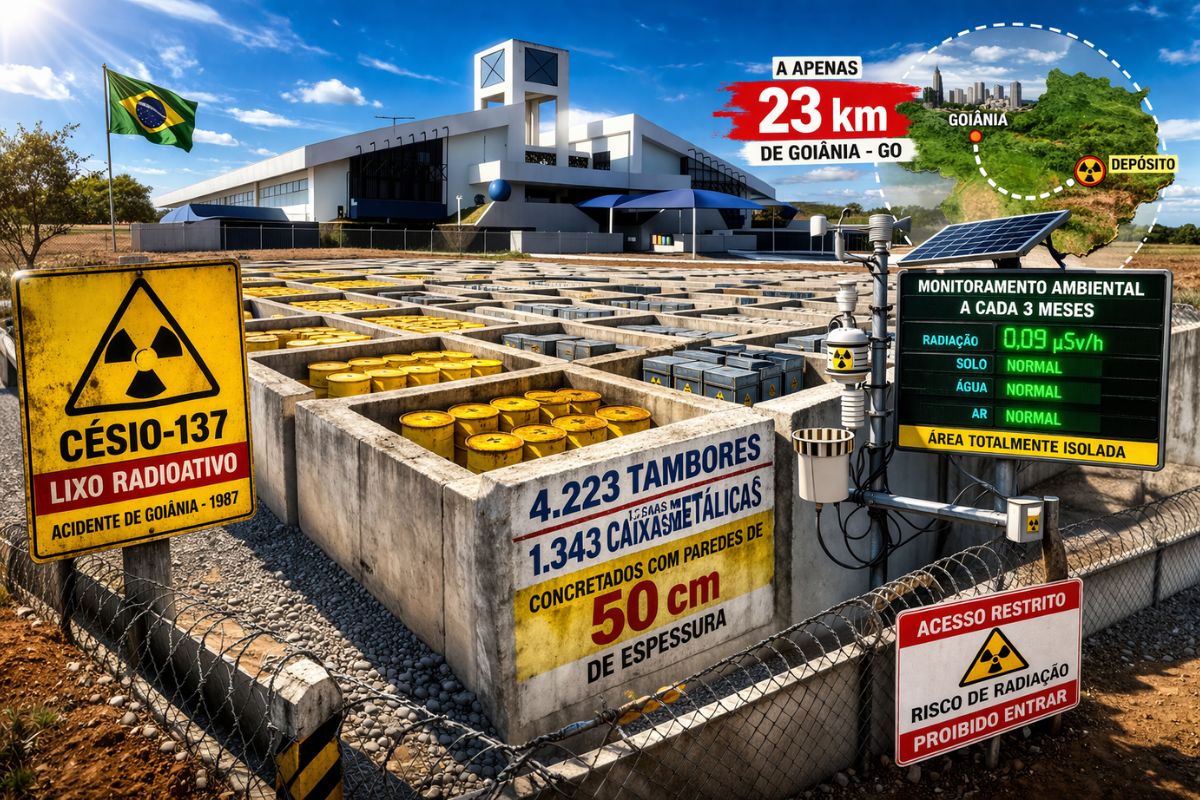
There are 4,223 drums and 1,343 metal boxes concreted with 50-centimeter walls that store the radioactive waste from Cesium-137 in the worst radiological accident in Brazil, just 23 kilometers from Goiânia, with environmental monitoring every three months.
Located on the border of the states of Mato Grosso and Goiás, the crater penetrated sedimentary layers of the Paraná Basin, exposing crystalline bedrock. Evidence such as shatter cones and impact breccias are irrefutable proof of its extraterrestrial impact origin of great magnitude.
Araguainha and Ponte Branca, the Brazilian Cities in the Heart of the Crater

At the geographic epicenter of the crater is Araguainha (MT), a small Brazilian city with just over 900 residents, situated over the central uplift of the structure. Its economy is primarily based on public service and family agriculture. Ponte Branca (MT), on the northeast edge, is slightly larger, with about 2,000 residents, and its economy is more focused on soy agriculture and livestock.
Both communities, as well as others in the municipalities of Alto Araguaia (MT), Doverlândia (GO), Mineiros (GO), and Santa Rita do Araguaia (GO), live under the direct influence of the unique geography shaped by the impact, facing common challenges of infrastructure and access.
The Intriguing Link Between the Araguainha Crater and the Permian-Triassic Extinction
The dating of the Araguainha impact places it very close to the mass extinction event at the end of the Permian, the most severe in the history of life on Earth. Although the impact itself is not considered sufficient to cause a direct global extinction, scientists are investigating its role as a possible trigger or contributing factor.
Theories suggest that the impact may have triggered massive earthquakes, tsunamis, and, crucially, the release of enormous amounts of methane from impacted oil shales, leading to rapid global warming. Research in this Brazilian city and its surroundings is vital to understand these mechanisms.
Daily Life and the Perceptions of Residents About Living in the Largest Crater in South America
The residents of Araguainha recognize the circular topography of the region, referring to it as the “Araguainha Dome.” The extraordinary landscape has inspired local legends, such as that Adolf Hitler sent envoys in search of “cosmic energies” (in fact, they were German scientists studying the crater in the 70s).
Another story, about foreigners collecting rocks, was sadly confirmed when samples of the astrobleme were found for sale in Paris, leading to an investigation by the Federal Public Ministry. These narratives form the rich cultural heritage of this Brazilian city.
The Future of the Araguainha Dome and This Unique Brazilian City as a Geopark


The Araguainha Dome has undeniable potential for geotourism, being recognized by the International Union of Geological Sciences (IUGS) as one of the 100 main sites of world geological heritage. There is a proposal for the creation of the “Geopark Astroblema of Araguainha – Ponte Branca”, identifying geosites that reveal evidence of the impact, as well as sites of paleontological and archaeological interest.
Despite the still modest tourist infrastructure, there is an organized effort to promote tourism in the region. Success will depend on investments, careful planning to minimize environmental impacts, and fundamentally, the involvement and benefit of local communities in this unique Brazilian city and its surroundings.








Seja o primeiro a reagir!