





 Portuguese
  English
  Spanish
  6 min of reading
  0 comments


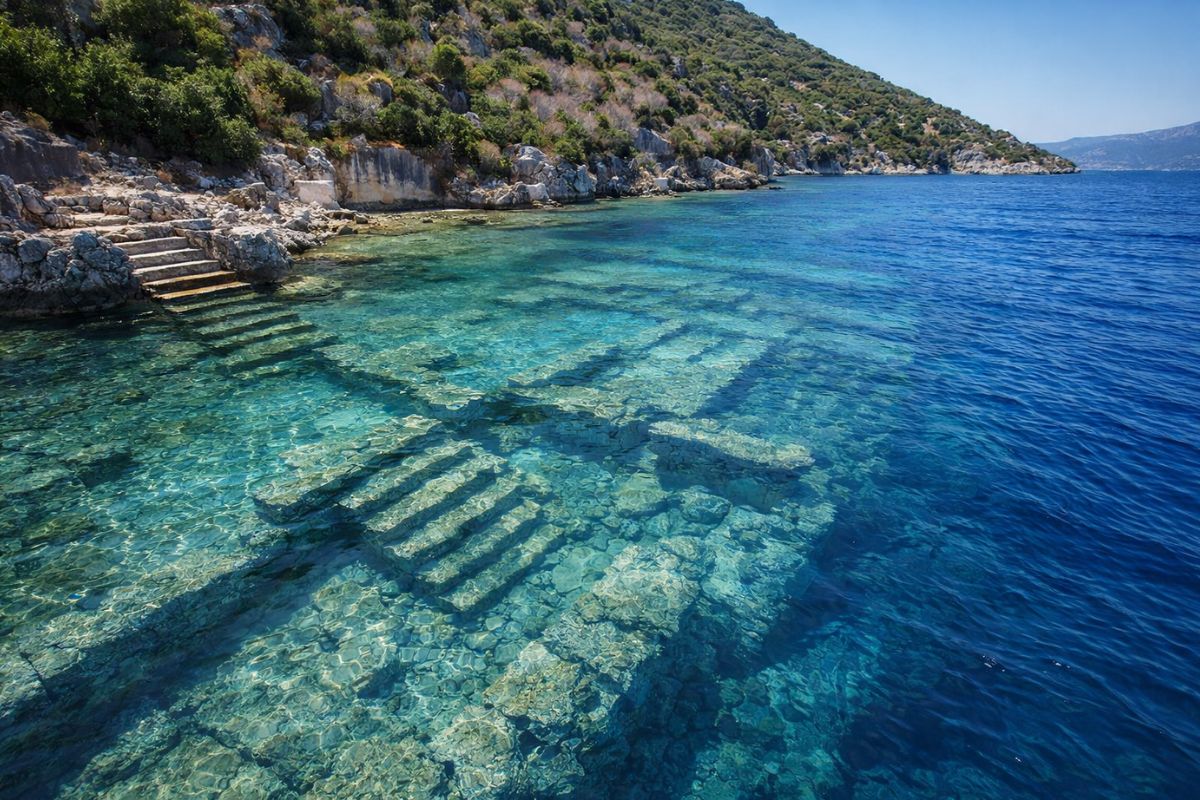
On The Turkish Island Of Kekova, An Entire City Called Dolichiste Rests Visible Under Crystal-Clear Waters: Stairs, Channels, And Hewn Rocks Appear Without Diving. Swallowed After An Earthquake In The 2nd Century, It Became A Protected Sanctuary Since The 90s, Accessible Only By Boat Or Kayak To Keep The Lycian History Intact, Untouched.
The entire city that “sleeps” beneath the turquoise sea of Kekova doesn’t require diving to impress: just look down and realize that there are walls, stairs, and traces of ancient life drawn below the water’s surface. In few places in the world, the sensation of proximity to the past is both uncomfortable and fascinating at the same time, because what is there is visible and yet untouched.
What today seems almost surreal was once an ancient mecca of commerce before being swallowed by the ocean in the 2nd century after a devastating earthquake. The entire city of Dolichiste became a sanctuary for preservation, where the charm depends precisely on the distance: getting too close is not allowed, so the ruins remain where they are.
Where The Past Meets The Turquoise Sea Without Asking For Permission

The first surprise of Kekova is the transparency. The water acts like glass, and this changes everything: you do not “imagine” the ruins, you see them.
-
These living root bridges and ladders are over 700 years old and help indigenous people survive in one of the rainiest regions in the world.

-
From sertanejo star to international investor: Ana Castela invests millions in a mansion in the USA, creates a themed accommodation in Orlando, and shows that the “boiadeira” also wants to grow away from the stage.

-
The 10 most stunning motorhomes in the world: a $3 million trailer with a rooftop nightclub and garage for a Ferrari, “palaces on wheels” with Italian marble, private cinema, and five-star hotel luxury for billionaires.

-
Trump wanted to spend $400 million on the White House, but the courts prohibited the million-dollar construction.


At two meters deep, the entire city appears in fragments that seem to be paused in time, as if the line between land and sea had been redrawn without erasing what already existed.
It is in this proximity that the most powerful effect resides. Stairs, channels, and even structures resembling pipelines are clearly visible, in a sequence that makes anyone wonder how a civilization managed to organize the space with such precision.
The entire city turns into an open map beneath the waves, and each detail reinforces that this is not “just a pretty landscape”: it is an exposed historical archive.
Dolichiste: The Entire City That Became Ruins, But Did Not Become A Memory

Dolichiste is not treated as just any point on the coast. It is presented as an archaeological treasure and, at the same time, a fragility: what survived the earthquake and the advance of the sea may not survive repeated human contact, touches, drag, and unchecked curiosity.
Therefore, preservation is part of the experience. The visitor navigates knowing that the entire city is there, but one does not enter it as one would enter a common attraction.
The feeling is like visiting something that was not meant to be “visited”, but rather to remain as testimony. The very existence of the place, visible and forbidden, leaves the question hanging: what is worth more, total access or undisturbed permanence?
Ruins On Land And Beneath The Waves: The Design Of The Entire City Continues

The ruins are not limited to what is submerged. They also extend on solid ground, as if the entire city had been sliced by ground movement and water, keeping parts at different levels of the same scenario.
This helps to understand why the site is described as one of the most impressive and untouched submerged scenarios: it is not an “isolated point,” it is a set.
The strict protection since the 90s reinforces this idea of a preserved set. It is not just one stone here and another there: it is an entire heritage maintained under rules, so that history remains intact.
The entire city, in this sense, functions as a heritage that depends on the discipline of those who observe, not on the daring of those who try to get closer.
Lycian Sarcophagi: The Tombs That Emerge And Become Postcards
Among the most emblematic images is the Lycian sarcophagus that emerges solitary from the sea. It appears to “float,” but it does not; it is there as a monument crossed by water, with an almost theatrical presence. These pieces resemble small stone houses with decorated reliefs and are scattered throughout the region, reinforcing that the Lycian mark is not a detail, it is identity.
Some of these tombs are on land; others have been “embraced” by ground movement and are partially submerged.
It’s as if the entire city had left messages at different heights, to remind that the transformation of the place did not happen slowly: it was a shock, a displacement, a before and after marked by stones that remained where they have always been, now surrounded by sea.
Kalekoy And Simena: The Village That Remains, The Isolation That Explains The Charm

Close to the submerged ruins, Kalekoy (the ancient Simena) maintains a charm that does not depend on luxury but on isolation. Without road access, the village receives visitors who arrive on foot or by boat, creating an atmosphere of pause: less noise, less hurry, more silence to look.
The scene is dominated by a fortress from the 4th century BC built to defend the trade route against pirates. At the top, a theater for 300 people amplifies the sense of contrast: from above, one can imagine the entire city that the sea “swallowed” and understand why that point was strategic.
The place is not just beautiful; it explains an ancient logic of commerce, defense, and movement that made sense for the world of its time.
Why Diving Is Prohibited And What It Truly Protects
The prohibition on swimming or diving in protected areas is not a whim. It exists to prevent the degradation of vestiges by human contact and to reduce risks of improper extraction of amphorae and artifacts.
In other words, the rule protects not just “stones”: it protects context, preserves the narrative, and prevents the entire city from becoming a disassembled puzzle due to curiosity and opportunism.
The result is a type of visit that requires self-control. Exploration is allowed by boat or kayak, maintaining a sufficient distance so that history can continue to be seen through the “mirror” of the Turkish waters. The entire city remains visible but not accessible, and this is precisely why it still seems so intact.
Kekova offers a rare experience: an entire city submerged two meters deep, with ruins visible to the naked eye, Lycian tombs emerging from the water, and a strict protection that transforms the visit into a silent lesson on preservation.
Dolichiste, swallowed after an earthquake in the 2nd century, remains a sanctuary since the 90s, accessible only by boat or kayak, so that the scenery continues to be impressive and untouched.
If you were there and saw the entire city so close, would you accept the total prohibition on diving to preserve everything intact or would you advocate some type of controlled access? And what would impact you more: the ruins under the turquoise sea, the Lycian sarcophagi emerging from the water, or the feeling of observing an entire city without being able to touch it?







-

-

-

-

-

-

29 pessoas reagiram a isso.