





 Portuguese
  English
  Spanish
  3 min of reading
  0 comments


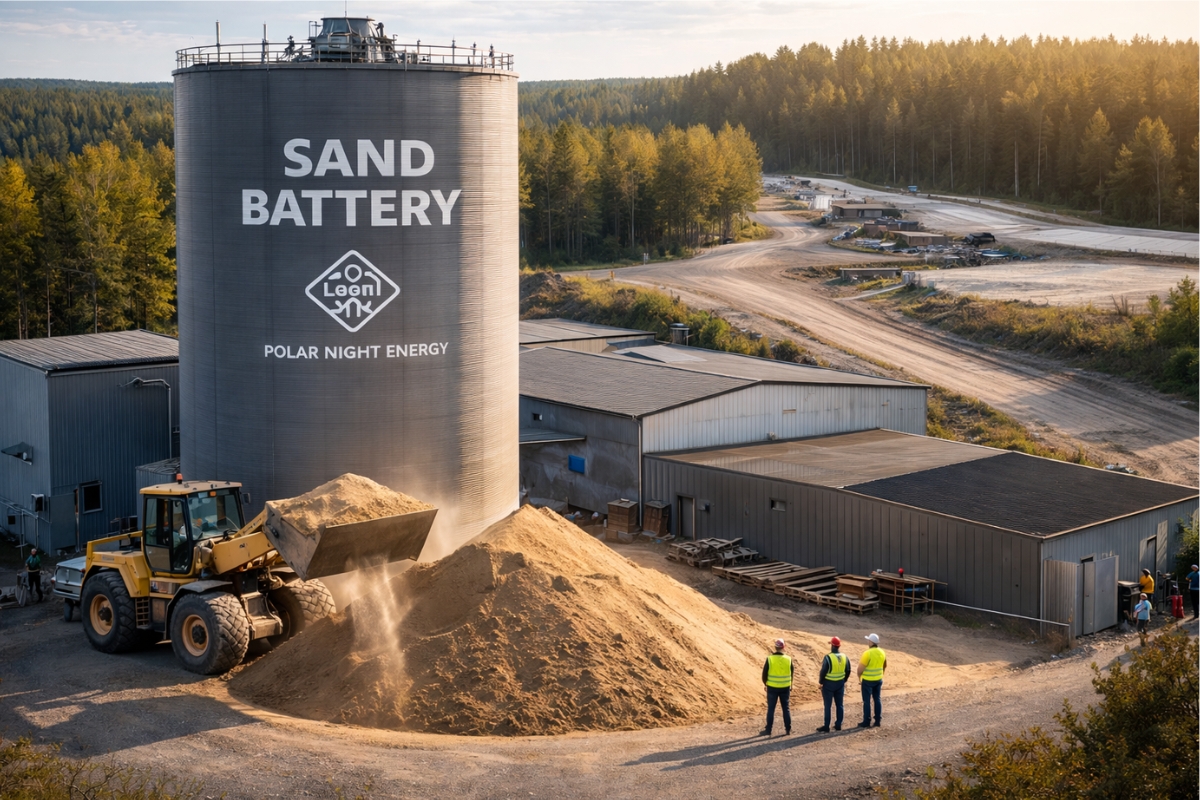
In Pornainen, Polar Night Energy Implemented a Thermal Battery with 100 MWh to Store Renewable Heat, Reducing Fossil Fuel and Attracting Attention from the Energy Sector
The Finnish town of Pornainen has launched an industrial-scale sand battery designed to store heat and release thermal energy when demand increases in the cold.
The project relies on a simple and highly efficient concept: storing energy in the form of temperature, using a large volume of mineral material inside a well-insulated silo.
The information was disclosed by Polar Night Energy, a Finnish thermal energy storage company.
-
With a cost per shot close to zero, the DragonFire laser could change naval warfare in 2027 and provide British ships with nearly unlimited defense against drones.

-
A British startup creates tires that generate electricity in electric vehicles when passing over potholes, speed bumps, and cracks.

-
Scientists have created robots made with living cells that have their own nervous system, swim on their own, explore the environment, and self-organize without any genetic engineering, and now they want to do the same with human cells.

-
Students create a solar-powered ambulance that operates without a plug, without fuel, and still keeps medical equipment running in remote areas.

What Changed in Pornainen with 1 MW and 100 MWh in the Heating Network
The thermal battery now supplies the local district heating network, helping to reduce the use of fossil fuels in heat supply.
The system was installed to deliver up to 1 MW of thermal power and store 100 MWh of energy in the form of heat, values that define the actual size of the project.
In practice, this allows for the production and storage of heat when renewable energy is available and its use later, reducing dependence on thermal generation during peak times.
How the Silo Heats the Material and Reaches About 600°C without Using Gas

The operation begins when there is excess renewable electricity. This energy powers the heating of the system, raising the internal temperature to levels up to 600°C.
The heat is retained thanks to the isolation of the set, which sustains storage for long periods and helps to navigate variations in consumption.
When the network requires it, the system transfers the stored heat to provide useful thermal energy to the district heating.
Why 2,000 Tons of Crushed Stone Become a Giant Thermal Battery
The storage uses about 2,000 tons of high thermal capacity crushed stone, chosen for its ability to retain heat for a long time in a large volume.
This logic works well because the goal is to provide stable heat, not direct electricity for equipment and outlets.
Scale makes a difference: an inexpensive and abundant material, combined with control and insulation, becomes energy infrastructure with a real impact in winter.
What Usage Timelines Appear, Ranging from Almost 1 Week in Winter to 1 Month in Summer

The sizing was designed to cover up to 1 month of heat demand in the summer and almost 1 week in the winter, within the local network.
This describes the possible service time with the installed capacity in different consumption scenarios, without relying on immediate replenishment at all times.
pv magazine, an international publication in the solar and energy sector, provided the cited numbers and timelines.
Where This Technology Can Go and What Limits It Still Has
The sand battery is suitable for uses that require heat, such as district heating and industrial thermal processes.
It does not serve the same purpose as a traditional electric battery, as the storage is thermal and the focus is on delivering temperature for heating systems.
Pornainen has become a practical example: a heated material silo reducing the need for combustion to keep the city warm during critical periods.
The sand battery in Pornainen demonstrates a direct pathway to reduce fossil fuel use in urban heating by using a simple idea: storing heat in large mineral mass.
With 1 MW of thermal delivery and 100 MWh of storage, the system creates a new logic for the cold: leveraging renewable energy when it is abundant and releasing heat when it is needed.









-

Uma pessoa reagiu a isso.