





 Portuguese
  English
  Spanish
  3 min of reading
  22 comments




Accelerated Decline of Aquifers, Water Contamination and Inequality in Access Place a Large Metropolis at the Center of an International Alert That Also Reaches Brazil
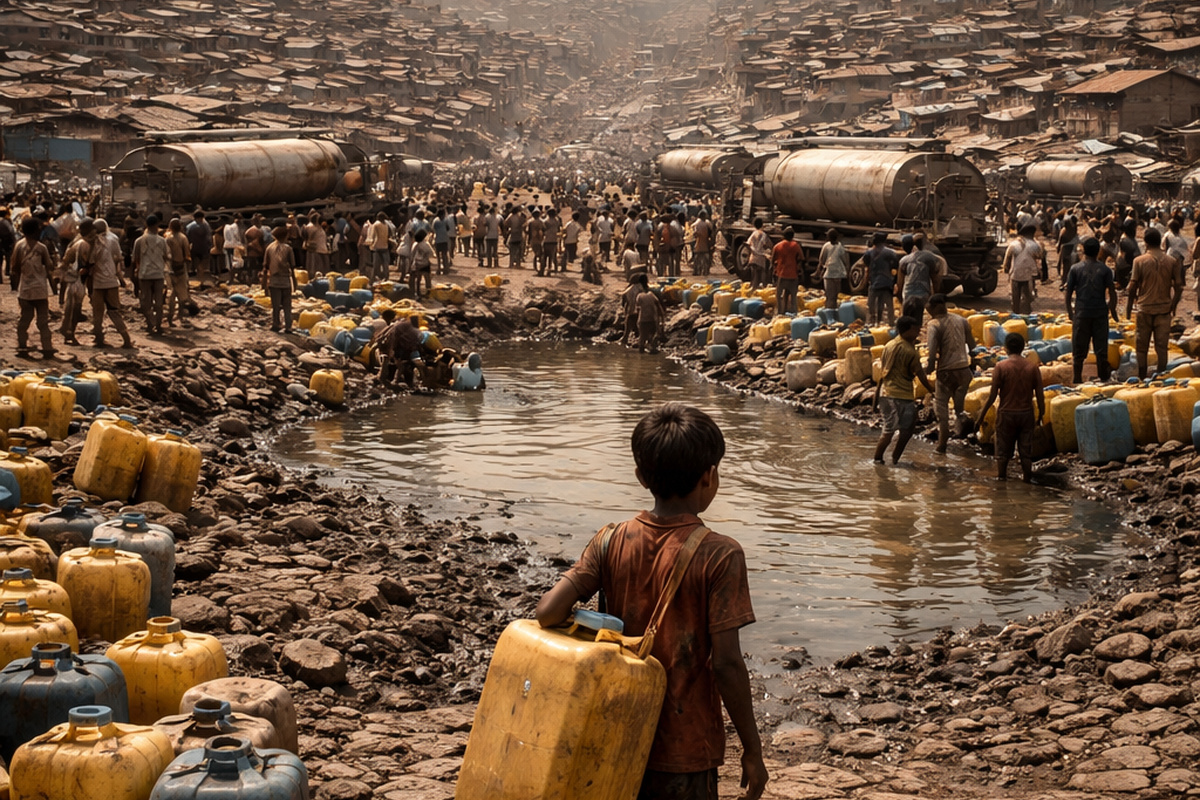
Kabul, the capital of Afghanistan, one of the most populous cities in the world, faces a concrete risk of running completely out of water by 2030. Over the past decade, the situation has continuously worsened and now represents a possible historical milestone of urban water crisis in the modern era.
At the same time, recent technical reports indicate that groundwater aquifers are heading towards collapse. Without emergency measures, the city could become the first major modern metropolis to run out of water, according to assessments released by international institutions.
Technical Study Reveals Alarming Decline of Aquifer Levels
A study published in 2025 by the NGO Mercy Corps indicates that the water table level has fallen between 25 and 30 meters in the last ten years. Furthermore, the volume of water extracted from the underground has consistently surpassed its natural replenishment capacity.
-
Four humans are flying towards the Moon inside the Orion capsule launched by the SLS rocket, and on April 6, Artemis II will disappear behind the far side of the Moon without communication with Earth for nearly an hour.
-
Worlds covered by water, atmospheres filled with hydrogen, and the possibility of life beyond Earth: ocean planets are rewriting the map of cosmic search and forcing scientists to rethink where to look.

-
Argentina achieves the unimaginable after more than 110 years and reintroduces the largest native herbivore of South America to the Chaco to restore a lost link in nature.

-
Returning to the Moon now costs a billion-dollar bill and reignites the competition between the USA and China for science, technology, and rare minerals on lunar soil.


Currently, annual pumping exceeds natural recharge by approximately 44 million cubic meters per year. Thus, experts estimate that, if this pace continues, the water collapse could occur before the end of the decade, possibly even before 2030.
As a direct result, scarcity has ceased to be sporadic and has become a structural problem, affecting domestic water supply and public health security.
Climate Change and Inadequate Management Intensify the Crisis
Simultaneously, the water crisis arises from the combination of climate change, accelerated urban growth, and inadequate water resource management. In recent years, the local climate has become warm and dry, while rainfall — already scarce — has decreased even more.
These changes have hindered the replenishment of natural reservoirs and have been linked to the effects of climate change in Central Asia, according to recent environmental analyses. Thus, pressure on aquifers has continuously increased, without long-term structural solutions.
Urban Expansion and Inequality Deepen the Problem
Meanwhile, disordered urban expansion, intensified by decades of conflict, has worsened the situation. The city has come to house millions of internally displaced people, which has overwhelmed an already limited infrastructure.
Currently, about 90% of the population relies on artisanal wells for daily supply. However, these wells quickly dry up due to excessive exploitation, making access to water increasingly unstable.
In addition to scarcity, the city faces a serious water quality crisis. Studies indicate that up to 80% of groundwater is contaminated with sewage, salinity, and heavy metals like arsenic. As a consequence, estimates from UNICEF show that eight out of ten inhabitants consume unsafe drinking water, increasing health and epidemiological risks.
In this scenario, social inequality intensifies. Wealthier families pay for water delivered by tanker trucks, while poorer populations depend on increasingly scarce and unsafe sources.
Global Alert with Direct Reflections in Brazil
In light of this situation, experts have begun to treat the case as an international alert. They highlight three key points: the uncontrolled exploitation of aquifers could render cities uninhabitable, precarious infrastructures accelerate water and health crises, and long-term planning prevents collapses.
This alert also reaches Brazil. Although the country is associated with water abundance, data from the National Water Agency shows that between 2013 and 2016, droughts and dry spells affected approximately 48 million Brazilians.
Given this scenario, the crisis reinforces that water security requires responsible management, consistent public policies, and ongoing prevention, even in countries historically rich in natural resources.







Que reBOSTAgem!
Muito confusa, não cita a cidade, além de diversos erros e incoerências.
Reportagem mal feira com dados confusos , omite a cidade. Um lixo
A água não acaba, ela muda de lugar ( pra acabar tem que quebrar formula H2O isso não ocorre livre na natureza). O problema é que estão transformando os rios em esgoto. Só observar quando um pequeno curso d’água passa numa cidade, entra limpo e vira esgoto ( no bairro buritis em BH está claro isso. Uma pequeno riacho entra limpinho no bairro e em poucos metros transforma em esgoto logo na entrada do bairro).