





 Portuguese
  English
  Spanish
  8 min of reading
  3 comments


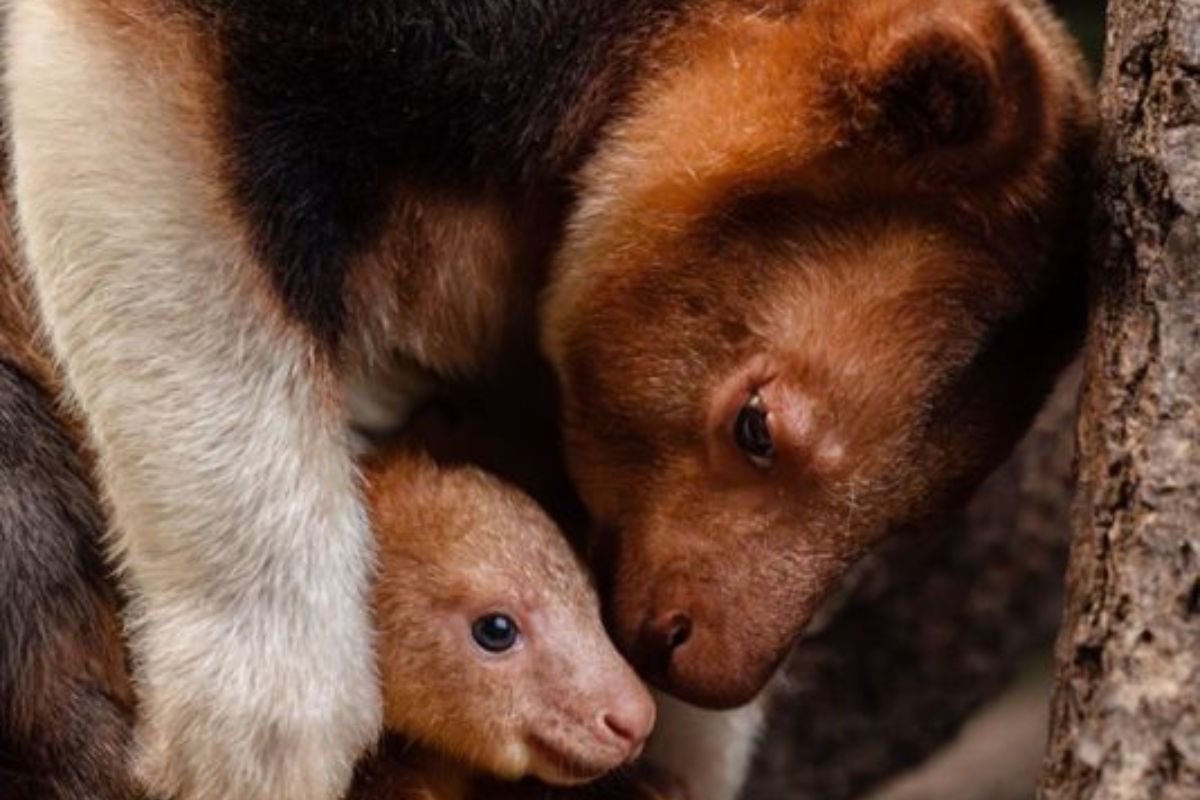


In Chester Zoo, England, Extinction Gained a Real Adversary with the Birth of a Goodfellow’s Tree Kangaroo Joey. Mother Kitawa Was Monitored Since Gestation, The Baby Was Born the Size of a Jellybean, Now Nears 2 Kg and Represents One of the Most Complex Births in the Animal Kingdom.
Extinction has ceased to be a distant word and turned into a concrete alert at Chester Zoo, in England, with the birth of a Goodfellow’s tree kangaroo joey, one of the rarest species of marsupials on the planet. The family lives in one of the most important conservation centers in Europe, specialized in the captive breeding of endangered species, and each step of the birth was treated as a critical event, from monitoring the gestation to the first signs of the baby’s development.
In recent days, the joey started to poke its head out of the pouch for the first time, a detail that seems simple, but for an endangered species, it acts as a milestone. When it was born, it weighed only a few grams, the size of a jellybean, and about three months later it has already reached nearly 2 kg, a progress that reinforces the extent of the effort involved and the significance of this birth in a scenario of the silent disappearance of species.
A Rare Birth at Chester Zoo and What It Represents

What happened was direct and, at the same time, immense: a new life emerged within a conservation program in England, at a place where the goal is not only to keep animals but to ensure that endangered species have a real chance to continue existing.
-
Something is happening around the Earth: Inside the huge explosion of fireballs in 2026

-
A hot air bubble coming from Argentina expands over Brazil, causing thermometers to exceed 38 degrees with a thermal sensation of 40 degrees in late March, affecting 6 states at once.

-
The radish leaf that almost everyone throws away has more polyphenols, flavonoids, and fiber than the consumed root, and a 2025 study showed that the leaf contains compounds that protect the intestine, combat inflammation, and may inhibit the growth of cancer cells.

-
A planet that seemed to defy the laws of physics has intrigued scientists for decades, until the James Webb revealed what is really affecting Saturn’s rotation.

Chester Zoo is described as a major conservation center in Europe, focused on captive breeding. This matters because, for rare species, each joey is not “just another one”. It is a piece of the future.
It carries with it the continuity of an entire lineage that, outside, faces population decline and increasing risk.
And that is precisely why this birth was celebrated. It’s not just excitement over seeing a baby appearing in the pouch.
It’s the feeling that, in a world where extinction advances, there are still possible victories when there is monitoring, method, and persistence.
Kitawa, the Monitored Mother and the “Investment” of Energy that Few Species Endure
The mother, Kitawa, was being closely monitored since it was discovered that she was pregnant. This detail says a lot.
In species that do not reproduce quickly, the margin for error is small. There is no easy “compensation” afterward. If something goes wrong, the impact weighs more.
The Night Program Manager at Chester Zoo, David White, summarizes this clearly: tree kangaroos do not reproduce quickly and a joey represents a huge investment of energy for the mother.
This sentence, by itself, explains why each birth turns into news.
When nature puts so much energy into a single joey, birth ceases to be routine and becomes an exception.
And it is precisely this exception that has been achieved now, with a whole team collaborating to ensure the safe arrival of the baby, caretakers, veterinarians, and scientists working as a continuous line of protection.
The First “Public Sign” of the Baby and Why the Head Out of the Pouch Becomes a Milestone
A few days ago, the joey began to poke its head out of the pouch.
This is the kind of scene that excites for being beautiful, but the real reason for the impact goes beyond.
This moment functions as a “public sign” of progress. It suggests that the joey has reached a point where it begins to expose itself to the environment outside the natural nursery that is the pouch.
It is not independence yet, but it is progress. It’s the body saying: I am here, I am growing, I am thriving.
And when talking about a rare, endangered species, thriving is already a powerful message.
Birth the Size of a Jellybean and Transformation into Nearly 2 Kg

The contrast between the beginning and now is one of the strongest parts of this story.
The joey was born weighing a few grams, described as the size of a jellybean. Shortly after, around three months, it is already nearing 2 kg.
This leap in development is more than just a number.
It draws a line of survival: from the tiny and extremely vulnerable stage to a body that begins to gain structure, volume, weight, and presence.
It’s the kind of growth that, for conservation, becomes measurable hope. It is not an opinion, it is not a wish. It is a simple, yet concrete, fact that shows that the baby has crossed a sensitive stretch of the path.
One of the Most Complex Births in the Animal Kingdom and the Instinctive Race to the Pouch
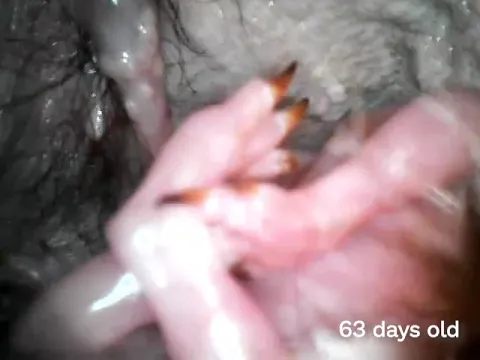

The birth process of the Goodfellow’s tree kangaroo is described as one of the most complex in the animal kingdom. And the most impressive moment comes right after birth.
Moments after being born, with its eyes still tightly closed, the joey instinctively climbs up the mother’s belly to reach the pouch.
This is not an external “aid.” It is the joey itself fulfilling a survival sequence that seems impossible when considering its initial size.
To ease this path, the mother marks a sort of trail on her own fur, licking and guiding the baby through a channel to the pouch.
This detail is brutally important: in a context of extreme fragility, the correct path is the difference between living and failing.
Once inside the pouch, the joey receives all the nutrition it needs while growing.
The pouch, here, is not just a shelter. It is the entire system of continuity.
Life in the Canopy: Why This Kangaroo Doesn’t Live Like the Others

The Goodfellow’s tree kangaroo is native to the tropical rainforest mountains of Papua New Guinea, an island in the Pacific Ocean. It is described as smaller and different from relatives in Australia, and this appears in its way of life.
It is not an animal that makes long jumps on the ground, like the classic image of a kangaroo that many people have in mind. And
it uses its body strength to leap between the tree canopies, up high, where the forest is the entire world.
It is capable of jumping up to 9 meters away and has long curved claws and feet that help it climb between branches.
It is a body designed for verticality, for risk, and for balance, in an environment where falling or losing the way can also be fatal.
What It Eats and What This Reveals About Its Habitat
Herbivorous, these marsupials feed on flowers, leaves, and grasses. This reinforces the intimate connection between the animal and the forest.
When the forest is destroyed, it is not just “fewer trees.” It is less food, less cover, less safe passage up high. For an animal that lives in the canopy, the habitat is not a backdrop.
It is the infrastructure of life.
That is why, when it is said that hunting and habitat destruction have reduced the population by 50% in the last 30 years, one can understand the real weight of this decline.
It is not just a straight-line number. It is a gradual impoverishment of the environment that supports everything.
Extinction and 50% Decline: The Signs of Danger That Have Accumulated for Decades
The species is considered endangered by the International Union for Conservation of Nature’s Red List.
And the hardest fact comes along: in the last 30 years, hunting and habitat destruction have caused the population to decline by 50%.
Half. In three decades.
For a rare species, this decline is not just “concerning.” It is the type of movement that, if it continues, could push it to a point of no return. And that is why a birth in a conservation environment gains so much symbolism.
It appears as a response to a trend of disappearance.
It does not solve the problem of the world outside, but it proves that disappearance is not inevitable when consistent intervention exists.
The Role of the Conservation Program and Why the Birth Is Not “Luck”
David White states that the birth required a lot of work from caretakers, veterinarians, and scientists, all collaborating to ensure the safe arrival of the joey, and that everything learned helps protect the species.
This is essential to understand the true magnitude of the event: it is not a coincidence. It is the result of monitoring, routine, observation, and careful decisions.
When it comes to endangered species, learning does not stay trapped in a room. It becomes a tool for the next steps.
The joey is the celebration, but it is also a living fact. Each observed behavior, each phase overcome, each growth advance becomes part of what can support future protection strategies.
Why This Joey Became a Global Symbol So Quickly
Because it encompasses everything that haunts those who follow conservation: rarity, risk, fragility, short time, and a species that can disappear without much noise.
The birth places a concrete scene in front of people.
It is not a loose statistic. It is a baby that was born tiny, instinctively ran to the pouch, grew inside this natural “nursery,” and is now beginning to show itself to the world with its head out.
This creates a narrative of resistance, and that is why the birth becomes a symbol.
It represents the race against extinction that happens silently, species by species, until one day the absence becomes normal.
What Could Happen Now: The Next Forays Outside the Pouch
The central information here is that soon the joey is expected to make its first forays outside the mother’s pouch. This is the next anticipated chapter.
It is the moment when the baby goes from “protected presence” to “presence that begins to test the environment.” Each exit and return is learning. Each movement shows adaptation.
And for an endangered species, every small step becomes big news.
Do you think the world only notices extinction when a species has already disappeared, or is there still time to turn the tide before total silence?






Unfortunately the human race is a very selfish and destructive species. Instead of living in harmony with nature and respecting the lives of other species; we take what we want and do not think of the consequences that it has on others. In many cases we don’t even respect our own species with different races and ethnicities. How ironic is it that the human race decides what species are overpopulated when we are overpopulated ourselves. More needs to be done to protect other species from endangerment and extinction, especially when we are the main cause of their demise.
A sad but hopeful story
Virar o jogo seria trazer de volta o habitat natural desse **** para que ele pudesse se reproduzir livre e deixar de ser uma espécie em extinção. Virar o jogo seria reeducar os humanos para respeitarem as demais espécies do planeta ao invés de ameaçá-las.
O que se está fazendo é afagar o ego dos humanos enquanto mais uma espécie vira objeto de estudo em laboratório. E mais humanos se sentem orgulhosos de serem quase deuses, afinal, estão criando vidas.