





 Portuguese
  English
  Spanish
  6 min of reading
  0 comments


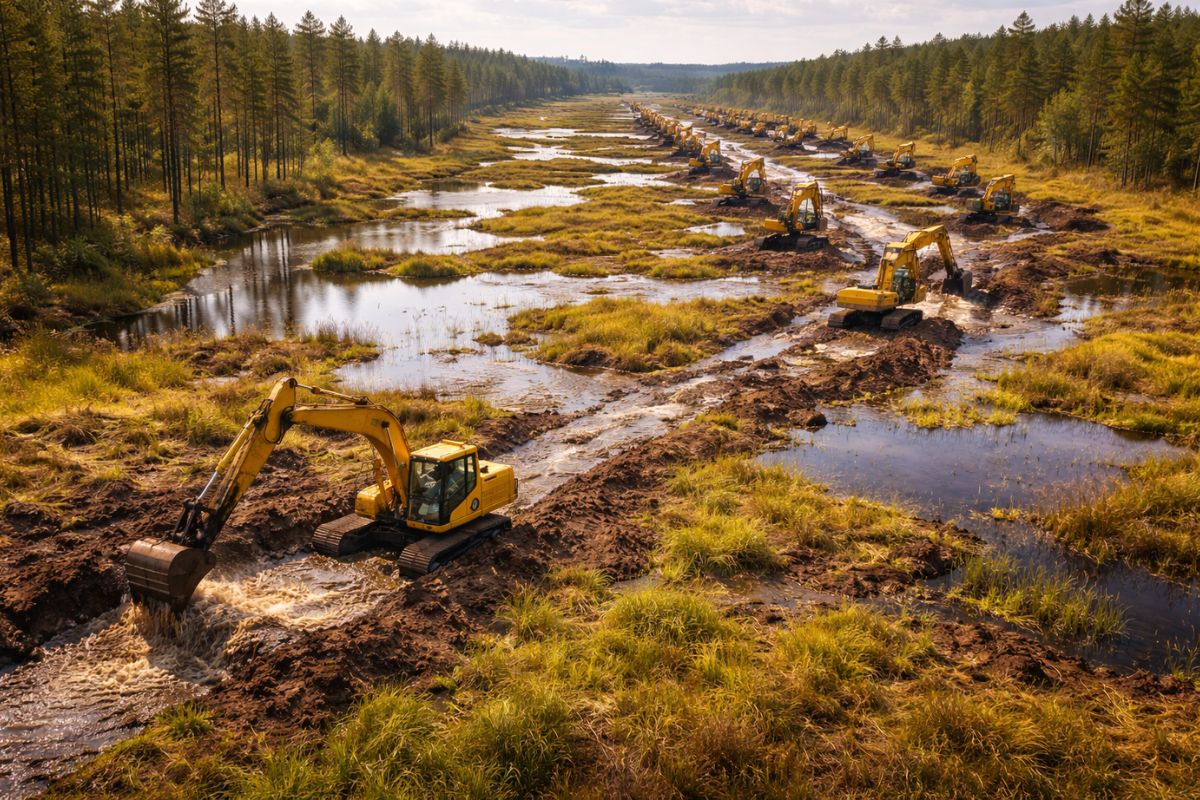
The Wetland Restoration Led by SCA on Lands in Sweden Totals 1,165 Hectares Between 2021 and 2025, with Ditch Closures, Rewetting of Peatlands, and Works to Increase Water Retention, Restore Natural Hydrology, and Consolidate a Long-Term Forestry Agenda Over the Years.
The wetland restoration carried out by SCA on lands in Sweden has evolved from a dispersed set of initiatives into an organized front of large-scale intervention. Between 2021 and 2025, the company reported that it has restored 1,165 hectares through ditch closures, rewetting of peatlands, and measures aimed at returning water to lands that had been drained to maintain productivity for decades.
The main balance includes 883 hectares led directly by SCA and 282 hectares restored with the participation of other stakeholders, in areas where the company acts as landowner. Additionally, the company claims to have restored, in the same period, two extensive projects of peatlands totaling 325 hectares. The central data, therefore, is not just the recovered area, but the change in scale of a forest policy that has begun to place hydrology back at the center of land use decisions.
How SCA Transformed Restoration into a Permanent Front of Work

The decision to intensify wetland restoration was made by SCA in 2021, when the company determined that it would expand the rewetting of selected areas on its properties.
-
A gigantic dam project in the Himalayas could solve one crisis but silently create another for millions of people.
-
Nikola Tesla said that intelligent people tend to have fewer friends, and now science partially confirms this: a study with over 15,000 people showed that for the more intelligent, socializing too much can even reduce life satisfaction.

-
A superyacht worth US$ 17 million is delivered in impeccable condition, sets out to sail, and hits a bridge in the Bahamas just two hours later.

-
Residents of Australia woke up to a sky completely red like blood before the arrival of Cyclone Narelle, which hit the coast with winds of 250 km/h, tearing off roofs and lifting iron dust in a scene they described as apocalyptic.


The justification presented combines three fronts: improving water retention in the landscape, supporting climate goals, and restoring hydrological function to areas that had been drained over time.
In practice, this shifts the focus from simple productive exploitation to an attempt to reorganize the physical functioning of the land.
According to Anna Cabrajic, forest ecologist at SCA and responsible for compiling the data, the advancement of the projects results from work conducted by nature conservation specialists distributed across the company’s various geographical areas.
This detail matters because it shows that wetland restoration has not been treated as an isolated action or a one-off compensation, but as a technical program integrated into the company’s operational structure.
The movement also reveals an important inflection in the forestry sector. Instead of accepting the conditions created by old drainage as permanent, SCA began to work to undo part of this infrastructure.
This includes filling in ditches, constructing barriers with plugs to raise the water levels, and, in some cases, removing trees that had grown around these drained strips. By doing this, the company not only changes the visible landscape, but also attempts to alter the behavior of the soil and water.
At the core of this reasoning is the idea that artificially productive wetlands do not always maintain long-term balance. If the land depends on permanent drainage to continue functioning under a certain logic, the hydrological cost tends to accumulate.
Wetland restoration then enters as an attempt to return permanence to water where drainage had turned excess into the norm.
What Closing Ditches Really Changes in the Hydrology of Peatlands

The measures described by SCA may seem simple on the surface, but they operate on a decisive mechanism. When ditches are opened in peatlands, water starts to drain more quickly and the soil ceases to remain saturated long enough to sustain its natural dynamics.
By filling in these channels and erecting small retention structures, the project attempts to restore the previous hydrology, keeping water in the area for a longer time and slowing artificial drainage.
This retention of water is treated by the company as a dual-function gain. First, because it allows the land to operate again as a wetland, with greater water retention.
Second, because this extra time of retention favors natural purification, helping to capture nutrients and heavy metals coming from the surrounding soil.
In other words, closing ditches is not just about saturating the land, but about reprogramming the flow that traverses the landscape.
Anna Cabrajic argues that wetland restoration helps stabilize water flow and improve water quality in the streams. This point is central because it shifts the benefit beyond the boundary of the restored area.
The expected effect does not stop at the site where the excavator operates or where the ditch is filled. It extends to the surrounding drainage network, influencing flow, retention, and passage of dissolved or suspended material.
In peatlands, this change tends to be even more sensitive because these are areas whose structure depends precisely on retained water.
When drainage is imposed for decades, the original functionality weakens. By rewetting and blocking ditches, SCA attempts to reverse this process.
What is at stake is not just making the soil wetter, but restoring coherence to a system that had been reorganized by the need to produce.
Where Numbers Gain Concrete Dimension in the Ejdån-Malmvattenån Project


The scale of wetland restoration becomes clearer in the project of the Ejdån-Malmvattenån swamps, in the municipality of Sollefteå, completed in 2025.
In this case, SCA’s efforts reached six areas of drained peatlands around Graningesjön Lake, recovering approximately 18 kilometers of ditches and rewetting about 150 hectares.
The schedule began with deforestation in May 2025, progressed through filling the channels during the summer, and was completed by the end of September.
This cut helps to understand the actual size of the works. Talking about 1,165 hectares may sound abstract, but 18 kilometers of ditches closed in a single front show the physical density of the intervention.
This is not about small linear adjustments, but rather a territorial reconfiguration that requires machinery, decisions about layout, water level control, and accurate reading of what should start retaining moisture again.
Mikael Berg, who works with wetlands at SCA, stated that it will be important to follow the development of these swamps in the coming years.
The comment makes sense because rewetting projects do not end with the execution phase.
The closure of drainage alters the hydrological base of the land, but the effects consolidate over time as water begins to remain in the area and the system finds a new balance.
Most of these projects received funding from the LONA program, aimed at long-term local commitments to conservation. This adds an important institutional layer.
The wetland restoration promoted by SCA depends on business action but also relies on public instruments that expand the feasibility of the works.
Without this arrangement, recovering large extensions of drained peatlands would be slower, more expensive, and likely more restricted.
Why the Company Also Included Areas of Peat Extraction in This Count
In recent years, SCA has also participated in the restoration of areas of peat extraction on its lands, used until the early 2020s in operations linked to Öviks Energi.
In this section of the agenda, the recovery was led by Neova, responsible for extraction, but SCA states it made clear in consultations held in 2023 how the restoration should be executed.
The described result was the complete filling of all drainage, including edge ditches and furrows.
This point shows that wetland restoration was not limited to former drained forest areas. It was also applied in surfaces that underwent intensive use until very recent years.
In Mörttjärnsmyran, for example, the restored area integrates Mörttjärnsmyren, where SCA also closed 5,000 meters of ditches in the same year, within the Ejdån-Malmvattenån project, forming a more continuous restored strip.
In the case of Norrmossaflon, the expectation presented is that the area will convert into a wetland contiguous to a burned forest area of 80 hectares following the 2018 fire.
The company treats this design as particularly promising for the region.
The relevant data here is the formation of continuous blocks, not just isolated patches of rewetting. When restored areas begin to touch, the hydrological function gains scale and consistency.
This enlargement of the scope helps to understand why SCA insists on associating its projects with Sweden’s climate goals.
The company argues that all wetland restorations positively contribute to national goals linked to thriving wetlands, vibrant lakes, and waterways, and reducing climate impact.
Even if this framing comes from the company itself, it reveals the ambition of the program: to turn wetland restoration into a visible part of Sweden’s environmental strategy, and not just a peripheral local management work.









-

Uma pessoa reagiu a isso.