





 Portuguese
  English
  Spanish
  4 min of reading
  0 comments


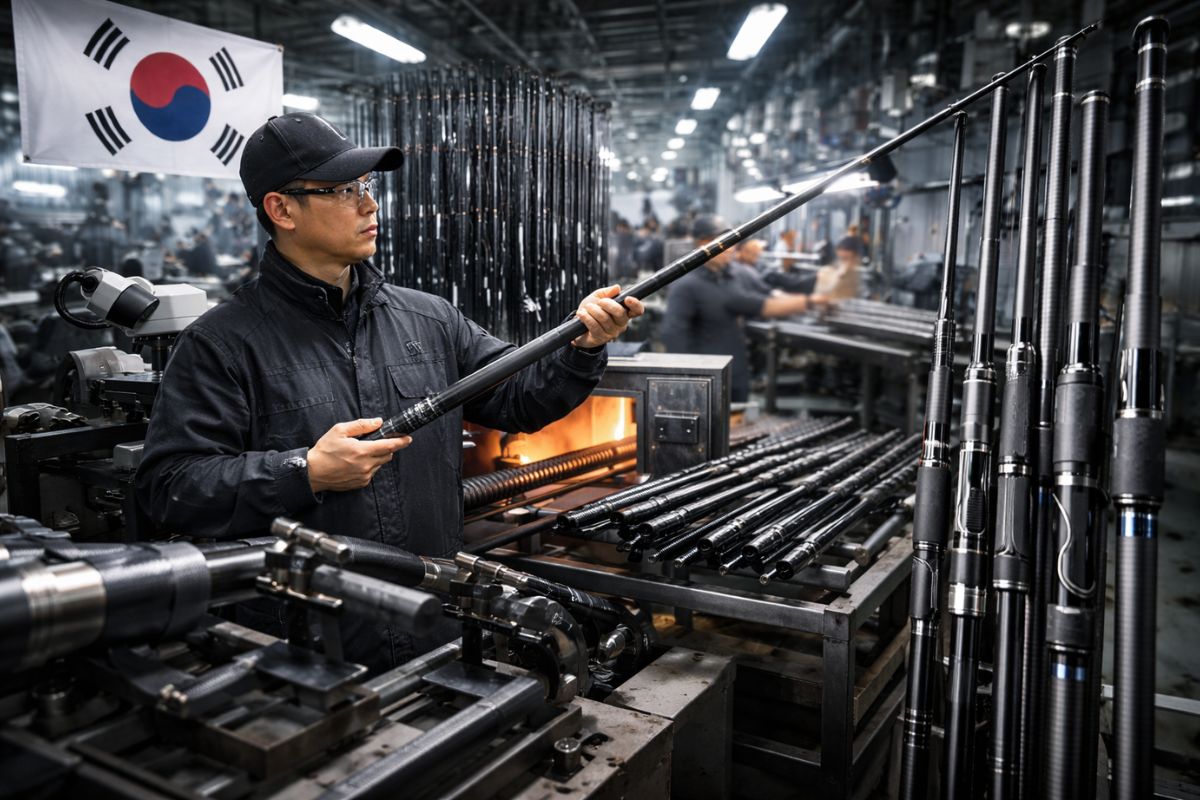
Inside a Korean Factory in Incheon, the production of fishing rods made of carbon begins with the cutting of the fabric and ends only after an inspection that measures straightness, finish, and defects. Since 1988, the flow passes through mold, winding, electric oven, painting, guides, and epoxy until the final packaging.
The Korean factory visited in Incheon has been operating since 1988 and reveals a point that almost no one notices in fishing rods: the material does not “start” as a rod; it is built in layers, thermal curing, and dimensional control. What determines the product’s destiny is the inspection, which can approve the piece or push the process for corrections.
What supports this result are workers who perform manual assembly and visual and tactile inspection, step by step, while the electric oven and coatings set the shape of the carbon. The reason for this rigor is simple: a micro flaw in a guide, epoxy, or alignment translates to performance loss, risk of breakage, and customer return, even when everything seems perfect to the naked eye.
Carbon Fabric and the Cut That Already Defines the Rod

The cycle begins with carbon fabric. In the Korean factory, the carbon is measured and cut according to the type and size of fishing rods, because the geometry of the blank depends on the shape of the cut.
-
He started running at 66 years old, broke records at 82, and is now a subject of study for having a metabolic age comparable to that of a 20-year-old, in a case that is intriguing scientists and inspiring the world.

-
Oldest tree on the planet reappears after 130 years of searches: Wattieza, 385 million years old, was 10 meters tall and had no leaves or seeds; Gilboa fossils in New York solved the mystery in 2007.

-
A 48-square-meter house assembled in hours with 4,000 bricks made of recycled plastic that does not absorb moisture, has natural thermal insulation, and costs less than 90,000 reais in a complete kit.

-
Luciano Hang revealed that Havan’s air fleet has already accumulated more than 20,000 landings, 10,000 flight hours, and 6 million kilometers traveled, and he says that without the planes, the company would never have grown so quickly.


A cut outside of the standard alters thickness, conicity, and action, and this becomes apparent later in the flexing.
After cutting, the carbon fabric is attached to the mold.
In Incheon, the mold varies according to the model, but the logic is repeated: position the carbon precisely so that the winding forms a uniform wall.
It is here that the Korean factory “programs” the mechanical behavior of the fishing rods even before the oven.
Winding, PP Tape, and Electric Oven: Where Carbon Becomes Structure

With the fabric secured to the mold, the Korean factory uses a winding machine to turn the carbon into a continuous tube.
The next step is gluing with PP tape, wrapped around the carbon to compress the layers and reduce voids.
The technical goal is to control compaction and adhesion, avoiding weak areas.
Next, the engraved rod goes into the electric oven to dry and shape. The heat stabilizes the assembly and fixes the shape imposed by the mold.
After the electric oven, the carbon blank is separated from the mold and the PP tape is removed, revealing a still raw surface that needs standardization to become a usable rod.
Cut, Polishing, Painting, and Printing: Finishing That Is Also Control
After leaving the mold, the Korean factory cuts the piece to ensure a consistent length.
This standardization reduces variation between batches of fishing rods, which is important for those who buy the same model expecting the same behavior.
Next comes polishing to eliminate rough surfaces and points of tension concentration.
With the blank dry and smooth, the colored paint is applied and dried again in a drying room. Only after that do printing and labels enter, followed by coating.
Here, the finishing is not just aesthetic: it reveals defects and protects the carbon, because paint flaws, pores, and scratches can indicate curing or handling issues.
Manual Assembly, Guides, and Epoxy: The Part That Defines Real Use
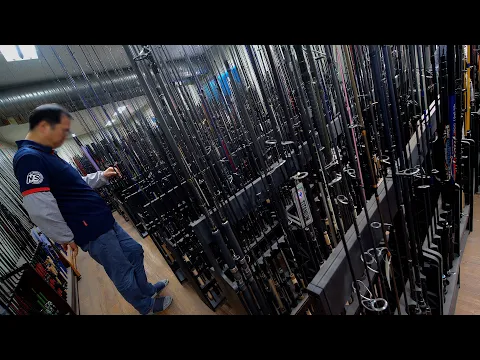

With the body ready, the Korean factory moves on to join pieces when the type of rod requires segments.
The fitting areas are polished to ensure tolerance and coupling, and the manual assembly combines sections according to the model.
In fishing rods for bait, the attachment of guides becomes a critical alignment step.
After the guides are attached, epoxy is applied.
The epoxy secures the guide, seals the binding, and influences durability and sensitivity, because excess weighs down and runs, while lack leads to looseness.
Depending on the type, epoxy also appears in parts of fitting or connection.
The epoxy, here, is a structural component, not a cosmetic detail.
Final Inspection and the Moment When Everything Can Return to the Beginning
After coating and drying, the carbon rod undergoes inspection.
The worker looks for rough areas on the surface, corrects them through polishing, and checks if the guides are straight.
In a Korean factory, this inspection acts as a quality screening that separates “product” from “rework”, even when the piece is already assembled.
When it passes, the product is assembled as a finished item and inspected once more before packaging.
When it fails, the logic is tough: it goes back for adjustments, finish corrections, guide realignment, or epoxy review, until the inspection is satisfied.
The secret that almost no one sees is this invisible cost, the one of rejecting what seems ready to protect the consistency of fishing rods.
The Korean factory in Incheon sums up a question that applies to any technical item made in series: who guarantees performance is the process, not the appearance.
If you have ever had a carbon rod that lost sensitivity, peeled at the guide, or misaligned with little use, the answer often lies in the same point: inspection and stage control, or lack thereof.
What detail of the fishing rods do you trust most to judge quality: weight, alignment of guides, finish of the epoxy, or rigidity of the carbon? And if the inspection failed a “pretty” piece, would you prefer to pay more for consistency or risk a cheaper and unpredictable model?









-

-

-

3 pessoas reagiram a isso.