





 Portuguese
  English
  Spanish
  4 min of reading
  0 comments



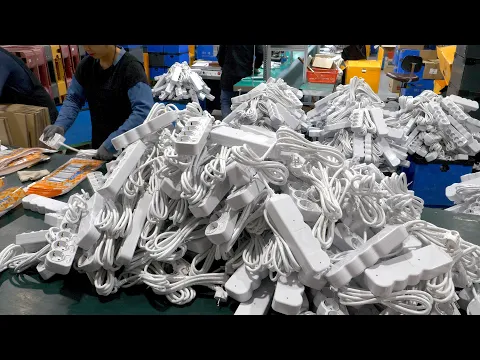
In Bucheon, in Gyeonggi-do, a Korean factory exposes what is hidden in every power strip: cutting and stripping the cable, grounding plug injection, soldering and pressing, defect inspection and final seal, as well as the 2-year replacement notice and the 1000W ceiling.
In practice, the Korean factory transforms an everyday item into a sequence of technical decisions: where the wire is stripped, how the plug is shaped, which point receives solder, and at what stage the power strip fails due to assembly error. The result is a seemingly simple product, yet filled with risks if the process fails.
The process also reveals a point often ignored in household use: the 1000W limit is not a bureaucratic detail, it defines what can be plugged in simultaneously and for how long. In environments with hair dryers and other high-power devices, 1000W becomes a safety parameter, not a convenience.
From Bench to the Body of the Power Strip

The line starts with assembling the parts into the body of the power strip.
-
He started running at 66 years old, broke records at 82, and is now a subject of study for having a metabolic age comparable to that of a 20-year-old, in a case that is intriguing scientists and inspiring the world.

-
Oldest tree on the planet reappears after 130 years of searches: Wattieza, 385 million years old, was 10 meters tall and had no leaves or seeds; Gilboa fossils in New York solved the mystery in 2007.

-
A 48-square-meter house assembled in hours with 4,000 bricks made of recycled plastic that does not absorb moisture, has natural thermal insulation, and costs less than 90,000 reais in a complete kit.

-
Luciano Hang revealed that Havan’s air fleet has already accumulated more than 20,000 landings, 10,000 flight hours, and 6 million kilometers traveled, and he says that without the planes, the company would never have grown so quickly.


At this stage, internal contacts, housings, and fixing points are positioned to receive the cable, and standardization reduces variation between units.
Small misalignments here become slack, heating, and premature wear in actual use.
Next, the Korean factory prepares the cable in batches.
The cutting to a defined length is followed by stripping the end and the controlled removal of the wire’s outer layer, which determines the effective contact area.
In terms of quality, the consistency of the stripping is as relevant as the conductor material.
Injected Plug and Grounding as Critical Step

After preparing the cable, the grounding plug is connected to the wire, and the assembly proceeds to inject the plug.
The injection encapsulates conductors and strain relief into a single piece, reducing the chance of breakage from repeated bending.
A poorly injected plug may look normal, but fail internally when the cable is twisted or pulled.
The Korean factory also needs to connect the parts to the body of the power strip, creating a predictable electrical continuity.
This is the point where mechanical tolerances and conductivity meet: the plug fits, but it also needs to conduct with low resistance.
In production, this means controlling material, position, and fitting force.
Soldering, Pressing, and the Hunt for Invisible Defects
With the body and cable assembled, the soldering of internal parts begins.
The solder closes the circuit, secures connections, and reduces micro slack that could generate sparks or localized heating.
It’s not just “gluing metal”: poor soldering alters electrical resistance and accelerates failures under load, especially when the power strip operates near the limit.
After the soldering, the body is covered and undergoes defect inspection, followed by an additional step in the pressing machine.
The pressing reinforces fittings and reduces the chance of loose parts, while the inspection attempts to capture issues that do not appear in the casing.
In this Korean factory, the logic is simple: if the failure is not seen now, it will show up at the customer’s.
Packaging, Final Inspection, and the 2-Year Rule

Packaging is not just aesthetic.
The power strip is sealed in vinyl, portioned, and checked again, with weight checkers and metal detectors cited as part of the industrial routine.
The redundancy exists because contamination, missing parts, or metallic fragments can turn an accessory into a source of short circuits and overheating.
In the usage notice, the recommendation is to replace the power strip every 2 years and check the power before plugging in devices.
The Korean factory highlights that many hair dryers have higher power than they seem, and this changes everyday life: 1000W is not a “margin,” but an operational ceiling.
If 1000W is exceeded, the chance of overheating increases, and the plug and solder become tested in the worst-case scenario.
How the 1000W Limit Changes Daily Life
The 1000W limit reorganizes the electrical routine at home and work.
Instead of “plugging everything into the strip,” safe usage requires prioritization and alternation: hair dryers, portable heaters, and other high-power items should rarely compete on the same power strip.
When 1000W becomes the rule, the extension stops being a convenience and turns into load management.
There’s also a perception effect: a power strip that looks intact does not guarantee internal integrity.
If the plug has been strained, if the solder has been subjected to repeated heat, or if the casing has lost pressure after drops, the failure can be silent.
In this scenario, respecting 1000W and watching for signs of heating becomes the only defense without instruments.
In the end, the Korean factory shows that safety starts before the outlet and continues after the purchase. If you use power strips every day, it’s worth responding with real examples: in what situations have you ignored 1000W, and which device makes you take more risks with the same plug?









-

-

-

-

-

-

23 pessoas reagiram a isso.