





 Portuguese
  English
  Spanish
  4 min of reading
  0 comments


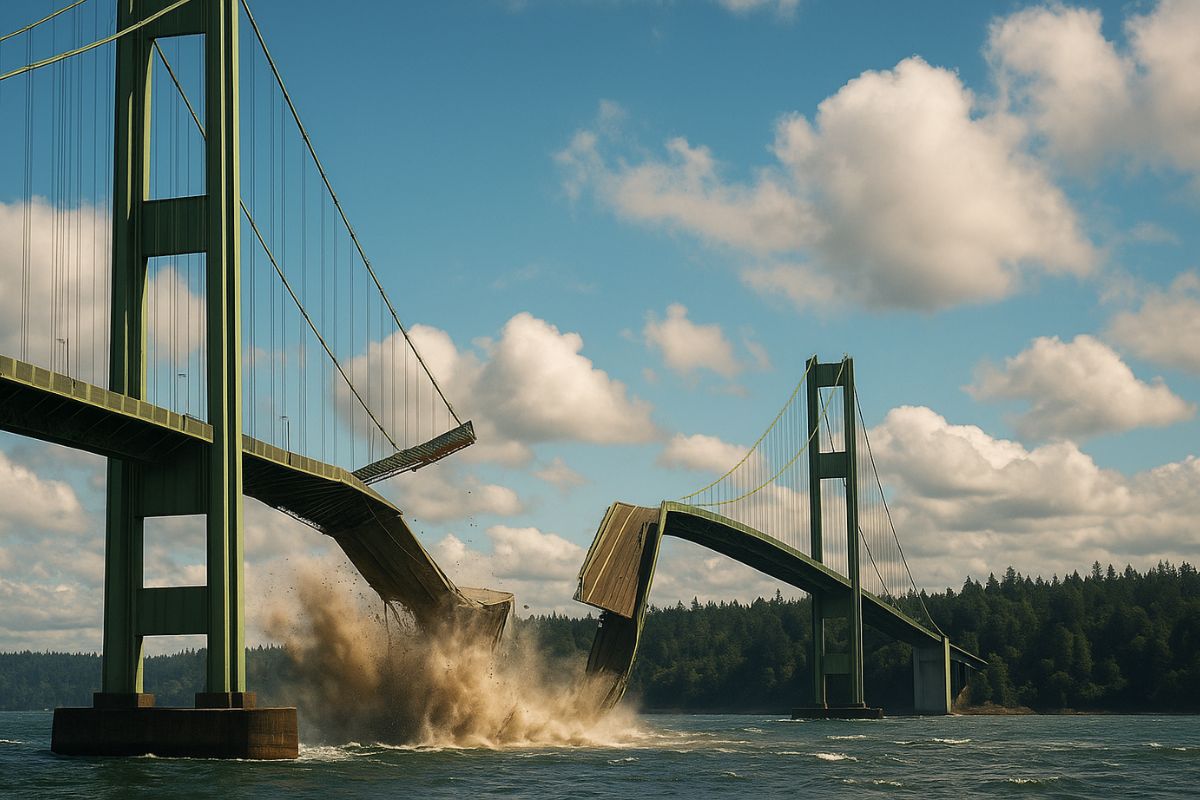
Tacoma Narrows Bridge Collapse: A 1,800-Meter Structure That Fell Four Months After Its Inauguration, Under Winds of Just 64 Km/h, and Forever Changed Bridge Suspension Design.
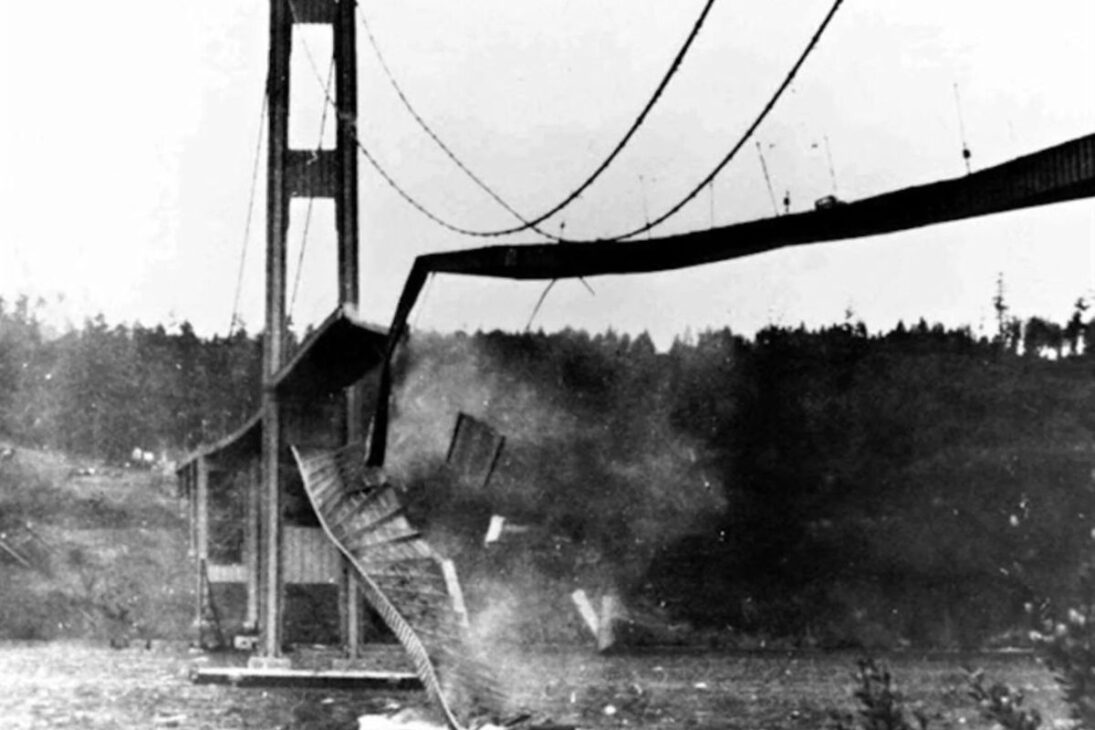
The Tacoma Narrows Bridge Collapse occurred on November 7, 1940, and became a pivotal technical alert in history. The structure connected the shores of Tacoma Narrows in the United States, with a main span of 853 meters, then the third largest in the world. Four months after opening to traffic, the bridge collapsed under moderate winds, something that local residents already feared due to visible oscillations in day-to-day life.
The investigation revealed a lethal combination of extreme slenderness and aerodynamic instability. To reduce costs and “clean” the shape, the deck used thin plate girders instead of deep trusses. The result was a very flexible platform. On the day of the collapse, the vertical oscillations evolved into violent twisting, leading to the progressive rupture of the deck and suspension elements.
Who Designed It, What Was Built, and Where the Critical Decision Failed
The bridge was designed by a team led by Leon Moisseiff, an authority on suspension bridges. The design over Tacoma Narrows sought lightness and competitive costs, legitimate goals for the time. The central span of 853 meters required stiffness and energy dissipation, but the adopted solution prioritized the slenderness of the deck.
-
The narrowest house in the world is only 63 centimeters wide, but inside it can accommodate a bathroom, kitchen, bedroom, office, and even two staircases.

-
In the middle of the sea, these enormous concrete and steel structures, built by the British Navy to protect strategic maritime routes, look like they came straight out of a Star Wars movie.
-
For years, no one could cross a neighborhood in Tokyo because of the tracks, but an impressive solution changed mobility and completely transformed the local routine.

-
With 15 floors, an unusual building in Curitiba uses concrete, pilasters, and exposed roofs to create the effect of stacked houses.


The central technical decision was to replace trusses with thin solid webs, creating flat surfaces against the wind.
This reduced mass and structural height, but increased susceptibility to aeroelastic coupling, a topic still marginal in the design repertoire of that period.
How Winds of 64 Km/h Brought Down a Large Bridge
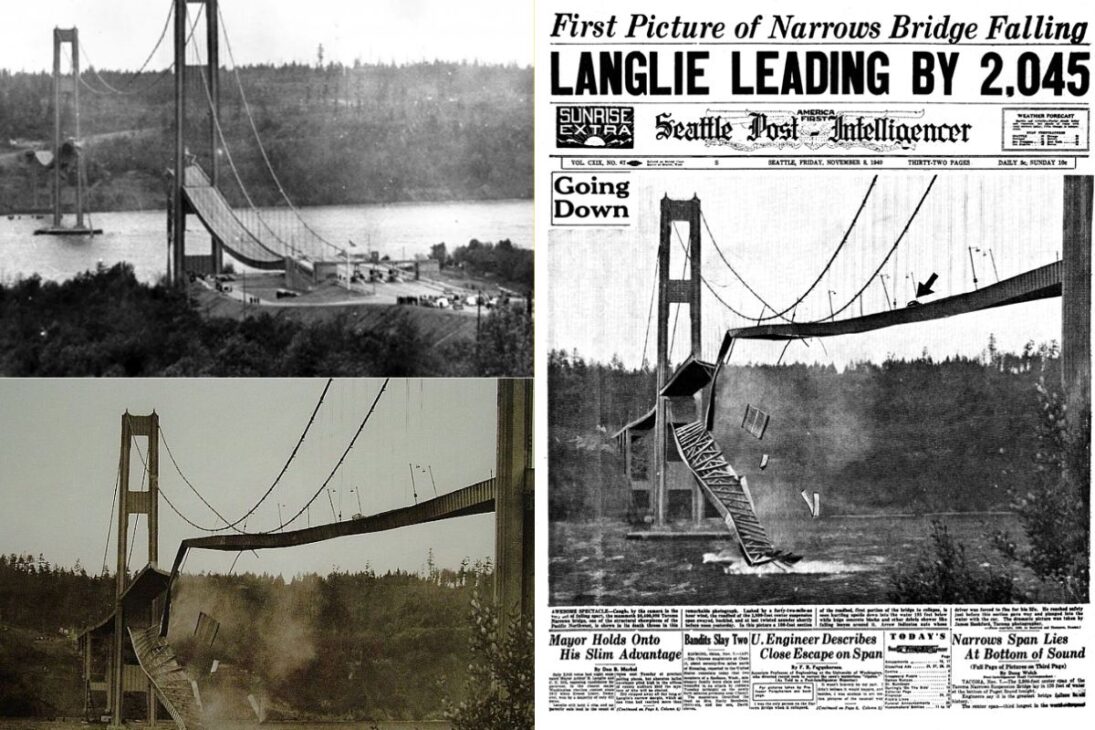
The lingering question is simple and straightforward. How did winds of only 64 Km/h produce catastrophic damage in just a few minutes?
The answer lies in the phenomenon of aeroelastic vibration, where the airflow not only excites the structure but also feeds back its movements with energy, amplifying them.
In the case of the “Galloping Gertie”, a nickname given during construction, the deck already showed noticeable oscillations in light winds.
On the day of the event, the instability migrated from a predominantly vertical mode to a torsional mode, alternating edge-to-edge rotations.
Without sufficient torsional rigidity, the system entered a state of self-excitation until the deck ruptured and the integrity of the cable system was lost.
What Engineering Learned: Aerodynamics, Rigidity, and Wind Tunnel Testing
The Tacoma Narrows Bridge Collapse made aerodynamics a mandatory part of the design of long bridges.
From this case, scale models began to be systematically tested in wind tunnels, and decks gained solutions such as ventilated sections and profiles with better flow behavior.
Another lesson was structural. Appropriate torsional rigidity and dissipation mechanisms became essential in extreme spans.
In summary, the apparent cost saved in form can turn into systemic risk when fluid-structure interaction is neglected.
Why the Case Remains Relevant for Linear Works and Large Spans
Bridges, walkways, and viaducts in windy environments continue to be subject to the same physical principle. Designs that prioritize only lightness can reduce safety margins against environmental excitations.
Prevention combines aerodynamically stable section, well-distributed rigidity, and experimental validation of calculation hypotheses.
There is also an operational dimension. Monitoring, inspections focused on vibrations, and closing protocols in adverse conditions integrate safety policy.
The goal is simple yet critical: to prevent the energy of the wind from doing net positive work on the structure, leading it to unacceptable amplitudes.
Legacy and Regulatory Impact
The Tacoma Narrows Bridge Collapse gave rise to a new standard of design and verification. Standards began to require aeroelastic evaluation, and engineering schools incorporated the topic as a foundational discipline in suspension and cable-stayed bridges.
The episode demonstrates that failures rarely stem from a single error, but from accumulated decisions that, under a common environmental stimulus, expose the vulnerability of the system.
From a public perspective, the case solidified the perception that good engineering is not just about resistance calculations; it is also about understanding the environment.
When structures interact with wind and turbulence, shape is part of performance, and experimental validation becomes as essential as numerical sizing.
The Tacoma Narrows Bridge Collapse remains a reference study because it translates, in images and data, the importance of aerodynamics and rigidity in large spans.
Good design means anticipating dynamic behavior and limiting sources of energy feedback that turn moderate wind into catastrophic failure.
Which lesson do you consider most decisive to prevent new cases like Tacoma Narrows: the necessity of wind tunnel testing or increased rigidity and ventilation of the deck?






-

Uma pessoa reagiu a isso.