





 Portuguese
  English
  Spanish
  5 min of reading
  0 comments


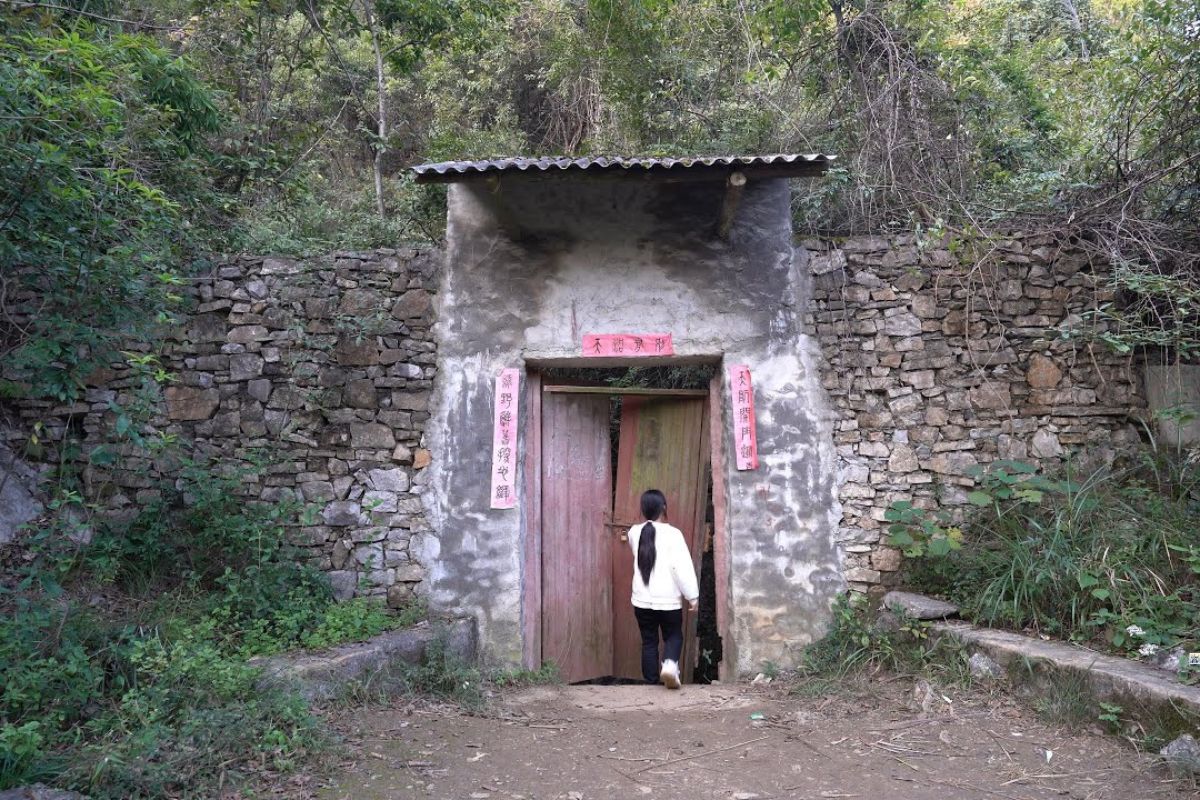
A Rotted Wooden Door Leads to the Foot of an Milennium Cliff in Chongqing, to a Karst Sinkhole with Stone Steps, Water Channels that Drip All Year Round, Remnants of Habitation, a Small Sanctuary, and Statues Carved in Rock, Composing a Rare Set of a Forgotten Temple Under a Natural Abyss
In Beibei, a mountainous area of Chongqing, an ancient door embedded in low walls opens to a monumental void. Just beyond the passage, the ground breaks into a karst sinkhole with vertical walls, vigorous vegetation in the sun, and hand-carved stone steps that lead to the damp bottom. At the base, stone walls laid block by block, worn rugs, a broom, and bottles indicate recent human use, while niches and rock shelves suggest older occupation.
The edge of the millennium cliff in Chongqing continuously drips water, feeding puddles and simple channels. Scattered across the terraces are altars with cult images, including the Medicine Buddha and a figure with multiple arms attributed to Guanyin. On one wall, a low-relief on a lotus throne reinforces the hypothesis that the hole once housed a discreet temple that thrived in the past and was abandoned over time.
Where It Is and How to Get There
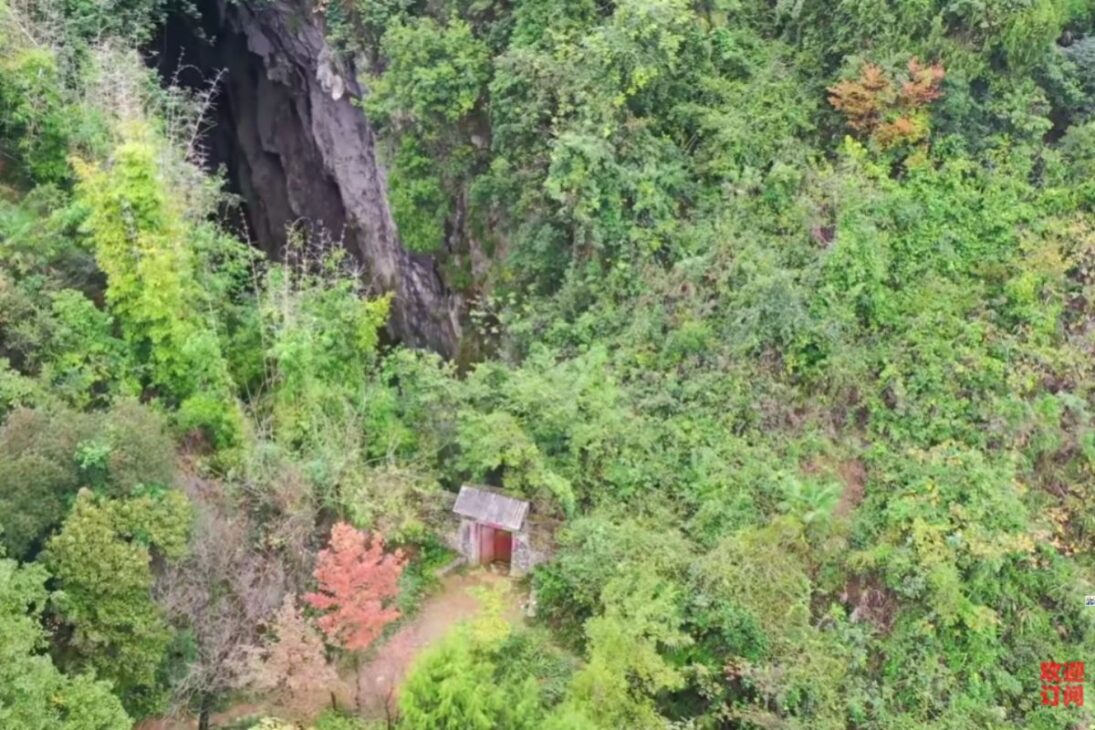
Access is located in the mountains of Beibei, Chongqing, via trails that wind through dense forests, rustic bridges over ravines, and sections prone to landslides.
-
A rare storm transformed part of the Gulf into an unlikely scene of hail, extreme rain, and tornado risk in the middle of the desert, with volumes that exceeded the annual average in a single day.

-
Brazil catches the world’s attention with ships powered by ethanol and biodiesel that have lower emissions, an unprecedented certification with advantages in chartering, and a revolution in cabotage.

-
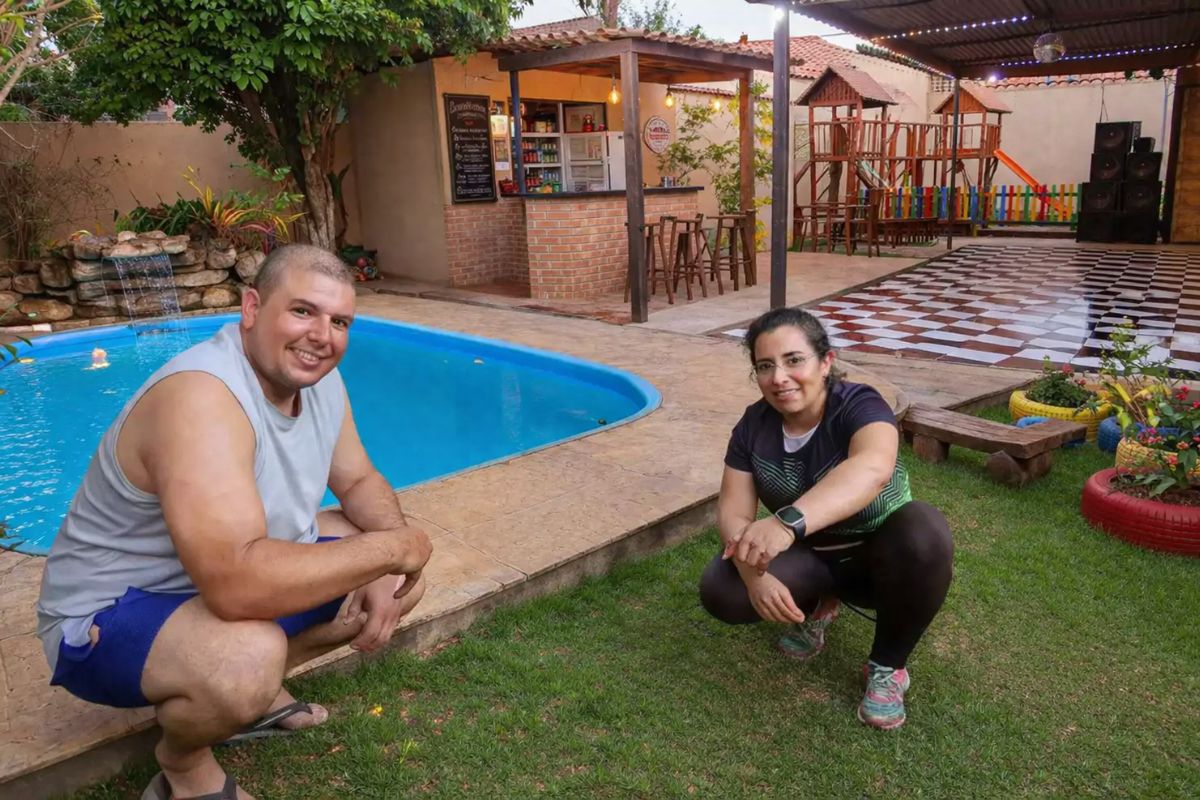
A couple who only has Sundays free has built a hand-dug pool, a hamburger joint, a dance hall, and a playground in their own home without hiring a mason, and even with breaks due to accidents and the pandemic, the work has never truly stopped.
-
Furniture made with aluminum and glass does not warp and has become an alternative to replace MDF in Brazil.
The “straight line” distance can be misleading: the terrain requires successive detours, multiplying the journey and effort needed to conquer the slopes to reach the door.
The entrance, camouflaged by vegetation, serves as a boundary between the outside and the open chamber of the tiankeng.
Once beyond the threshold, the hiker faces uneven steps, constant humidity on the walls, and slippery areas, a scenario that demands cautious movement, especially on rainy days.
What Exists Behind the Ancient Door
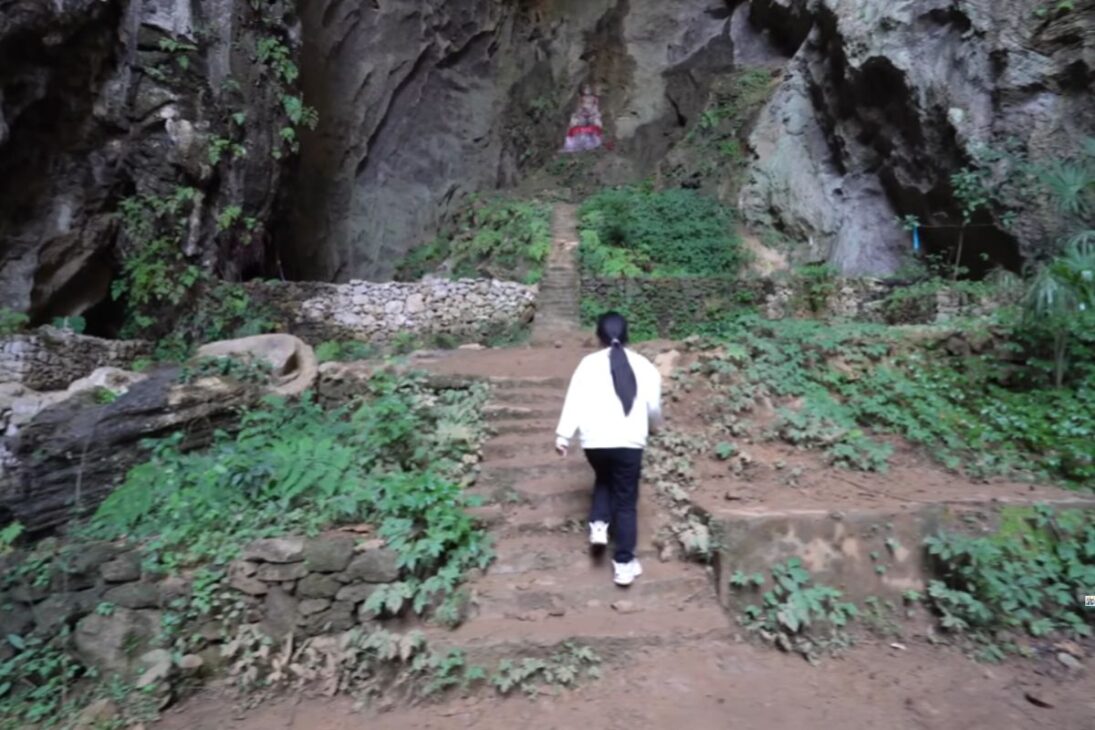
Behind the door, the void reveals itself to be extremely vast, with direct sunlight enhancing the greenery inside the doline.
The stone steps, clearly built by hand, connect terraces where low walls, platforms, and support marks can be seen, as if there were houses fitted into the rock.
At the bottom, flat surfaces accumulate sediments and water.
Among the current remnants, bottles, a broom, and a stick indicate that people have recently descended.
The feeling is of a functional place, used now as shelter, now as a space for devotion.
Evidence of Cult and Human Occupation
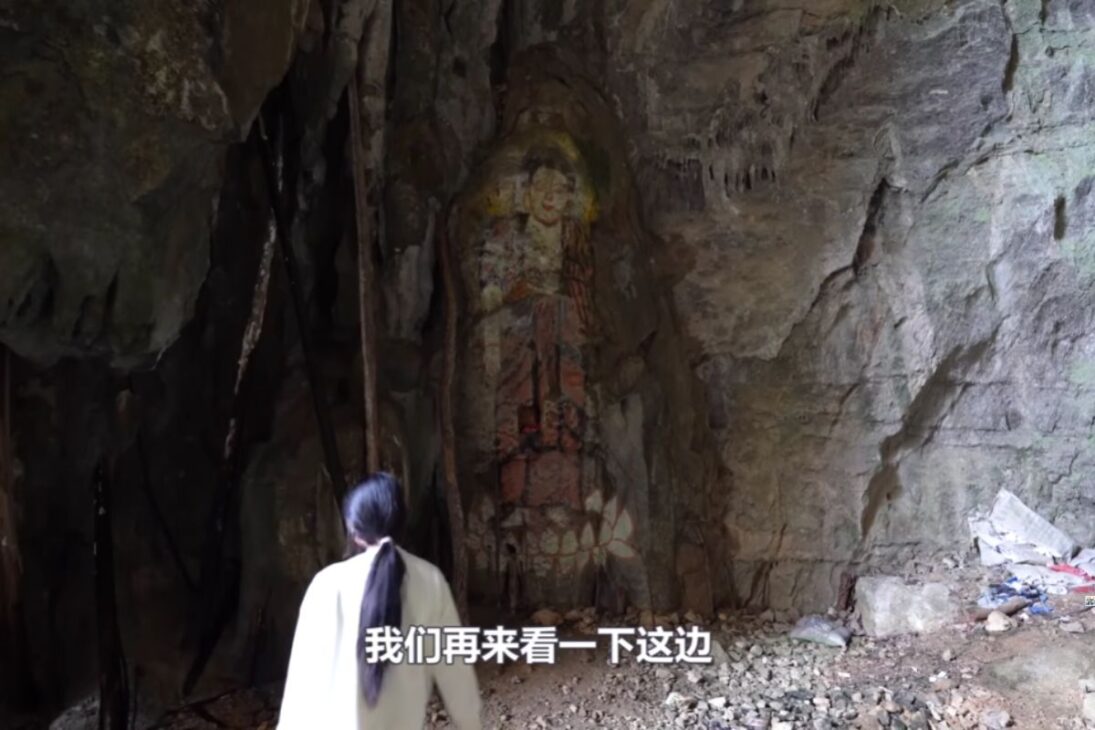
The terraces show altars with ancient offerings, an image of the Medicine Buddha, and the representation of Guanyin of a Thousand Arms.
There is also a niche with a statue carved directly into the rock, placed facing the mouth of the cave, reinforcing the symbolic alignment between faith and landscape.
At another point, an eroded mural on a lotus throne survives the humidity.
The presence of foundations and walls indicates previous light structures were set up, possibly cells, storage areas, and shelters that, combined with signs of recent circulation, suggest a fluctuation between periods of intense use and phases of abandonment.
Geology of the Tiankeng and the Dynamics of Water
The sinkhole follows the logic of karst terrain: dissolution of soluble rocks over thousands to millions of years, fractures enlarged by percolation, and localized subsidence that opens the crater.
On the walls, water drips continuously, feeding puddles and small sheets on the lowered floor.
This water is both a geological and cultural factor. Geologically, it maintains the humid microclimate, accelerates joint erosion, and deposits minerals.
Culturally, it offers a clean and accessible source at specific terraces, explaining the site’s choice for shelter and ritual.
The water that drips all year round also requires constant maintenance of the passages and imposes limits on occupation.
Why a Temple Beneath a Cliff
Temples in natural cavities combine climatic protection, acoustics, and seclusion.
The position beneath the millennium cliff in Chongqing creates a silent, isolated, and easily controllable environment, with a guardable entrance and a water supply.
In times of instability, this type of installation served as refuge and place of worship.
The subsequent decline may result from changes in local routes, a reduction of resident monks, natural disasters that silted access paths, or simple migration of religious practices to safer and more visible areas.
The result is a discreet heritage, whose value persists in the remnants and in the landscape.
Risks, Preservation, and Visit Ethics
The descent involves wet slabs, mud, and loose blocks. Without continuous railings, any visit requires sturdy boots, a helmet, and a light source.
The humidity facilitates falls, and the presence of logs wedged in the cliff should not be interpreted as a reliable anchor.
From a heritage perspective, not removing objects, not lighting fires, and avoiding touching images and murals are essential.
Responsible photographic documentation and georeferencing help map damages and guide protection actions.
The ideal is for local initiatives to assess minimal signage and access control during the wetter periods.
What Still Intrigues
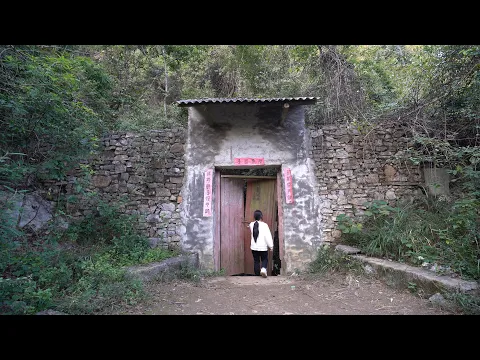

Unanswered questions remain: Who built the steps and walls, when the sanctuary reached its peak, and what events precipitated the abandonment.
The iconography suggests Buddhist syncretism, but erosion obscures dateable details.
A systematic study could combine photogrammetric surveys, stratigraphic readings of the deposits, and analysis of biocrusts on the walls.
Also intriguing is the function of woods resting on the rock.
Between mundane explanations of local reinforcement and popular interpretations of an apotropaic nature, the concrete fact is that the site maintains layers of meanings superimposed on geography.
Under the millennium cliff in Chongqing, nature and devotion have left a rare set of material signs in a void of stone and water.
Among steps, altars, and drips, the site calls for documentation and care.
In your opinion, what should be the priority now: structured archaeological investigation or immediate protection with access control?







Seja o primeiro a reagir!