





 Portuguese
  English
  Spanish
  8 min of reading
  1 comment


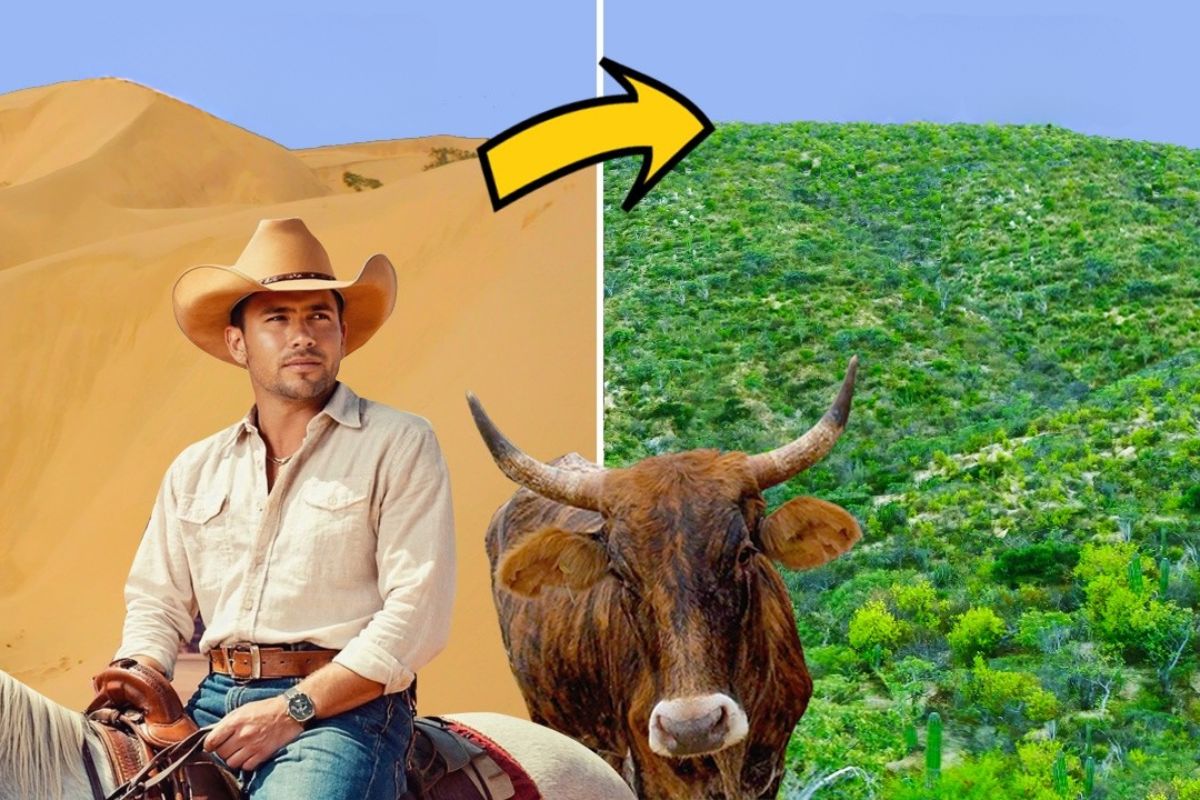


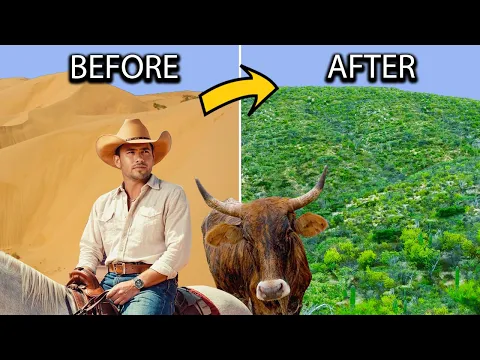
In The Desert Of Baja California, In The Driest State Of Mexico, The Cacachilas Ranch Has Water During The 6-Month Drought. With 16,500 Hectares, 20 Pastures Of 80 To 100 Hectares, Monthly Rotation And 1.5 Years Rest, 116 Cows Control Erosion, Recharge Aquifers And Turn Into 5-Year Research.
A transformation considered unlikely for a desert is already underway in southern Baja California, in the driest state of Mexico: during the driest time of the year, when it hasn’t rained for 6 months and the land should be completely dry, the managed area of the ranch appears <strong/lush and green, with water present where there normally wouldn’t be.
The turning point did not come from conventional irrigation, but from fencing, rotational grazing, and regenerative management applied at scale, combining livestock, watershed management, and organic farming over 16,500 hectares. The intervention reached a level of result that motivated a 5-year scientific project to measure and prove, with metrics and quantitative evidence, what is happening in the desert.
The Scenario In The Driest Desert Of Mexico And Why It Matters

The south of Baja California is home to about 1 million people and, despite the label of arid region, is not a biological void. The local desert is described as one of the most biodiverse in the world, with medicinal plants, giant cacti, and unusual elephant-shaped trees. In a specific area, however, ecological decline had been advancing due to uncontrolled logging and grazing.
-
With a cost per shot close to zero, the DragonFire laser could change naval warfare in 2027 and provide British ships with nearly unlimited defense against drones.

-
A British startup creates tires that generate electricity in electric vehicles when passing over potholes, speed bumps, and cracks.

-
Scientists have created robots made with living cells that have their own nervous system, swim on their own, explore the environment, and self-organize without any genetic engineering, and now they want to do the same with human cells.

-
Students create a solar-powered ambulance that operates without a plug, without fuel, and still keeps medical equipment running in remote areas.


In this context, the debate is inevitable. As cows are not native to North America, there is controversy over using cattle to regenerate desert and even about leaving deserts completely alone. The Cacachilas Ranch enters this discussion with an operational premise: the problem is not just having cattle, but how the cattle is managed within the ecosystem.
Cacachilas Ranch, Scale And Components Of The Regenerative Project

The ranch is presented as a “must-see” regenerative farming and conservation project due to its size and the combination of fronts. The total area is 16,500 hectares and there are two types of livestock with different functions.
The cattle are used for erosion control and landscape restoration over large areas. The goats are intended for milk and organic artisanal cheese production, integrating productive logic into land management. Additionally, the project includes two farms with regenerative methods, agriculture, and agroforestry, cultivating seeds adapted to the desert and forming fertile soil through a special inoculation formula that introduces microorganisms to desert soil.
The most sensitive environmental core involves water: the ranch claims to have implemented one of the most significant programs in the world for erosion control, with impacts that go beyond holding soil. The set of actions would have recharged wells and groundwater and, more than that, brought back water flow year-round to rivers that had been dry for decades.
The Proof Of The Fence And The Contrast With The Degraded Surroundings

The most direct visual verification appears at the property line. A record shows the “fence line” as the boundary between two ecological states. On the ranch side, there is much more vegetation. On the outside, the neighboring land appears with fewer plants and more exposed soil, even at the same time of year.
The team visits exactly this point in the driest time of the year, with 6 months since the last significant rain, to observe the difference with the naked eye. The disparity holds on the ground: outside the managed area, the soil is described as harder and dryer, with little infiltration, favoring surface runoff and erosion. Inside the managed area, the landscape shows higher density of green vegetation, compatible with recovery and rest after controlled grazing.
On the way to the fence line, signs of fauna return still appear: two deer and a jackrabbit are spotted on the road, amidst dense vegetation that contrasts with the aridity surrounding.
What Free Grazing Does To The Desert: Erosion, Exposed Roots, And Soil That Cannot Absorb Water

To compare methods, the team visits a location about 10 minutes from the ranch where cattle and goats graze freely. The difference is described as shocking. What appears on the horizon are severely eroded valleys, ravines, and sparse vegetation. The roots of trees and plants are exposed, indicating that rainwater has washed away the topsoil and lowered the land level.
The causal chain is described with operational clarity. Without plants, the soil loses protection. With animals grazing freely, the vegetation is consumed before it can recover. The soil becomes exposed and cannot absorb water efficiently. When it rains, the water does not infiltrate: it runs off, accelerates erosion, and enlarges the ravines.
There is also an important physical detail observed at the ranch to explain why infiltration changes: in areas where cows do not step, the soil forms a hard layer, a kind of hydrophobic crust, which prevents water from penetrating. Where management leads cows to circulate and not remain, the soil appears looser and “broken,” allowing infiltration and favoring absorption by plants and aquifer recharge.
The Heart Of The Method: Fences, 20 Pastures, And Rotation To Avoid Overgrazing
The ranch describes a central operational rule: not to leave the cows too long in the same place. To achieve this, it installed fences and divided the land into pastures, controlling where and how often the herd grazes.
The detailed structure is as follows: there are 20 pastures, each with 80 to 100 hectares. The cows stay in a paddock for about one month. Then, the pasture goes into rest, totaling approximately one and a half years of recovery between herd visits. Practically speaking, the ranch refers to closing grazing areas for a rest period of 1.5 years, so that the land has a chance to recover.
When the herd returns, the area should be greener and have more plants. The logic is to treat rest as an ecological input, not as a productive loss. The management starts from the understanding that, in the desert, plant recovery is slow and requires a real window for reconstitution.
Low Cattle Density, 116 Cows, And 1,750 Hectares To Promote Infiltration And Life In The Soil
Another critical point is density. The ranch claims to work with low herd density, defined as the number of cows relative to the total area, lower than in conventional livestock. This gives more space and reduces pressure time on each section of vegetation, improving soil condition.
The numerical reference presented is 116 cows being regularly transferred to a large area of 1,750 hectares, described as almost 8 times more than the “normal.” The very contrast is explained by an average cited: “the normal” would be one cow per half hectare. At the ranch, the strategy is reversed: keep the herd controlled, rotating, with prolonged rest, to foster ecosystem growth and avoid compaction and overgrazing.
The ecological dynamics of the cattle are described without romanticization. Cows walk, eat, and defecate. This organic material fertilizes the land, returns nutrients, and helps spread seeds. Grazing can also “prune” plants and stimulate growth, as long as the pressure is controlled and there is a real recovery period for the desert.
The “Desert-Friendly” Cow, Historical Origin, And Crossbreeding At The Ranch
The herd is described as criollo cattle, known as the “desert-friendly cow” for its ability to thrive in arid conditions. It is presented as the oldest known breed of cattle in the Americas, introduced by the Spanish.
The ranch also began crossbreeding this cattle with Angus and Red Wagyu to observe performance and adaptation. The stated goal is not aesthetics, but to understand how the system behaves and how cattle farming can operate within the ecological limits of the desert without repeating the cycle of degradation seen in the surroundings.
Holistic Management And The Attempt To Mimic Predators That Move Herds
The ecological justification of the method appears in a direct analogy. In natural ecosystems, herds do not stay static: predators move them. The cited comparison is to the African savanna, where lions move wildebeests, avoiding stagnation and reducing prolonged pressure in a single spot.
In the desert of southern Baja California, this mechanism does not exist for cows, which are not natural to the area. Therefore, human intervention enters as a substitute for the role of predators, moving the herd through fences and rotation. The ranch calls this set of practices holistic management, aimed at mimicking processes from nature and “returning to the natural cycle,” adjusted to the desert ecosystem.
Water That Returns To Flow, Aquifers Recharged, And The Scientific Interest Of 5 Years
The most sensitive result, because it contradicts expectations of a region with 6 months without rain, is the water. The ranch reports not only improvement in vegetation, but recovery of hydrological dynamics, with wells and groundwater recharged and return of year-round flow in rivers that had been dry for decades.
The declared level of impact led to an additional step: scientists would be in the midst of a 5-year research project to produce metrics and quantitative evidence about these achievements. The reason is clear: in debates about livestock and desert, visual impression is not enough. Measurement and evidence are what can separate an isolated case from a replicable model.
What The Cacachilas Ranch Still Connects: Goats, Organics, Agroforestry And Soil With Microorganisms
Regenerative management is not limited to cattle. The ranch operates goats for milk and organic artisanal cheese, as well as two farms with regenerative agriculture and agroforestry. A specific front is described as the cultivation of seeds adapted to the desert and the formation of fertile soil through inoculation with microorganisms.
The narrative includes the expectation of visiting these areas, observing the growth of mycelium to improve the soil and understanding how the watershed restoration project made ephemeral desert streams flow with water year-round. Overall, the approach is of integration: livestock, soil, and water treated as a system, not as separate sectors.
Practical Implications And The Limit Of The Debate About “Leaving The Desert In Peace”
The case exposes a real conflict. On one side, the idea of not intervening in the desert. On the other, the diagnosis that part of the ecological decline is a direct product of uncontrolled logging and grazing, which is already an intervention, but a degrading one.
The Cacachilas Ranch advocates for intervention with a method: fencing to interrupt free grazing, rotation to reduce pressure, long rest to allow regeneration, low density to avoid compaction, and a landscape design that reconstructs infiltration, aquifer recharge, and protection against erosion. Instead of “more cattle,” the bet is on more control and more recovery time in the desert.
If your region suffers from erosion, exposed soil, and drying rivers, the most realistic path is to look at what has already been tested for nearly 16 years: fencing, rotation, rest, and low density, combined with watershed restoration and soil construction. The question now is who has the governance, technique, and patience to sustain this type of management in the desert, without shortcuts and easy promises.
Do you think that fencing and rotational grazing can be a serious solution to recover a degraded desert, or should this be avoided at all costs?








Engraçado que no Brasil existem vários estados com muitas cabeças de **** a centenas de anos convivendo em áreas secas ninguém soube até o momento qual benefício já tiveram, essa história surgiu em uma reportagem de um país que descobriu essa mentira, e agora querem viralizar, usem a inteligência para o bem e não para passar informações falsa