





 Portuguese
  English
  Spanish
  3 min of reading
  0 comments


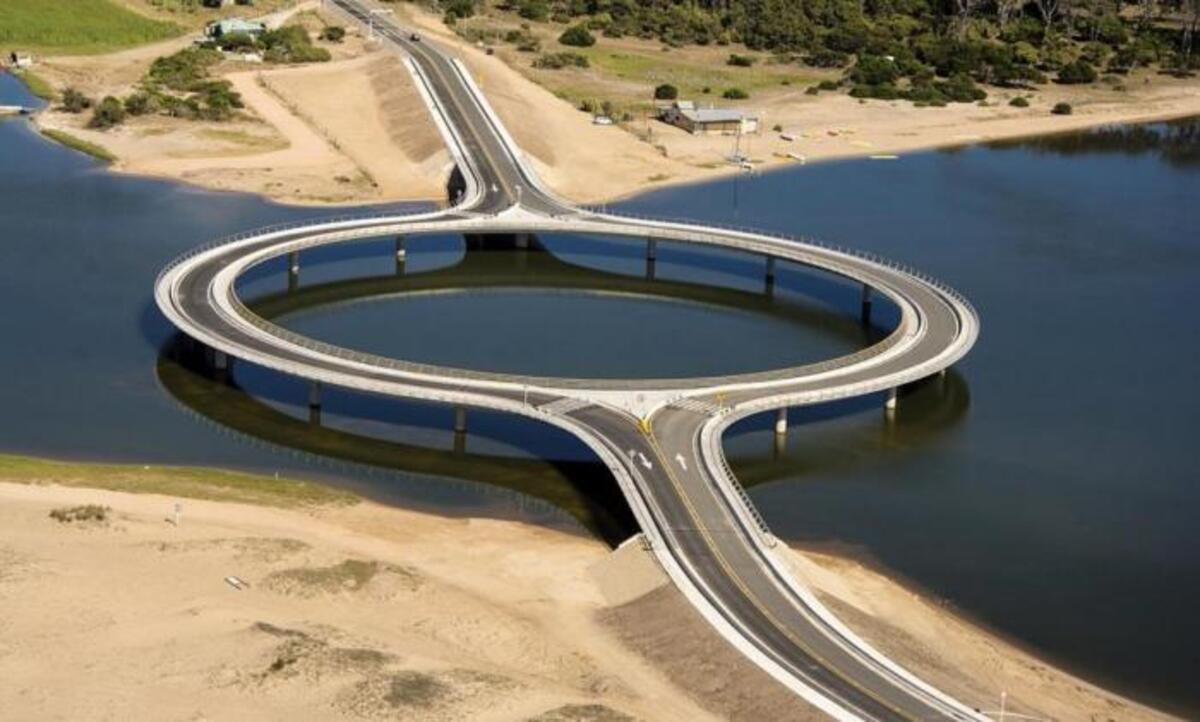
The Circular Bridge of Laguna Garzón, in Uruguay, Emerged as Innovation and Intelligent Design, But Why Is It Like That?
Far from being just an architectural extravagance, its unique shape, which raises the curiosity “why is it like that” and “why not straight,” conceals an ingenious purpose that goes beyond aesthetics. This masterpiece of engineering not only connects people but also redefines the concept of infrastructure with a touch of genius.
The Question of Shape: Why Is It Like That and Why Not Straight?
The first question that arises when viewing the Circular Bridge of Laguna Garzón is undoubtedly: why is it like that? And the curiosity extends to why not straight, like most of the bridges we know?
The answer lies in the confluence of multiple objectives, which transformed the need to cross a body of water into a solution that prioritizes safety, experience, and environmental preservation.
-
Four humans are flying towards the Moon inside the Orion capsule launched by the SLS rocket, and on April 6, Artemis II will disappear behind the far side of the Moon without communication with Earth for nearly an hour.
-
Worlds covered by water, atmospheres filled with hydrogen, and the possibility of life beyond Earth: ocean planets are rewriting the map of cosmic search and forcing scientists to rethink where to look.

-
Argentina achieves the unimaginable after more than 110 years and reintroduces the largest native herbivore of South America to the Chaco to restore a lost link in nature.

-
Returning to the Moon now costs a billion-dollar bill and reignites the competition between the USA and China for science, technology, and rare minerals on lunar soil.

The circular shape of the bridge is not a whim of designer Rafael Viñoly. On the contrary, it is an ingenious solution to reduce vehicle speed.
By forcing drivers to make gentle turns, the bridge naturally decreases traffic speed, making the crossing safer. This is crucial, especially considering that the region is a popular tourist destination and an ecologically sensitive area.
In addition to safety, the circular design offers a unique experience. It compels drivers to pay more attention to the scenery around Laguna Garzón, turning a simple crossing into a moment of contemplation and enjoyment of the natural beauty.
In other words, the bridge is not just a pathway; it is a destination in itself, a viewpoint that invites slowing down and interacting with the environment.
Innovation and Integration: The Purpose Behind Circular Design
The innovation of the Circular Bridge of Laguna goes beyond its shape. It represents a new paradigm in bridge engineering, where functionality merges with environmental responsibility and human experience.
The circular design allows the bridge to serve multiple purposes. For example, it incorporates pedestrian passages on its inner and outer sides, transforming it into a panoramic walkway.
This encourages interaction of people with the lagoon, whether to enjoy the view, observe birds, or even fish. There are also areas dedicated to fishermen, integrating the local community with the bridge’s structure.
The construction of the bridge itself was a challenge of innovation. With a length of 323 meters, it is supported by pillars that rise from the water, minimizing the environmental impact on the lagoon.
The use of modern materials and techniques ensured not only the strength and durability of the structure but also its harmony with the region’s natural landscape.
More Than a Bridge, An Icon of Sustainability and Experience
The Circular Bridge of Laguna Garzón is a testament to the idea that innovation in infrastructure can go beyond merely connecting two points.
By answering the questions of why it is like that and why not straight, we discover that its design was meticulously planned to optimize safety, promote environmental appreciation, and create a communal gathering space.
It has become a postcard of Uruguay, admired by engineers, tourists, and local residents.
The success of the circular-shaped bridge inspires other projects to think “outside the box,” showing that creative design, when well-founded, can lead to more efficient, safe, and harmonious solutions with the environment and people.






-

2 pessoas reagiram a isso.