





 Portuguese
  English
  Spanish
  5 min of reading
  0 comments


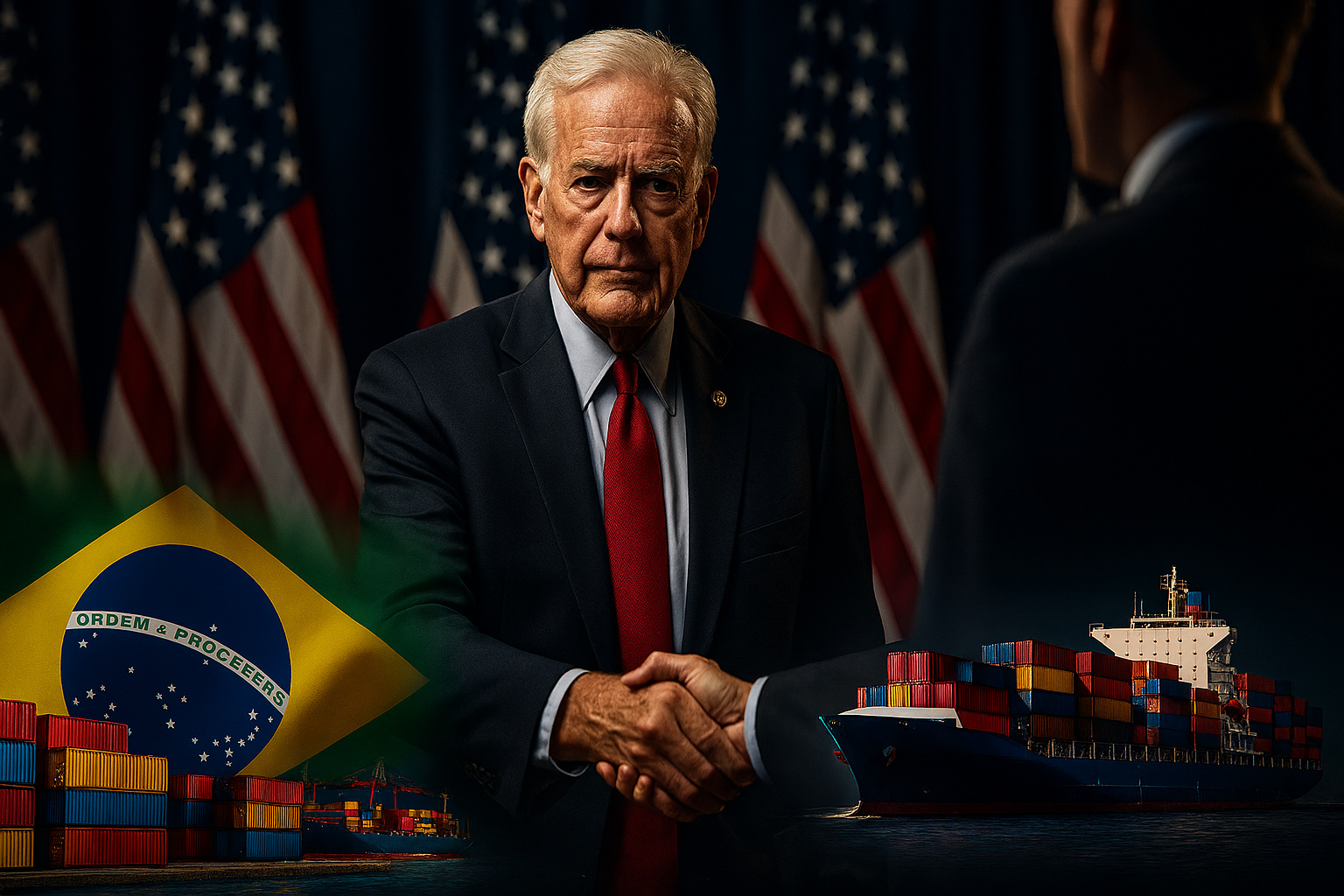
Senator Rand Paul, An Ally of Trump, Joins Democrats in Bill to Block 50% Tariff on Brazilian Products Imposed by the White House, According to CartaCapital.
Trade between Brazil and the United States has entered the center of an unusual political debate in Washington. A Republican senator allied with Donald Trump made an unexpected decision and chose to align with Democratic lawmakers in a joint effort to overturn the 50% tariff on Brazilian products imposed by the White House.
The initiative drew attention not only for its economic impact but for the rare convergence of rival political forces in a Congress marked by polarization. The gesture shows how Brazil, one of the largest exporters of commodities to the United States, has become a strategic piece in discussions about tariffs and international trade.
The 50% Tariff Against Brazilian Products
According to a report by CartaCapital, the U.S. government announced the implementation of tariffs of 50% on Brazilian goods, using the legal provision known as the International Emergency Economic Powers Act (IEEPA) as justification.
-
Iran authorizes the passage of ships with essential goods in the Strait of Hormuz, requires coordination and protocols; UN postpones resolution to reopen the oil route, while China, France, and Russia reject the use of force.
-
The Ukraine war exposes the strength of the M113 armored vehicle amid modern warfare with military drones.

-
Maritime geopolitics: China and the USA compete for strategic ports in Peru.
-
Iran shoots down two US aircraft: F-15 fighter crashes in mountainous area, one crew member is rescued and another is still missing; second crash in the Persian Gulf exposes still active air defense, says US intelligence.



This instrument grants the president exceptional powers to intervene in foreign trade matters when he considers there to be a threat to national security. Originally, the IEEPA was created in 1977 to deal with emergency crises — such as terrorism, wars, and sanctions against authoritarian regimes.
However, in recent years, the provision has been used more broadly to implement protectionist measures, and Brazil’s case has become an example of this.
An Unlikely Union: Democrats and a Trump Ally Together
The bill against the tariff was introduced by a group of Democrats led by Tim Kaine, Chuck Schumer, Jeanne Shaheen, and Ron Wyden, all heavyweights within the Senate. The surprise, however, came with the support from Rand Paul, a Republican senator from Kentucky and ally of Trump.
Paul, known for his conservative profile and alignment with the party’s more hardline faction, joined the Democrats in a movement that defied expectations. By signing the bill, he positioned himself against the White House, signaling that the tariff does not find consensus even within the Trump camp.
This union is interpreted as an attempt to reaffirm Congress’s role in controlling American trade policy. For lawmakers, the Executive cannot resort to the IEEPA indiscriminately to impose barriers without legislative debate.
Brazil as a Piece on the Chessboard
Brazil is one of the ten largest trading partners of the United States. In 2024, bilateral trade exceeded US$ 100 billion, with highlights on products such as oil and derivatives, steel, coffee, cellulose, beef, and manufactured goods.
The 50% tariff would endanger Brazil’s competitiveness precisely in sectors where the country has been gaining ground in the American market. For Brasília, the measure sounded like a setback at a time when international negotiations are seeking to expand trade agreements and ensure predictability for exporters.
At the same time, there are industrial and agricultural sectors in the U.S. that rely on Brazilian supplies. This interdependence helps explain why part of Congress decided to mobilize against the measure.
Rand Paul’s Role
Rand Paul’s entry into the debate reinforced the political weight of the bill. An ally of Trump, he represents a segment of the Republican Party that often advocates for tariffs and barriers against importers. His support for the Democratic text was seen as a pragmatic gesture.
Paul argued that the use of the IEEPA in this case was exaggerated and inappropriate, exceeding the legal limits of the measure. Furthermore, according to the report from CartaCapital, the senator expressed concern that political accusations against Bolsonaro were being used as a backdrop to justify punitive trade measures against Brazil.
This statement reinforced the idea that the tariff had not only economic character but also political.
Democrats and Trade Control
For the Democrats, Brazil’s case is an example of the need to curb the Executive’s excessive power in international trade. They argue that the Congress should deliberate on high-impact tariffs, preventing unilateral decisions from the White House from harming established trade relations.
The Democratic leader in the Senate, Chuck Schumer, stated that the indiscriminate use of the IEEPA puts the credibility of the U.S. as a trade partner at risk. Tim Kaine highlighted that measures like the tariff weaken alliances and create instability in global supply chains.
Potential Impacts for Brazil
Even though the CartaCapital article does not detail the specific sectors affected, it is evident that a 50% tariff would have significant repercussions on the Brazilian trade balance. The country could lose market share in the U.S. to competitors like Mexico, Canada, and Asian countries.
Moreover, products with high symbolic value, such as coffee and steel, could suffer directly, reducing profit margins for exporters and threatening jobs in strategic sectors of the national economy.
A Rare Bipartisan Gesture
In the context of political polarization in the U.S., the union of Democrats with Rand Paul draws attention. Analysts suggest that this movement could be a turning point, showing that even on tough issues like trade protectionism, there is room for consensus when strategic interests are at play.
The episode also highlights how Brazil has come to be treated as a relevant actor in internal disputes of American politics. The tariff is not just an economic measure; it is also a symbol of the clash between Congress and the Executive over the limits of presidential power in trade.
What Lies Ahead
The bipartisan bill still needs to go through the Senate, but it has already opened a space for resistance against the White House’s measure. If it advances, it could force a revision or even the suspension of the tariffs.
For Brazil, this represents an opportunity to avoid losses and bolster economic diplomacy in Washington. The Brazilian government is closely monitoring the negotiations and is expected to intensify dialogues with American business sectors that would also be impacted by the tariff.
A Warning for International Trade
The dispute over tariffs against Brazil shows how international trade has become a geopolitical battleground. On one side, powers use emergency measures as a tool of political pressure; on the other, emerging countries like Brazil need to defend themselves in multilateral and bilateral arenas.
The episode involving Democrats and a Trump ally is therefore a clear message: even strategic partners can become targets of unilateral measures, and the defense of national interest requires constant vigilance.









-

Uma pessoa reagiu a isso.