





 Portuguese
  English
  Spanish
  7 min of reading
  1 comment


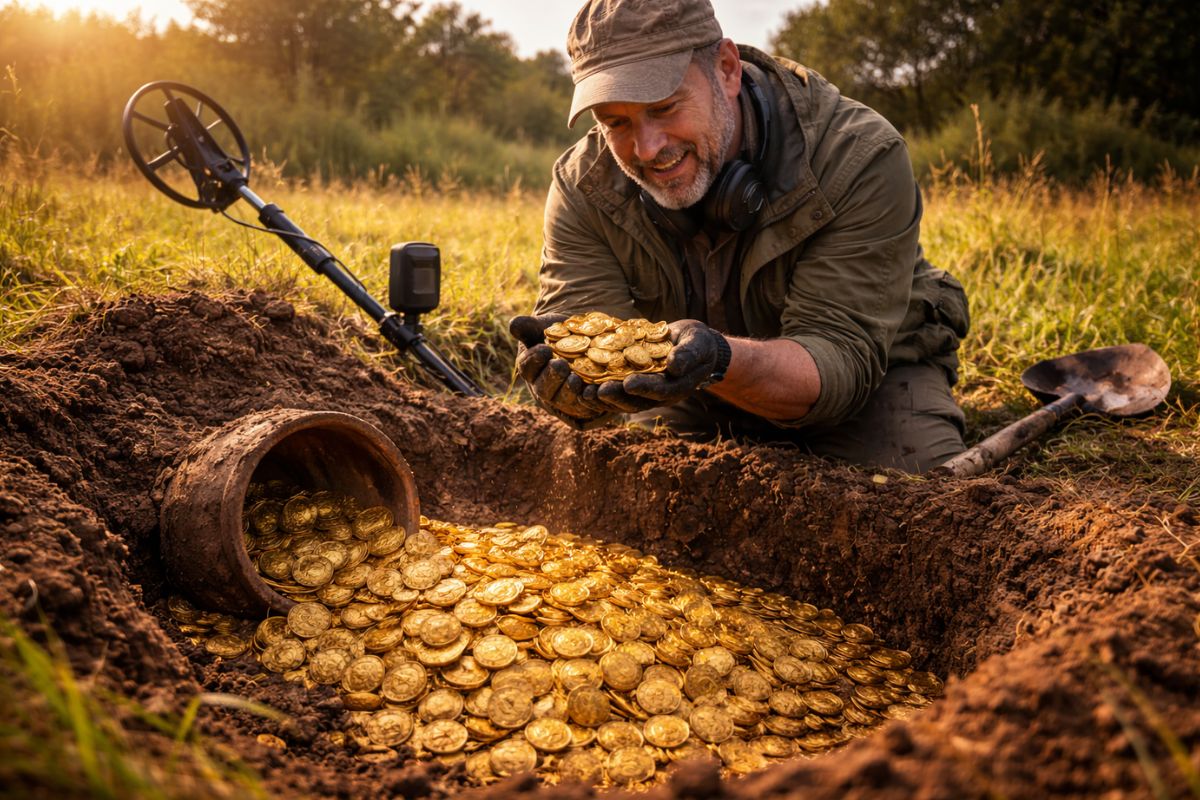


The Largest Gold Coin Treasure Ever Recorded In Britain Was Found In Great Baddow, Near Chelmsford, Contains 933 Pieces From The Iron Age, May Dialogue With Episodes Attributed To Julius Caesar And Was Purchased By The Chelmsford Museum For Permanent Public Display After Funding Of £250,000 Specific.
The largest gold coin treasure from the Iron Age ever recorded in Britain came from a field in Great Baddow, but its impact has surpassed the initial surprise of the discovery. With 933 coins and fragments of a possible container, the set is now secured by the Chelmsford Museum, which prevented the pieces from being dispersed and transformed the find into public heritage.
The acquisition completed in May 2025 reorganizes the archaeological weight of Chelmsford within the debate on the Iron Age in eastern England. At the same time, the case carries two layers that make it even more relevant: the hypothesis of a connection with Julius Caesar and the legal controversy surrounding how the treasure was found and initially hidden.
A Set Of 933 Coins That Changed The Scale Of The Discovery

The so-called Great Baddow Treasure was discovered in 2020, over 2,000 years after it was buried. Dated between 60 and 20 B.C., it comprises 933 gold coins and fragments of a possible container or vase.
-
A gigantic dam project in the Himalayas could solve one crisis but silently create another for millions of people.

-
Nikola Tesla said that intelligent people tend to have fewer friends, and now science partially confirms this: a study with over 15,000 people showed that for the more intelligent, socializing too much can even reduce life satisfaction.

-
A superyacht worth US$ 17 million is delivered in impeccable condition, sets out to sail, and hits a bridge in the Bahamas just two hours later.

-
Residents of Australia woke up to a sky completely red like blood before the arrival of Cyclone Narelle, which hit the coast with winds of 250 km/h, tearing off roofs and lifting iron dust in a scene they described as apocalyptic.


This volume alone shifts the discovery to an exceptional level, because it transforms the find into the largest gold coin treasure of the Iron Age ever found in British territory.
The composition of the set also helps to explain its relevance. Of the 933 coins, 930 are eastern British staters of the Whaddon Chase type, in addition to three different individual pieces.
This allows researchers to observe not only a rare numerical accumulation but also a specific monetary pattern, linked to a period when groups from the Iron Age in Britain began to mint their own coins with regional matrices, after an initial phase of importing Celtic coins from abroad.
The find is of national importance because it does not just add one more object to the archaeological inventory. It expands the field of questions about the circulation of wealth, political organization, and shifts of power in eastern England.
When such a large set emerges intact, in the same context, archaeology gains a rare chance to observe concentration, intent, and scale at the same time.
For Chelmsford, the effect is even more direct. The return of the treasure to the city, advocated by local authorities and the curatorial team, strengthens the reading that the region was not peripheral in the Iron Age, but an active part of a zone of power circulation, tribute, and conflict.
This point leads the Chelmsford Museum to treat the acquisition not just as an institutional triumph, but as a recovery of a central piece of local history itself.
What The Coins Suggest About Tribes, Power, And Julius Caesar

The most sensitive interpretation of the set lies in the possible connection with Julius Caesar. According to Claire Willetts from the Chelmsford Museum, it is believed that most of the coins were produced in a region later associated with the so-called Catuvellauni.
The theory raised from this is that the lot could have been intended for the payment of tribute to the Roman general Julius Caesar, amid the turmoil recorded around the second invasion of Britain in 54 B.C.
This hypothesis is not presented as a closed certainty, and that needs to be clear. The value of the treasure lies precisely in providing material support for a discussion that until now relied much more on Roman sources than on direct archaeological evidence.
The strength of the point is not to prove a specific historical event alone, but to reduce the distance between written account and physical vestige.
The discovery in Great Baddow, in an area traditionally associated with the Trinovantes, also fuels another important reading.
If most of the coins were produced in a zone linked to the Catuvellauni, the presence of the set in Trinovant territory may indicate movement, pressure, or influence from western groups to the east.
This gives the largest gold coin treasure a decisive role in understanding aggressions and power rearrangements between neighboring peoples of the Iron Age.
In this sense, the find weighs because it touches on an old gap. The material from the Chelmsford Museum itself highlights that there was little archaeological evidence to corroborate episodes of regional upheaval related to Julius Caesar.
Now, without ending the debate, the treasure forces a reassessment of how this eastern Britain articulated politically on the verge of deeper changes in the Roman and insular world.
How The Chelmsford Museum Prevented The Treasure From Being Divided
The treasure was acquired in May 2025 thanks to £250,000 funding from the National Lottery Heritage Fund.
There were also contributions from the Chelmsford City Council, the Friends of Chelmsford Museums, the Essex Archaeology and History Society, the Essex Heritage Trust, the British Archaeological Council of the East, and the Essex Numismatic Society.
The financial operation was decisive because without it the set could have been fragmented.
Councilor Jennie Lardge emphasized this point by stating that the fundraising effort aimed to bring the treasure back to Chelmsford and prevent it from being divided and sold to private individuals. This is a central dimension of the case.
A find of this scale loses some of its historical value when it is separated because the coins cease to be read as a set and begin to circulate as isolated market items.
The Chelmsford Museum stepped in precisely to avoid this rupture.
The funding, however, will not only serve for the purchase. It will also support new research, outreach activities, and community projects designed to bring the local population closer to the treasure.
This reinforces the strategy of the Chelmsford Museum to turn the find into a public platform of knowledge, and not just a showcase of visual impact. Exhibiting is important, but studying and contextualizing is what truly turns gold into history.
The expectation is that the set will be shown to the public for the first time in the summer of 2026, in a temporary exhibition dedicated to the theme.
After that, it will move to a permanent exhibition starting in the spring of 2027.
For Chelmsford, this means keeping close to where the largest gold coin treasure ever recorded in Britain was found, something that strengthens the link between territory, memory, and museum.
The Extraordinary Discovery Came With A Grave Violation
If archaeology gained a rare treasure, the case also exposed a serious conduct problem. The detectorist who found the set on private property in Great Baddow did not have permission to be on site.
Moreover, he did not immediately declare the find as required by the Treasure Act of 1996.
This delay was not a bureaucratic detail, but a concrete loss for the archaeological understanding of the context.
Later, the find was communicated to the landowner and the treasure was eventually delivered to the finds liaison officer of Essex. However, the situation had already worsened.
The discoverer was arrested by Essex Police for being in possession of more undeclared coins.
Subsequently, the Chelmsford Magistrates’ Court found him guilty of failing to declare possession of a treasure and attempting to steal 23 coins.
The case was then assessed by the Independent Treasure Valuation Committee, which recommended that the discoverer should not receive any reward.
The recommendation was that only the landowner should be rewarded for the discovery.
This decision is not ancillary: it sends a clear message that the scientific value of the find depends as much on the object as on how it is treated from the very first moment.
Therefore, the very episode has become a reminder of the importance of responsible metal detecting.
The largest gold coin treasure does not only serve to reopen the history of the Iron Age and possible connections with Julius Caesar. It also exposes how a monumental discovery can have its context damaged when basic rules are ignored.
What The Treasure Represents For Chelmsford Starting In 2026
When the set reaches public display, the Chelmsford Museum will not be showing just coins. It will be placing difficult questions before visitors about wealth, conflict, tribute, fear, and concealment.
Who collected so many precious pieces? Why was this volume buried and never recovered? And why did this territory of Chelmsford preserve a set of this scale for over two thousand years?
Lori Rogerson from the Portable Antiquities Program called attention to this engagement potential by saying that visitors will be impressed by the size of the find and the gold content. This is likely.
But the most lasting impact may lie in another plane.
The treasure impresses not only because it shines; it impresses because it returns complexity to a past still poorly understood.
For Chelmsford, the public display creates a rare opportunity to connect locals and visitors to the local Iron Age through a set that will be difficult to surpass in scale anytime soon.
For scholars, the largest gold coin treasure remains an open source for investigation. For the public, it serves as a gateway to a period when eastern England was far from being stationary or secondary.









isso que fizeram com o detequitorista o que achou o tesouro isso sim foi roubo não da a parte da gratificação dele :pois se não fosse ele estar lá procurando esse tesouro nunca ia ser encontrado isso e covardia de justiça ele tinha sim que receber a parte dele ele tem que entrar com a defesa dele e ir até o fim pra receber o que e dele : eu sou detequitorista jamais eu deixaria de lutar se fosse eu pra receber a minha parte