





 Português
  Inglês
  Espanhol
  5 min de leitura


According to the National Energy Balance (BEN) of 2019, hydropower plants account for 64% of the installed capacity for electricity generation. This amount demonstrates the significant weight that this source has within the national electric matrix.
The pricing policy for solar energy, regulation, and management of our matrix is based on the management of hydropower resources. Even when well-sized, hydropower plants do not always operate at their maximum capacity, failing to fully or partially take advantage of the available structure. This can occur due to oversizing for future expansions, operation with a greater safety margin, or due to the seasonality in the behavior of rivers.
Read Also
- Renewable energy sources saw significant growth in the energy matrix in 2019
- Safety Technician is called to work in Hydroelectric Power Plants in the regions of MG, ES, and RJ
- Solar energy surpasses Nuclear in the Brazilian energy matrix
- Wind energy is responsible for over 19,000 jobs in Brazil
The National Water Agency (ANA) predicts greater unpredictability of rivers due to the impacts of recent climate changes, which makes the operation of power plants even more unstable given the need to review water usage permits. This unpredictability can affect the physical guarantee of the plants, which is the amount of energy that a plant can supply given a predefined criterion. The physical guarantee serves as the basis for calculating and managing the internal energy supply of the country, which can lead to instability and idleness in the system.
Capacity Factor (CF)
One way to measure the idleness of a system (whether for generation, distribution, or transmission) is by its Capacity Factor (CF). This index is calculated as the ratio between the energy actually generated and the generation potential provided by the installed power of a plant (or in the case of a transmission or distribution line, the ratio is given as the energy transported by the line compared to the energy that can be transported based on its capacity).
-
Alone, the producer applies 7,400 hectares with the T100 drone in an optimized structure, replaces the generator with a silent battery, and demonstrates how technology reduces costs, increases productivity, and even challenges the uniport in the field.
-
China banned the export of 22 tons of meat from Argentina.

-
JBS, founded by the Batista brothers, continues to conquer the world: entrepreneurs built a ‘factory in the desert’ creating 3,000 jobs.

-
With only 1% of Brazil’s territory, Santa Catarina has built one of the most competitive industrial parks in the country, with 64,000 companies, nearly 1 million jobs, and a growth rate of 5.3% while the national industry is practically stagnant.

In the figure next to it, it is possible to verify the evolution of the CF of the national hydroelectric park, taken from the book Renewable Energy by Tolmasquim. The CF range operates between 50 and 60%, with a drop below 50% between the years 2010 and 2014.
A solution to this problem is provided by the Energy Research Company (EPE) in the technical note: “Hybrid Plants: a qualitative analysis of regulatory and commercial themes relevant to planning.” In this note, it is described that hybrid and associated generation plants increase the utilization of the capacity of distribution and transmission systems, optimize the use of the plant area, and benefit from the complementarity between energy sources, bringing advantages to the grid.
The addition of other energy generation sources in hydropower plants helps hydraulic generation during periods of low water flow and allows for the maintenance of reservoirs to better meet peak demand.
Furthermore, it is important to highlight that the adoption of hybridization, or the hybridization of sources, will lead to an “increase in the capacity factor” at the connection point, which will be translated into an increase in the percentage of generation of the plants and also a greater utilization of the available electrical infrastructures such as substations and transmission and distribution lines.
But What Are Hybrid Plants?
How is their topology characterized? Barbosa (2006) defines hybrid plants as those that utilize more than one primary source of electrical energy generation, characterized by the ability of one source to temporarily supply the lack of another, reducing interruptions and aiming for the optimization of energy and financial resources as primary objectives.
EPE, in its technical note, presents 4 possible models of hybrid plants, as presented below.
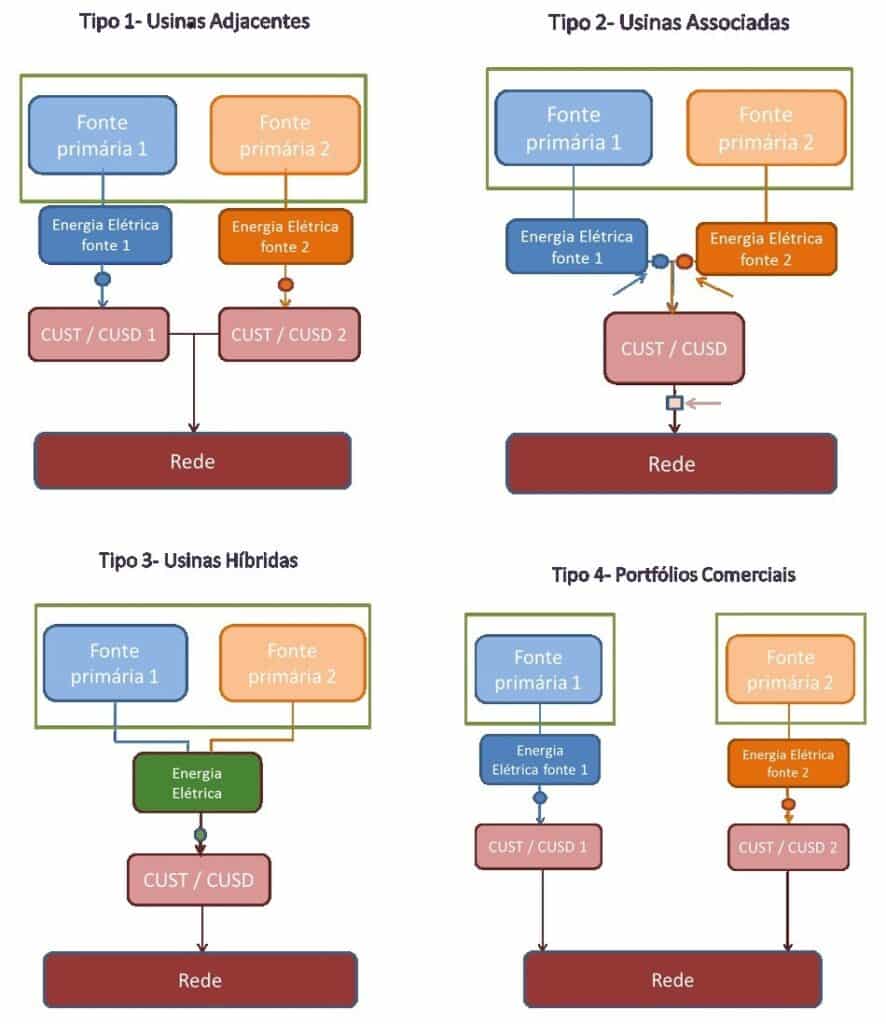
Adjacent Plants
These are basically those built in nearby locations, which can use the same terrain and share facilities of restricted interest, such as substations or transmission lines.
However, despite this sharing, in the view of the National Interconnected System (SIN), since they require nominal installed power compatible with their respective installations and do not share generation equipment, they are not considered proper hybrid plants.
Associated Plants
Two or more plants from distinct energy sources (hydropower and solar, for example), with complementary production characteristics and that, in addition to their proximity, physically and contractually share the connection infrastructure for access to the basic network or distribution network.
Hybrid Plants (strictu sensu)
Defined as those that combine their distinct energy resources still in the process of generating electricity. An example of this modality is heliothermal plants with biomass burning, where the steam produced by burning both sources (solar + biomass) is utilized in the same turbine.
Commercial Portfolios
Unlike the other previous arrangements, portfolio plants do not necessarily have physical proximity or shared equipment; however, the need to adopt different types of generation remains.
The arrangement is characterized by having shared commercial contracts aimed at reducing short-term energy purchase exposures, especially in quantity purchase contracts.
It is worth noting that this type of category does not impact the contracting of the distribution or transmission system, referring to the Distribution System Usage Tariff (TUSD) and the Transmission System Usage Tariff (TUST).
Solar Energy as an Option for Hybridization
The use of hybridization with solar energy + hydropower has been studied and tested for some time. Its results, especially regarding economic and environmental impact, have shown promise.
The use of photovoltaic solar energy in hydropower plants can be carried out in land areas close to the plant; however, its most emblematic use is over the reservoir lake of the plants.
The structures used in this type of application are high-density polyethylene floaters, which, in some Brazilian applications, are made from a resin produced by Braskem. A successful case study in Brazil was (and is being) the floating solar plant in Sobradinho, which is being constructed over the lake of the Sobradinho Hydroelectric Power Plant managed by the São Francisco Hydroelectric Company (Chesf).
The hydropower plant in question already has 1,050 MW of installed capacity from its 6 generating units of 175 MW each. The solar plant constructed over its lake currently has 1 MWp with an expected expansion of an additional 1.5 MWp, totaling a project of 2.5 MWp and a total investment of around R$ 55 million.
At first glance, the amount of R$ 55 million may scare a potential investor (around 22 R$/Wp), raising concerns regarding feasibility. However, it is worth noting that the investment amount covers a range of other R&D initiatives, such as studies on factors like incident solar radiation at the site; energy production and transport; installation and anchoring at the bottom of the reservoirs; the complementarity (read hybridization) of the generated energy; and the distribution of energy.
Credits: Weliton da Maia – External Assistance Technician at L8 Energy | Energy Engineering Student at Positivo University | Electronics Technician by Sociesc










Seja o primeiro a reagir!