





 Portuguese
  English
  Spanish
  4 min of reading
  0 comments


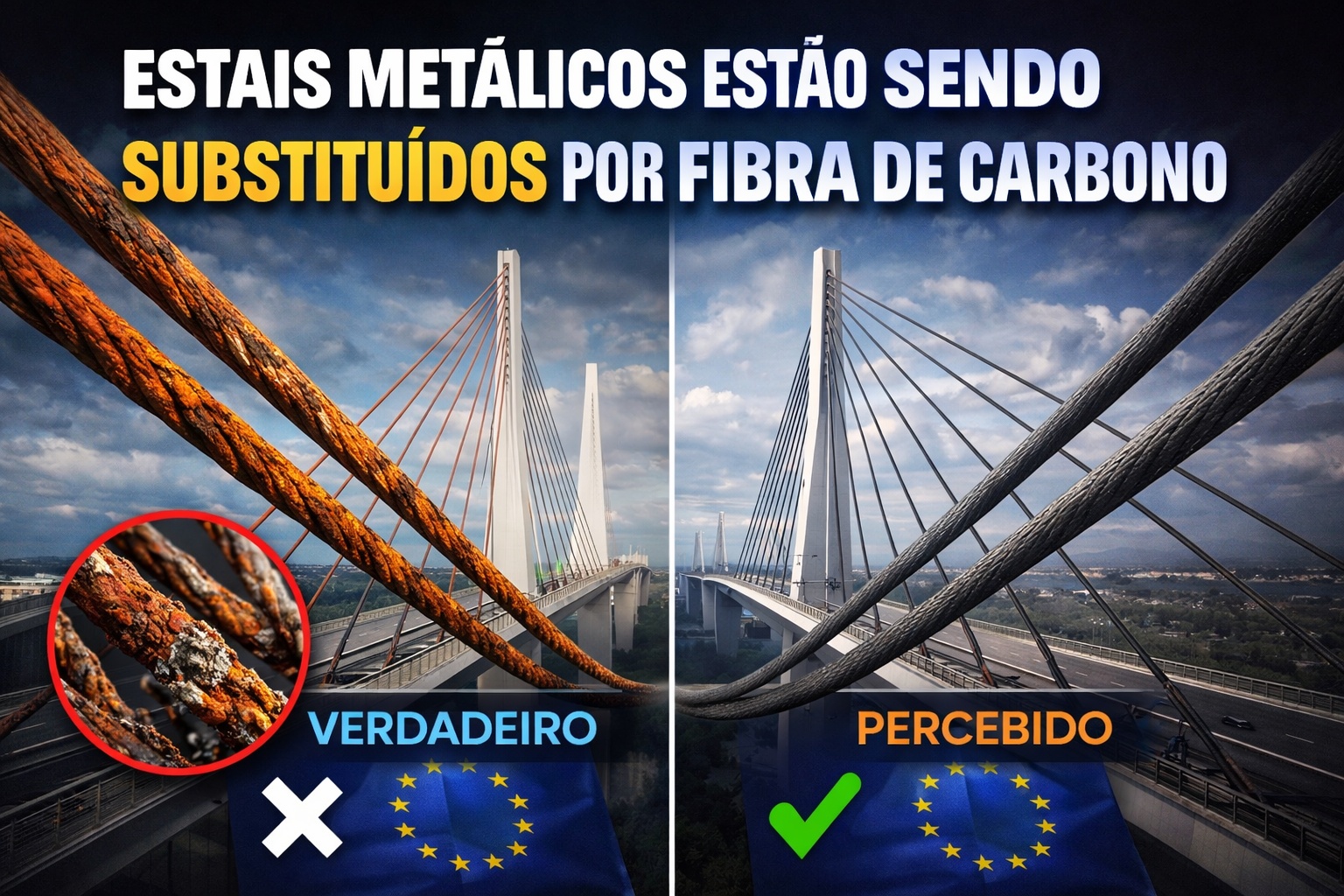
European Countries Have Started Using Carbon Fiber Cables in Stayed Bridges, Replacing Steel to Eliminate Corrosion, Reduce Structural Weight, and Extend the Service Life Validated by Decades of Monitoring.
The replacement of steel by carbon fiber cables (CFRP) in stayed bridges is not an experimental idea nor a future promise. It is a technical change that began to be tested in Europe back in the 1990s and has, over the last few decades, been validated in real projects, continuously monitored, precisely to address one of the biggest problems in modern bridge engineering: the invisible and progressive corrosion of metallic stays.
In countries such as Switzerland, Germany and Austria, the adoption of CFRP originated from national infrastructure research programs seeking solutions to dramatically extend the service life of stayed bridges without increasing the frequency of costly and disruptive interventions.
The Structural Problem That Motivated the Switch from Steel
Steel cables work under high permanent tension, subjected to millions of load cycles caused by traffic, wind, and thermal variations.
-
The lack of welders, electricians, and operators becomes a structural threat in 2025, with the construction industry and manufacturing already suffering from delays, cost pressures, and labor shortages in Brazil.
-
Brazil and Paraguay are just 46 meters away from a historic union on the bioceanic bridge that promises to revolutionize trade between the Atlantic and the Pacific.
-
With 55 km over the sea, a cost of US$ 20 billion, and enough steel to build 60 Eiffel Towers, China’s largest project has connected Hong Kong, Zhuhai, and Macau in a colossal bridge that defies the logic of engineering.
-
A trick with joint compound transforms a Styrofoam ceiling into a plaster-like ceiling: leveled panels, wires and mesh at the joints, sand, paint, and change the environment while spending little today.
Even with protective sheaths, drainage systems, and internal greases, steel remains vulnerable to internal corrosion, often detected only when the damage is already advanced.

In Europe, inspections of stayed bridges built in the 1970s and 1980s showed that cable corrosion became a limiting factor in service life, forcing complex and costly replacements. It was in this context that research institutes began testing non-metallic materials capable of withstanding extreme tension without oxidizing.
Real Projects That Use Carbon Fiber Cables
One of the milestones of this transition was the application of CFRP stays in the Storchenbrücke, in Switzerland. The bridge received carbon fiber cables as early as 1996, becoming one of the world’s first functional examples. Since then, the structure has been continuously monitored to assess fatigue behavior, deformations, and prestressing stability over time.
The technical follow-up is conducted by Empa, the Swiss federal laboratory for materials science. Decades of data have shown that CFRP cables have not exhibited corrosion, nor significant losses in structural performance, even under continuous climatic exposure.
In Germany, the material has been used not only in new bridges but also in structural reinforcements of existing bridges, where carbon fiber cables were added to relieve stress on old metallic stays, extending the structure’s service life without the need for major demolitions.
The Impact of Weight on Bridge Engineering
One of the most immediate effects of replacing steel with CFRP is the drastic reduction in the self-weight of the cables. Carbon fiber cables can weigh up to five times less than steel cables with similar load-bearing capacity. This difference is not just a detail: it changes the overall balance of the bridge.
With lighter stays, the stresses transmitted to the masts and foundations decrease. This allows for:
- slimmer structures,
- reduction of permanent loads,
- and greater safety margins against dynamic actions such as wind and vibration.
In recent European projects, this feature has begun to be explored as a design advantage, rather than just a secondary benefit.
Durability Measured in Decades, Not in Maintenance Cycles
While steel cables require frequent inspections, relubrication, and eventually replacement, CFRP cables completely change the maintenance logic. As they do not oxidize, the main degradation mechanism disappears.
Life cycle cost studies conducted by European road administrations indicate that, despite the higher initial cost, carbon fiber cables significantly reduce total expenses over decades, especially in aggressive environments, such as coastal regions or urban areas with high pollution.
Technical Challenges and Developed Solutions
The adoption of CFRP did not occur without obstacles. Unlike steel, carbon fiber exhibits more fragile rupture behavior, which required the development of specific anchoring systems capable of distributing tensions without concentrating excessive stresses.
These anchorages were designed, tested, and validated at full scale in Europe, becoming an essential part of the structural system. Today, they are as critical as the cable itself, ensuring long-term reliability and safety.
A Silent Change in Bridge Engineering
Although little known outside the technical field, the adoption of carbon fiber cables represents a silent yet profound change in how stayed bridges are conceived. It is not just about swapping one material for another, but about redefining the concept of durability, moving from structures that require constant intervention to systems designed to last generations with minimal maintenance.
The European experience shows that when materials technology, continuous monitoring, and advanced structural engineering come together, it is possible to change the historical “weak point” of stayed bridges and do so already in the present, in real projects, operating under normal traffic.









-

Uma pessoa reagiu a isso.