





 Portuguese
  English
  Spanish
 4 min of reading
  7 comments


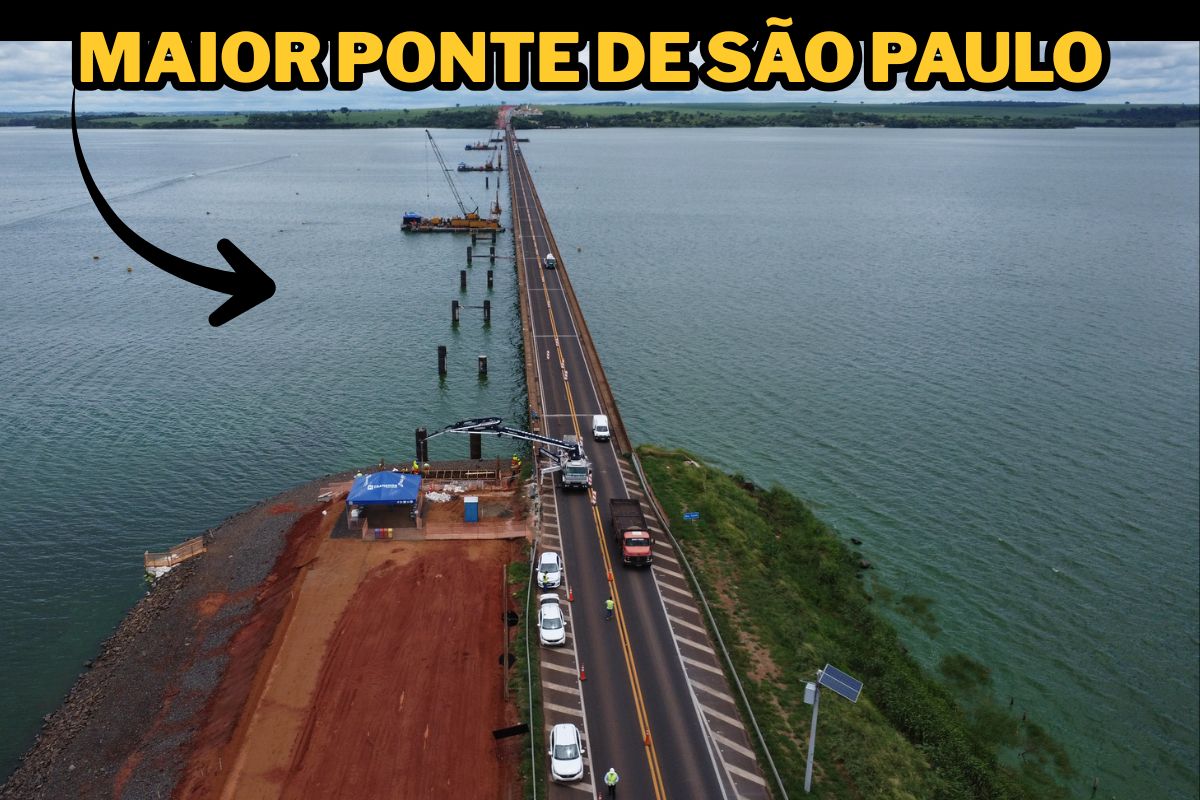


With 2.4 km in Length, the Largest Bridge in the State of SP Will Connect Novo Horizonte to Pongaí Over the Tietê River, Transforming the Flow of Agribusiness and the Logistical Future of São Paulo’s Interior
In the heart of São Paulo’s interior, the sound of jackhammers and the back and forth of trucks announce a silent and historic transformation. Between Novo Horizonte and Pongaí, the largest bridge in the state of SP is taking shape, a concrete and steel colossus extending 2.4 km over the Tietê River. The project promises to redefine regional mobility and consolidate a new logistical axis for agribusiness.
More than an investment in infrastructure, the project symbolizes decades of waiting and planning, with a projected completion in 2026 and a budget of R$ 373 million. The Engenheiro Gilberto Paim Pamplona bridge is the new landmark of the SP-333, a strategic highway that connects agricultural production, industrial centers, and the port of Santos.
A Project That Links Decades of Waiting to the Future of Mobility
For years, the stretch between Novo Horizonte and Pongaí suffered from logistical bottlenecks.
-
These living root bridges and ladders are over 700 years old and help indigenous people survive in one of the rainiest regions in the world.

-
From sertanejo star to international investor: Ana Castela invests millions in a mansion in the USA, creates a themed accommodation in Orlando, and shows that the “boiadeira” also wants to grow away from the stage.

-
The 10 most stunning motorhomes in the world: a $3 million trailer with a rooftop nightclub and garage for a Ferrari, “palaces on wheels” with Italian marble, private cinema, and five-star hotel luxury for billionaires.
-
Trump wanted to spend $400 million on the White House, but the courts prohibited the million-dollar construction.


The old single-lane bridge of the SP-333 could no longer handle the increasing flow of trucks and agricultural machines.
During harvest periods, the queues stretched for miles, compromising the flow of grains and increasing the risk of accidents.
In rainy times, the Tietê River became an additional obstacle, with floods interrupting traffic and affecting nearby communities.
The duplication of the bridge did not arise from improvisation, but from a long-term technical and political planning, which involved regional pressure and updates to traffic studies.
The new structure was designed as a definitive solution, combining modern engineering techniques, safety, and environmental mitigation.
Precision Engineering and Challenges Over the Tietê River
The duplication of the Engenheiro Gilberto Paim Pamplona bridge is progressing rapidly, with over 60% of the work completed.
The project includes deep foundations, longitudinal beams, and smart drainage systems, as well as dual lanes and modern shoulders.
Everything has been designed to withstand the high humidity and temperature variations of the region.
The construction method adopted, known as successive balance, allows symmetrical segments to be built from the central pillars, ensuring balance and safety over the flowing water.
Thousands of tons of steel and concrete are used, applied with strict control and sensors that monitor the integrity of the structure in real-time.
Every detail of the execution is monitored by automated systems, capable of identifying any structural anomaly before it poses a risk.
Sustainability and Environmental Control on the Construction Site
The magnitude of the project also required a detailed environmental approach.
All impacted vegetation was cataloged and compensated, with planting in nearby reforestation areas.
Wild animals were rescued under the supervision of biologists, and the drainage system prevents sediment from reaching the river during the construction process.
This technical and environmental care demonstrates that the largest bridge in the state of SP is not just a logistical advance, but also an example of sustainable infrastructure applied to Brazilian inland.
The work minimizes interference in local traffic and reduces the total execution time, without compromising the ecological balance of the surroundings.
Comparisons and Scale of the Largest Bridge in the State of SP
With an investment of R$ 373 million, the bridge surpasses the cost of several reference works in Brazil, such as the Guaíba bridge in Rio Grande do Sul.
In length, it will be 50% larger than the Octávio Frias de Oliveira cable-stayed bridge in São Paulo, and 60% longer than the crossing over the Madeira River in Rondônia.
In addition to its grandeur, the logistical impact is significant.
The duplication will allow up to a 40% reduction in travel time between Novo Horizonte and Itápolis, and a significant decrease in accident rates.
It is also estimated that the new corridor will increase the efficiency of agricultural and industrial transport, boosting regional GDP and strengthening integration with the port of Santos.
A New Logistical Axis for São Paulo’s Interior
With a projected completion in 2026, the Gilberto Paim Pamplona bridge consolidates a new cycle of modernization of São Paulo’s highways.
By doubling the capacity of the SP-333, the state enhances the fluidity in the transport of grains, meat, and industrial products, reducing costs and improving the competitiveness of production chains.
The impact will be felt throughout the northwestern region, with attraction of investments, generation of indirect jobs, and property appreciation in nearby cities.
The bridge becomes not just a crossing over the Tietê, but a symbol of the efficiency and structural advancement that São Paulo’s interior has long awaited.
And you, do you believe that works of this magnitude are the key to unlocking the regional development of the country? Share your opinion in the comments.









São Paulo é sem dúvidas alguma que superará todos os estragos que os governos anteriores causaram. Parabéns governador Tarcísio, vou aplaudi-lo quando presidente.
Vai poluir mais o Tietê
Excelente obra! São Paulo mostrando mais uma vez porque é a locomotiva do Brasil! Parabéns aos idealizadores com destaque ao nosso governador Tarcísio!