





 Portuguese
  English
  Spanish
  3 min of reading
  1 comment


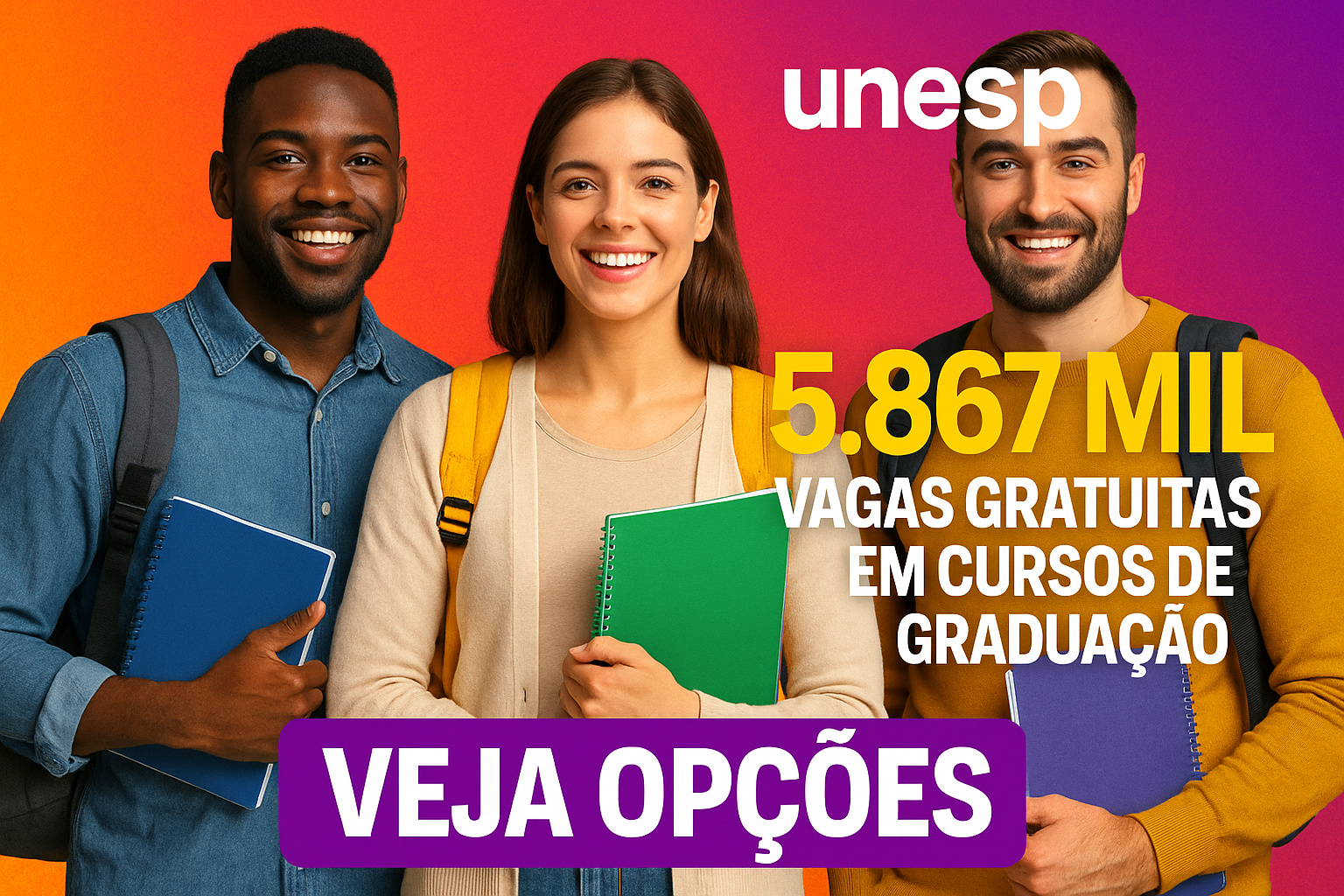


In Addition to Free Spots, the Selection Process Holds Requirements and Opportunities That Few Know
The São Paulo State University (Unesp) has announced the announcement for the Unesp 2026 Entrance Exam, one of the most awaited selection processes in Brazil. There will be 5,867 free spots in undergraduate courses, distributed across campuses throughout the state of São Paulo, reaffirming the institution’s mission to offer quality public education that is accessible.
More Than 5.8 Thousand Opportunities in Different Areas
The announcement details that, out of the total, 3,366 spots will be allocated to the Universal System (open competition). The Reserve System for Public Basic Education (SRVEBP) will hold 2,501 spots, exclusively for students who completed all of their high school education in public schools.
Within this system, there is also a significant social cut: 35% of the spots (869) are reserved for self-declared black, brown, or indigenous candidates (PPI). This mechanism ensures greater inclusion and diversity, reinforcing the university’s role as a promoter of social transformation.
-
Become a professional in logistics, mechanics, computer science, chemistry, or gastronomy at the Federal Institute: Ifes opens more than 1,000 spots in free technical courses with selection without an exam.

-
Take a 100% online and free course at Itaú: Foundation releases 156 options with certificates, registrations open for all of Brazil, unlimited access, areas such as technology, education, and management, and a flexible schedule without tutoring.

-
Senai will pay up to R$ 700 per month for those who take free technical courses: there are 12,000 open positions across Brazil and training with access to the technology market.

-
Take one of the free courses from SENAI! There are over 100 options for training completely online and with a guaranteed certificate in Logistics, Mechanics, Business, Energy, Safety, and much more; see how to enroll and boost your resume with SENAI EAD.

The Unesp 2026 Entrance Exam is not limited to a single field of knowledge. The institution maintains campuses in different cities and offers options in three major areas:
- Biological and Health Sciences: Medicine, Nursing, Pharmacy, Nutrition, Physiotherapy, Dentistry, and Veterinary Medicine.
- Exact Sciences, Engineering, and Technologies: Aeronautical Engineering, Civil Engineering, Chemical Engineering, Computer Science, Statistics, Physics, Mathematics, Chemistry, and Information Systems.
- Human, Social Sciences, and Arts: Law, Journalism, Administration, Architecture and Urbanism, Psychology, Letters, International Relations, Pedagogy, Visual Arts, Music, Theatre, among others.
In other words, the diversity of undergraduate courses increases opportunities for different student profiles.
How the Selection Process Will Work
The Unesp 2026 Entrance Exam will consist of two main stages, in addition to specific tests for some careers:
- First Stage: 90 objective questions on General Knowledge, covering Languages, Human Sciences, Natural Sciences, and Mathematics.
- Second Stage: 36 discursive questions on Specific Knowledge, applied over two consecutive days, in addition to a Dissertative Essay.
For candidates applying to courses such as Visual Arts, Theatre Arts, Performing Arts, Music, Architecture and Urbanism, and Design, there will also be a Specific Skills test.
The final score will be formed by the arithmetic average of the stages, considering all the mandatory tests according to the chosen course. This assessment model seeks to balance content analysis and argumentative ability.
The Weight of a Spot at Unesp
Securing one of the free spots at Unesp can mean not only access to a higher education course but also the opportunity for a life transformation. The selection process is known for its high competition, which requires strategic preparation on the part of candidates.
The institution, in addition to education, also stands out for its research infrastructure, outreach, and student support programs, such as scholarships and assistance, which allow students in situations of socioeconomic vulnerability to stay enrolled.
In a scenario where the cost of a private degree can easily exceed R$ 100 thousand throughout the course, having access to a free and quality education is a chance that can change futures.
And you? Faced with these 5,867 free spots, the reflection remains: how are you preparing to compete for an opportunity in the Unesp 2026 Entrance Exam?
Leave your opinion in the comments.







É um verdadeiro sacrilégio eu não morar em São Paulo para poder tomar posse de uma vaga dessas.