





 Portuguese
  English
  Spanish
  5 min of reading
  0 comments



The Marine Veteran John Eller Lived for Seven and a Half Years in a Storage Unit at the Back of a Property in Newton, with Power On and Informal Authorization from the Owner, Until Neighbor Complaints Led Supervision to Conclude That the Structure Had a License Only for Storage, Not Housing.
Marine veteran John Eller saw the life he had been quietly maintaining for over seven years collide with the rules of the city of Newton after a neighbor’s complaint led inspectors and police to the storage unit where he was living at the back of a property on North Caldwell Avenue.
The case gained traction because it involves more than just an eviction order. On one side is the formal requirement that a property must follow exactly the use for which it was licensed. On the other side is the reality of a man who served in the Navy during the Vietnam War and claims that simple space was, in practice, the only home he had.
How the Situation Came to Light
For a long time, John Eller’s stay in the storage unit went practically unnoticed. According to the city, they did not know that anyone was living in the structure until receiving complaints related to the property. Following those complaints, code inspectors and police went to the site and informed him that he would have to leave.
-
These living root bridges and ladders are over 700 years old and help indigenous people survive in one of the rainiest regions in the world.

-
From sertanejo star to international investor: Ana Castela invests millions in a mansion in the USA, creates a themed accommodation in Orlando, and shows that the “boiadeira” also wants to grow away from the stage.

-
The 10 most stunning motorhomes in the world: a $3 million trailer with a rooftop nightclub and garage for a Ferrari, “palaces on wheels” with Italian marble, private cinema, and five-star hotel luxury for billionaires.

-
Trump wanted to spend $400 million on the White House, but the courts prohibited the million-dollar construction.


The discovery drew attention because the space was located at the back of a house and did not present itself as a conventional residence. The veteran himself stated that he lived discreetly, without bothering anyone, and that his goal had always been just to live in peace. In his view, the complaint changed everything by exposing an arrangement that had been kept away from the city’s eyes.
What Led the City to Require Him to Leave
The central point of the impasse lies in the type of authorization granted to the property. The city of Newton maintains that the original license was intended for a storage unit, that is, a structure for storage, and not for a living space. This technical difference is precisely what supports the eviction order.
In practice, this means that the problem was not only John Eller’s presence at the location but the residential use of a building that, officially, should not serve that function.
When a building is approved to store objects, tools, or serve as support for the property, it does not automatically meet the legal requirements necessary for habitation, even if it has electricity or has been occupied for years.
The Veteran and Owner’s Versions

John Eller claims to have lived there for about seven and a half years. Before that, he faced homelessness, and it was in this context that the property owner, a longtime friend, decided to help him.
The two have known each other since high school, and according to the account provided, she suggested that he stay in the annex when she noticed he had nowhere to live in 2018.
The owner also provided documents received at that time and stated that there was an understanding that after meeting certain requirements, the structure could be inhabited. This point, however, does not appear to be a consensus with the municipal administration.
This is where the case shifts from being merely a story of accommodation to a confrontation between informal interpretation and official authorization.
Between Urban Rules and Human Reality
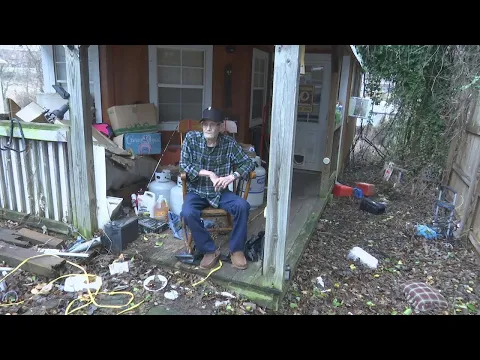

John Eller’s statement helps explain why the case resonates so much. He says he did not live in a mansion or a valuable property, but in the place he considered home.
The strength of the story lies precisely in this contradiction: the space was modest, improvised, and out of residential standards, yet still represented stability for someone who had already faced homelessness.
This contrast exposes a larger problem. When supervision finds an irregular occupation, it sees an infraction; those living there see survival.
In such situations, the cold application of urban regulations comes into direct contact with social fragility, friendship, improvisation, and lack of concrete alternatives. That is why cases like this often provoke public debate far beyond the bureaucratic issue.
The Complaints from Neighbors and the Weight of the Complaint
According to the city, there were multiple complaints about people living in improvised structures on the property. This indicates that the eviction order did not arise from a random inspection but from external pressure and an annoyance that reached the formal channels of local administration. In other words, the case only gained urgency after the surroundings reacted.
John Eller, for his part, interpreted the situation differently. He stated that the neighbors did not like his lifestyle and emphasized that he did not cause problems.
This divergence helps explain why the story is so sensitive: on one side, there is the perception of irregularity and discomfort; on the other, there is the feeling of persecution and sudden loss of a shelter that had been part of his routine for years.
What Could Happen from Now On
As of the reported moment, the city had not set a specific deadline for John Eller to leave the storage unit. Nonetheless, the pressure already existed: the owner reported being notified that the electricity to the building could be cut off if he did not leave the location. Without a clear deadline but with a concrete threat, the permanence became an immediate impasse.
At the same time, the municipal administration stated it had reached out to the Western Piedmont Homeless Response team to verify what kind of assistance could be offered.
This is an important point because it shows that the city is trying to combine supervision with social forwarding, although this still does not eliminate the most difficult question of all: where does someone go when they lose the only place they recognize as home.
When an Eviction Reveals a Bigger Problem
The episode in Newton is not just about a storage unit being used irregularly. It reveals how precarious housing situations can remain invisible for years until interrupted by a complaint, an inspection, or a stricter reading of urban rules.
The case of the Marine Veteran stands out precisely because it brings together legality, vulnerability, and personal ties in a single conflict.
In the end, a difficult tension remains unresolved with simple answers. The city insists that the structure was not approved for habitation.
The veteran insists that it was his home. Between these two points lies an uncomfortable but necessary debate about to what extent the duty to supervise goes and where the responsibility to offer a minimally dignified exit begins.
In your opinion, did the city act correctly in demanding the eviction, or should it have built an alternative before pressuring the Marine Veteran to leave?








-

3 pessoas reagiram a isso.